












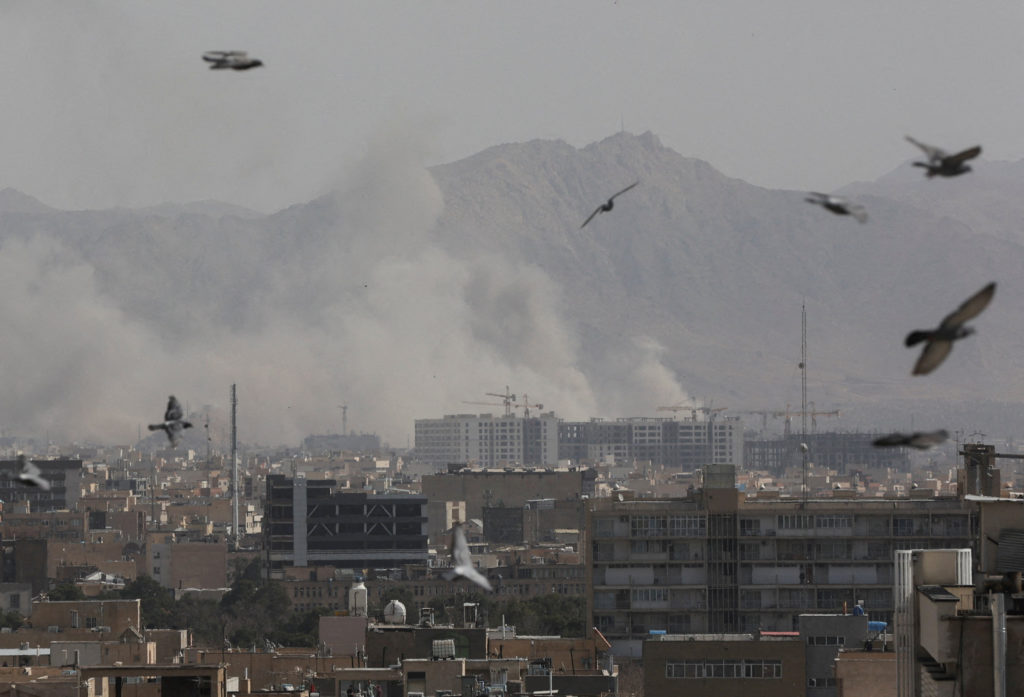











Operation Mahadev: How India Hunted Down 3 Pahalgam Terrorists in 93 Days Before They Could Flee
On the first anniversary of the Pahalgam terror attack, India reveals the full story of Operation Mahadev — a 93-day, 250 km pursuit that ended with PARA Special Forces eliminating all three Lashkar-e-Taiba terrorists in Dachhigam forests.

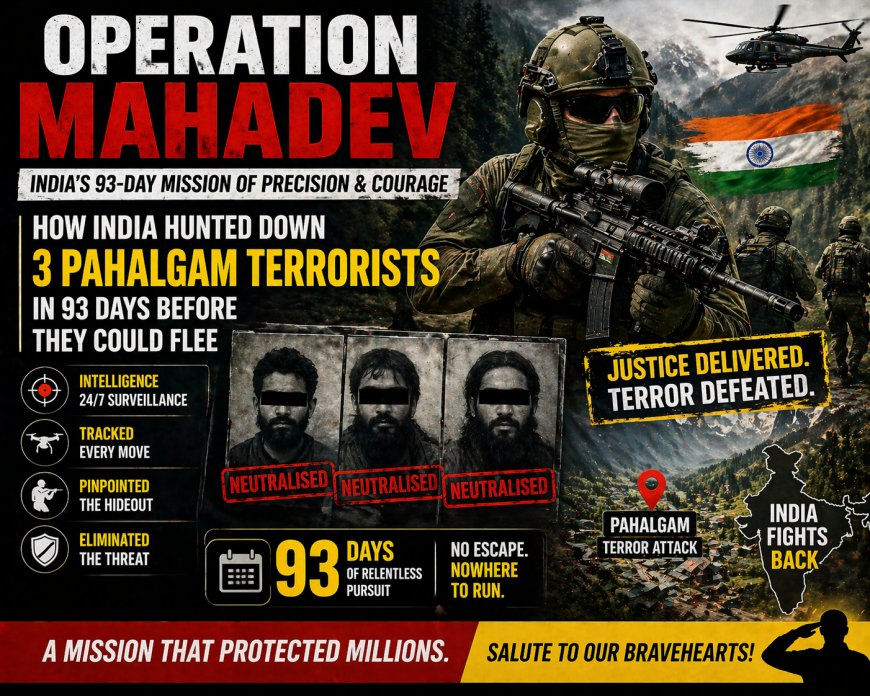
Operation Mahadev: The 93-Day Hunt That Brought the Pahalgam Terrorists to Justice
Today marks exactly one year since one of the most horrifying terror attacks on Indian soil in recent memory. On April 22, 2025, Pakistan-backed terrorists walked into the scenic meadow of Baisaran in Pahalgam, Jammu and Kashmir — a place beloved by tourists for its breathtaking natural beauty — and carried out cold-blooded, execution-style killings of 26 innocent civilians, most of them tourists, targeting victims on the basis of their religion.
As the nation pauses today to remember and mourn, Prime Minister Narendra Modi paid solemn tribute to the victims. In a post on X, Modi wrote: "Remembering the innocent lives lost in the gruesome Pahalgam terror attack on this day last year. They will never be forgotten. My thoughts are also with the bereaved families as they cope with this loss. As a nation, we stand united in grief and resolve. India will never bow to any form of terror. The heinous designs of terrorists will never succeed."
But today is not only a day of grief. It is also a day of reckoning — because India delivered on its promise. The three Pakistani terrorists responsible for the Baisaran massacre did not escape. They did not slip across the border to safety. They were hunted down, cornered, and eliminated — every single one of them — in one of the most meticulously executed counter-terror operations in recent Indian history.
This is the inside story of Operation Mahadev.
🩸 The Attack That Shook India: Baisaran, April 22, 2025
On April 22, 2025, the nation was left shocked after terrorists carried out an attack in Pahalgam, a region known for its scenic landscape and tourism. In the attack, Pakistan-backed terrorists entered a village and killed 26 people.
The attack was carried out by The Resistance Front, an offshoot of the Pakistan-based Lashkar-e-Taiba. The attackers identified victims based on their religion, forcing them to recite Islamic verses before opening fire. Among those killed were 25 tourists and a local pony operator who reportedly tried to protect them. Several victims were newly married, and many were shot at close range in front of their families.
The brutality was calculated. The targeting was deliberate. It wasn't simply an act of violence — it was designed to wound India's soul, create communal divisions, and strike fear into the hearts of anyone who dared visit the Valley. The cold-blooded, execution-style nature of the killings placed it among the most heinous terror acts India had witnessed in years.
For the Indian Army and security forces, the message was unmistakable. This was not just a crime. It was a declaration. And it demanded a response.
🎯 The Immediate Response: Identifying the Killers
Within hours of the massacre, Indian Army troops were on the ground in Baisaran, piecing together exactly what had happened. Eyewitness accounts, including testimony from an Army officer who was present at the location, confirmed the presence of three Pakistani terrorists.
Swift intelligence fusion through human intelligence, technical inputs, and survivor-based identification led to the confirmation of the perpetrators as Sulaiman Shah, Hamza Afgani, and Jibran Bhai — all members of the banned Lashkar-e-Taiba, headquartered in Pakistan.
The initial priority was clear: seal every possible escape route and prevent the three from slipping back across the Line of Control into Pakistan-occupied Kashmir. If they made it there, justice might never come. Every hour mattered.
🗺️ The Pursuit Begins: Into the Mountains of South Kashmir
What followed was one of the most sustained and complex counter-terror manhunts in recent Indian military history.
As intelligence inputs evolved, it became evident that the terrorists were moving through the upper reaches of South Kashmir — through Hapatnar, Bugmar, and Tral — gradually gravitating towards the dense and rugged forests of Dachhigam along the Mahadeo Ridge. New Kerala The terrain offered them cover but also trapped them — the same thick foliage and high altitude that shielded them also slowed their movement and narrowed their options.
Security forces gradually tightened the operational grid over a large forested area exceeding 300 square kilometres. Daily Gadyal This was not a conventional pursuit. The forests were vast, the terrain treacherous, and the terrorists knew how to move in it. This required patience, technology, and relentless pressure.
By the end of May 2025, a new concern emerged. The Amarnath Yatra — the annual pilgrimage that draws hundreds of thousands of devotees — was approaching. The possibility that the three killers might target the Yatra or use the pilgrim movement as cover to escape added enormous urgency to the operation.
Recognising the gravity of the threat, the scope of the operation was expanded. Additional forces, including elite PARA (Special Forces) units, were inducted to intensify the hunt.
🛸 The Technology That Made It Possible
Technology played a decisive role. Drones, remotely piloted aircraft, electro-optical sensors and other advanced surveillance tools were extensively employed to track movement in the dense forested zones. Even when the forests were too thick for human eyes to penetrate, sensors could detect thermal signatures and movement patterns.
Continuous intelligence validation kept pressure on the terrorists around the clock. Every time they moved, the grid tightened. Every time they rested, surveillance closed in. Their options — already limited by the terrain — were shrinking steadily.
The operation was not just about finding them. It was about ensuring they had nowhere left to run.
⚡ The Decisive Phase: July 10, 2025
After weeks of sustained pressure, the operation reached a turning point.
On July 10, 2025, based on fresh intelligence inputs, Operation Mahadev entered its decisive phase. Large-scale, coordinated operations were launched across Lidwas, Harwan, and Dachhigam. Troops were redeployed dynamically, and escape routes were systematically blocked, effectively isolating the terrorists within a confined zone.
After a relentless pursuit spanning over 250 kilometres and 93 days, the operational grid was finally compressed to a 25 square kilometre area.
Three months of forest pursuit, drone surveillance, intelligence fusion, ground patrols, and tactical patience had reduced the entire canvas of their potential escape to an area that PARA Special Forces could now dominate completely.
The end was near.
🪖 July 28, 2025: The Final Strike
On July 28, 2025, in a meticulously planned and executed operation, a PARA (Special Forces) team undertook a stealthy approach through treacherous terrain, covering 3 kilometres on foot over 10 hours.
Ten hours. On foot. Through some of the most difficult forested mountain terrain in Jammu and Kashmir. In the dark, in silence, with absolute tactical discipline — because a single noise, a single misstep, could have given the terrorists the warning they needed to scatter or fight back on their own terms.
In a swift and precise engagement, all three terrorists were neutralised, bringing the perpetrators of the Baisaran carnage to justice.
Sulaiman Shah. Hamza Afgani. Jibran Bhai. All three eliminated. None escaped.
Operation Mahadev was complete.
🇮🇳 India's Wider Response: Operation Sindoor
The elimination of the three direct perpetrators through Operation Mahadev was only part of India's response to the Pahalgam massacre.
India launched Operation Sindoor on May 7, 2025, targeting terror infrastructure in Pakistan and Pakistan-occupied Jammu and Kashmir. The Indian armed forces destroyed nine major terror launchpads linked to groups such as Lashkar-e-Taiba, Jaish-e-Mohammed, and Hizbul Mujahideen.
The strikes led to a four-day military confrontation, including drone activity and cross-border shelling. Indian forces carried out retaliatory strikes on key installations, including radar sites in Lahore and areas near Gujranwala. The escalation ended on May 10 after Pakistan's Director General of Military Operations reached out to his Indian counterpart, leading to a ceasefire.
The message was delivered on multiple fronts — through the courts of Dachhigam forest and through precision strikes deep inside Pakistan's terror infrastructure.
🏛️ Modi on the First Anniversary: India Will Never Forget
Today, as India marks one full year since the Baisaran massacre, the tribute is both solemn and resolute. PM Modi's words this morning captured that duality perfectly — grief for those lost, and iron determination that such attacks will never go unanswered.
The Indian Army also recalled Operation Sindoor and issued a strong message against terrorism, saying: "When boundaries of humanity are crossed, the response is decisive. Justice is served. India stands united." Deccan Chronicle
A black marble memorial has since been erected along the Lidder River in Pahalgam, bearing the names of all 26 victims, including local resident Adil Shah — the pony operator who tried to save the tourists and paid for his courage with his life.
📌 Operation Mahadev — Key Facts at a Glance
| Detail | Info |
|---|---|
| Attack Date | April 22, 2025 |
| Location | Baisaran, Pahalgam, J&K |
| Lives Lost | 26 civilians (25 tourists + 1 local) |
| Terror Group | The Resistance Front / Lashkar-e-Taiba |
| Terrorists Identified | Sulaiman Shah, Hamza Afgani, Jibran Bhai |
| Operation Launch | April 22, 2025 (immediate) |
| Operation Duration | 93 days |
| Distance Pursued | Over 250 kilometres |
| Final Zone Compressed To | 25 square kilometres |
| Final Assault Date | July 28, 2025 |
| Final Strike Force | PARA (Special Forces) |
| Final Approach | 3 km on foot over 10 hours |
| Outcome | All 3 terrorists neutralised |
💬 What Operation Mahadev Means for India
Operation Mahadev stands as a testament to the Indian Army's resolve, professionalism and unwavering commitment to safeguarding the nation. It exemplifies how seamless synergy between intelligence agencies and security forces, combined with advanced technology and tactical patience, can deliver decisive outcomes even in the most challenging conditions. Above all, the operation restored the faith of the people, demonstrating that those who perpetrate acts of terror will be relentlessly pursued and held accountable.
For the families of the 26 victims — the husbands, wives, parents, and children who lost someone they loved in those meadows one year ago — Operation Mahadev cannot undo the pain. Nothing can. But it delivers something that matters deeply: the certainty that India did not look away, did not forget, and did not stop until justice was served.
The Baisaran meadow is beautiful again in spring. The tourists are returning. And the three men who tried to extinguish that beauty, who tried to sow terror in India's most cherished valley — they were found, they were cornered, and they were eliminated.
India never forgot. India never will.
On this first anniversary of the Pahalgam terror attack, ViralDose joins the nation in remembering the 26 innocent lives lost at Baisaran. May they rest in peace.
What's Your Reaction?
 Like
0
Like
0
 Dislike
0
Dislike
0
 Love
0
Love
0
 Funny
0
Funny
0
 Angry
0
Angry
0
 Sad
0
Sad
0
 Wow
0
Wow
0