













Modi's Mann Ki Baat Ep 133: Buddha Purnima & Nuclear
PM Modi extended Buddha Purnima wishes, hailed the Kalpakkam reactor milestone & urged Census 2027 participation in the 133rd Mann Ki Baat on April 26, 2026.

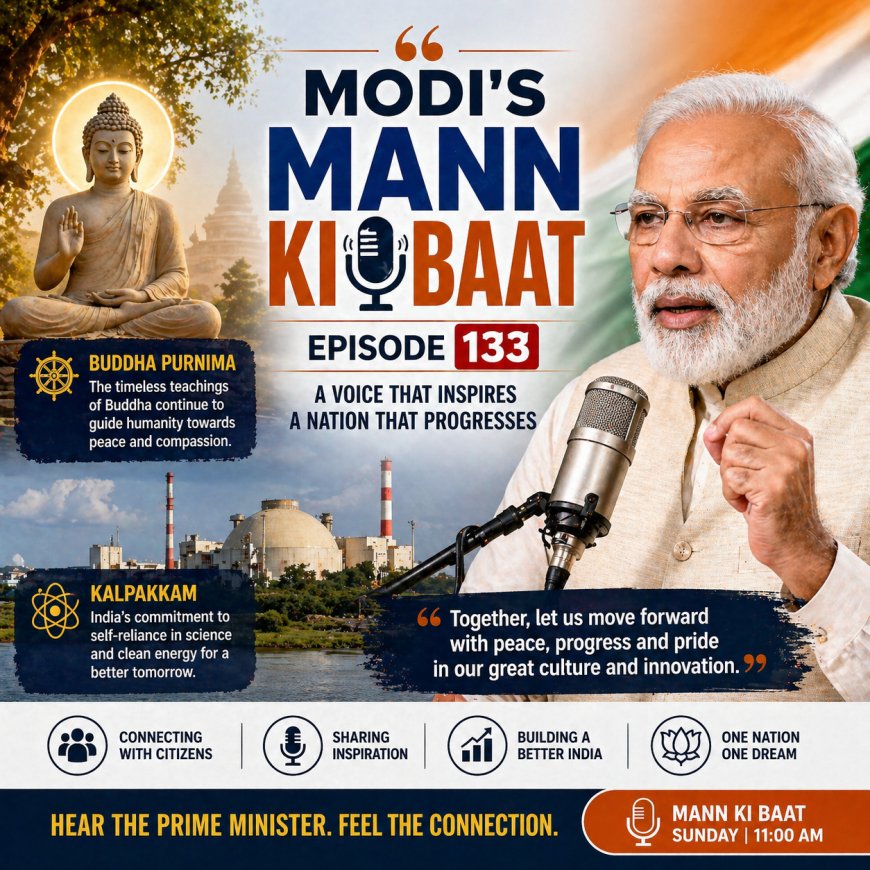
Modi's Mann Ki Baat Episode 133: Buddha Purnima Wishes, Nuclear Milestone & Census 2027
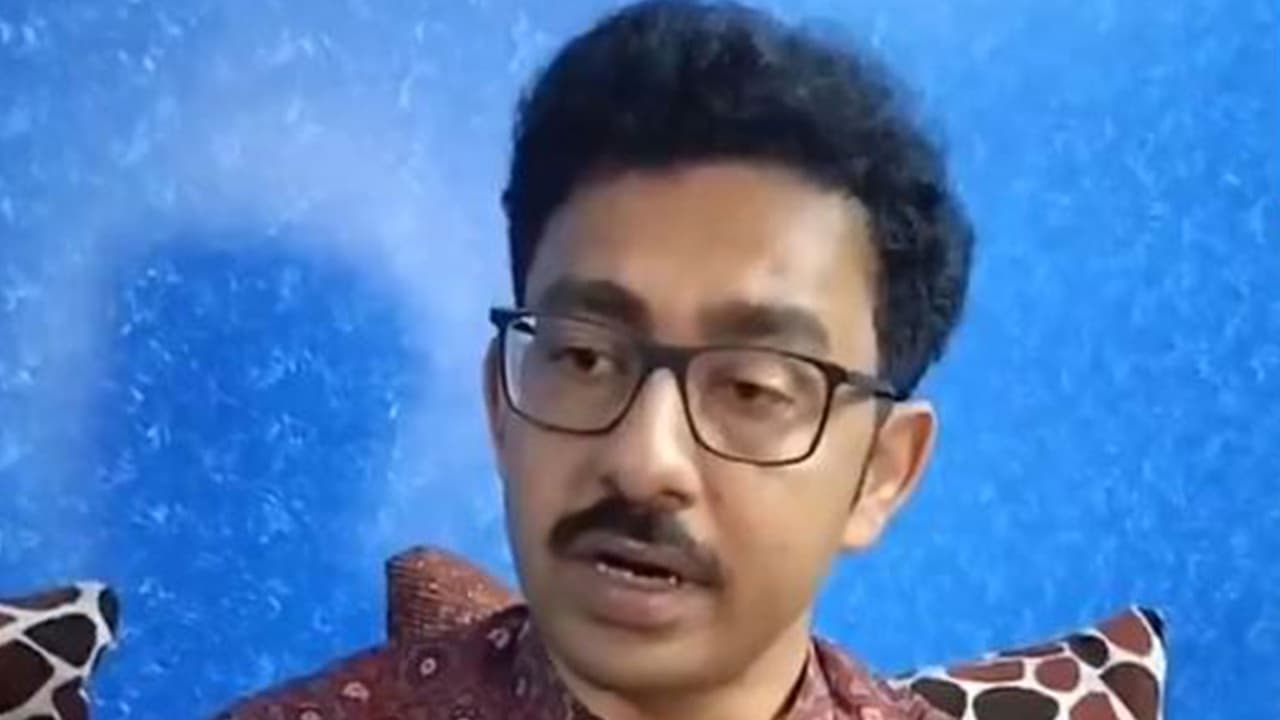
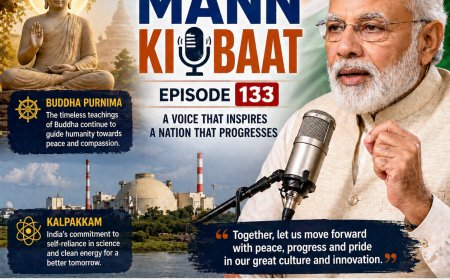
Every last Sunday of the month, Prime Minister Narendra Modi sits down with the people of India for his monthly radio address — Mann Ki Baat. The 133rd episode, broadcast today on April 26, 2026, was one of the more wide-ranging and thoughtful editions of the programme in recent memory. From Buddha's timeless wisdom to a historic nuclear energy milestone, from a Buddhist institution in the mountains of Chile to India's upcoming national census — PM Modi covered it all in his characteristic conversational style that has made Mann Ki Baat one of the most-listened-to radio programmes in the country.
Here is the full breakdown of everything he said today.
🌸 Buddha Purnima Wishes: "Peace Begins Within Us"
PM Modi extended greetings to citizens in advance for the upcoming celebration of Buddha Purnima and stated that the month of May is set to begin on an auspicious note with the festival. "The month of May is starting with an auspicious occasion. In a few days, we will celebrate Buddha Purnima. I extend my greetings to all countrymen in advance," the Prime Minister said.
Buddha Purnima falls on May 1, 2026 this year — making it a particularly significant opening to the new month.
But Modi's message wasn't simply a calendar greeting. He went deeper, drawing a direct line between the ancient wisdom of Lord Gautam Buddha and the anxiety-ridden world of 2026.
Highlighting the enduring relevance of Lord Gautam Buddha's teachings, PM Modi noted that his message continues to guide humanity, especially in challenging times. "The life message of Lord Gautam Buddha remains just as relevant today. He taught us that peace begins within us, and that victory over oneself is the greatest victory," he said.
Referring to the current global situation, he added that amid the tensions and conflicts the world is going through today, Buddha's teachings have become even more important.
In a world currently grappling with the US-Iran standoff, ongoing conflicts, and rising geopolitical stress, Modi's invocation of Buddha's philosophy of inner peace felt less like a formality and more like a deeply considered message. For more on the global tensions India is navigating right now, read our full coverage on
🌎 Buddha Beyond Borders: From Chile to Karnataka
What made today's Buddha Purnima segment particularly interesting was Modi's emphasis on the global reach of Buddhist teachings — showing that India's spiritual heritage is touching lives far beyond its borders.
PM Modi highlighted an institution in Chile that is promoting the ideas of Lord Buddha under the guidance of Drubpon Otzer Rinpoche, who was born in Ladakh. "This institution is connecting meditation and compassion to people's lives. The stupa built in the Cochiguaz Valley provides people with an experience of peace," he said.
The image of a Ladakh-born Buddhist monk building a stupa in the mountains of Chile — and thousands of South Americans finding peace through Buddhist meditation — is a powerful reminder of how universal these teachings truly are.
Closer to home, the Prime Minister gave the example of Karma Monastery in Karnataka, which is a vibrant forest area spread over 100 acres. He highlighted it as a living example of how the Buddhist tradition teaches people to connect with nature — combining spiritual practice with environmental consciousness.
⚛️ Historic Milestone: Kalpakkam Fast Breeder Reactor Achieves First Criticality
The biggest science and technology announcement of today's Mann Ki Baat came from Tamil Nadu — and it is genuinely historic.
PM Modi congratulated scientists for achieving first criticality at the Prototype Fast Breeder Reactor at Kalpakkam in Tamil Nadu, terming the accomplishment as a "historic milestone." In his radio show Mann Ki Baat, PM Modi, celebrating this feat, noted that the nuclear reactor is built with entirely indigenous technology, stating that this will give new energy to India's resolve of Viksit Bharat.
What does "first criticality" mean? It is the moment when a nuclear reactor successfully sustains a controlled chain reaction for the first time — the most critical step in bringing a new reactor to life. Achieving first criticality at Kalpakkam means the Prototype Fast Breeder Reactor is now operational in its core function, paving the way for full power generation.
The Kalpakkam PFBR is India's first indigenously designed and built fast breeder reactor — a next-generation nuclear technology that can use spent fuel from conventional reactors and significantly extend India's nuclear fuel reserves. India has one of the world's largest reserves of thorium, and fast breeder reactors are a key part of India's three-stage nuclear energy programme designed to eventually tap that thorium wealth.
For a country working toward energy independence and clean energy targets, this is a landmark moment. PM Modi's pride in the entirely indigenous nature of the technology was unmistakable — this is India's own achievement, built by Indian scientists at India's own institutions.
📊 Census 2027: Modi Calls It "Everyone's Responsibility"
The 133rd Mann Ki Baat also saw PM Modi speak extensively about the upcoming Census 2027 — urging every Indian to participate actively and addressing concerns about data privacy head-on.
In the 133rd episode of his monthly radio programme Mann Ki Baat, the Prime Minister said people can also enter their information themselves. This facility, he said, will be available 15 days before the enumerators visit their residences. Once they complete the process, they will be receiving a special ID on email or mobile, which people can show to the staff to verify their details.
This self-entry facility is a significant innovation — it reduces the burden on enumerators, improves accuracy, and gives citizens more ownership over their own data. The digital-first approach also aligns with India's push toward paperless governance.
"National census isn't just a government task. It's the responsibility of all of us. Your participation is crucial. The information you provide is completely secure, kept confidential. Let's make Census 2027 a success," PM Modi said, directly addressing fears over data security for the drive.
India's last census was in 2011 — the 2021 edition was postponed due to the COVID-19 pandemic. Census 2027 will be the first comprehensive national count of India's population in over 15 years, making it one of the most important administrative exercises the country will undertake this decade. The data collected will shape government policy, resource allocation, and welfare scheme planning for the next decade and beyond.
🎺 Beating the Retreat: Indian Music Takes Centre Stage
In a lighter but culturally significant moment, the Prime Minister also spoke about Beating the Retreat — an important part of the Republic Day festivities. The ceremony showcases the diverse musical traditions of different bands, and the inclusion of Indian music has increased in the event, which is being liked by the people.
The Beating the Retreat ceremony at Vijay Chowk, held each year on January 29 to mark the formal conclusion of Republic Day festivities, has in recent years seen a growing inclusion of classical Indian compositions and folk melodies alongside the traditional martial band music. Modi's acknowledgment of this cultural shift reflected his consistent push to celebrate and elevate India's homegrown artistic traditions on national platforms.
📻 About Mann Ki Baat — For Those New to the Programme
For readers who may be encountering Mann Ki Baat for the first time — this is PM Modi's monthly radio address, broadcast on the last Sunday of every month at 11 AM on All India Radio and Doordarshan.
The programme is broadcast across the entire Akashvani and Doordarshan network, the AIR News website, and the Newsonair mobile app. It is also live-streamed on the YouTube channels of AIR News, DD News, the PMO, and the Ministry of Information and Broadcasting. Akashvani broadcasts the programme in regional languages immediately after the Hindi broadcast.
Mann Ki Baat began in October 2014 and has now run for 133 episodes — making it one of the longest-running regular direct communication exercises between an Indian Prime Minister and the public. The format is deliberately conversational — Modi reads letters from citizens, highlights inspiring stories from across India, and addresses issues that may not make front-page headlines but matter deeply to ordinary people.
Today's 133rd episode covered topics that ranged from nuclear physics to Buddhist philosophy to national data collection — a reflection of the breadth of issues Modi believes deserve the attention of every Indian citizen.
📋 Episode 133 — Full Highlights at a Glance
| Topic | What Modi Said |
|---|---|
| Buddha Purnima | Extended advance wishes; Buddha Purnima on May 1, 2026 |
| Buddha's Teachings | "Peace begins within us; victory over oneself is the greatest victory" |
| Chile Buddhist Institution | Ladakh-born Drubpon Otzer Rinpoche building peace through meditation and the Cochiguaz Valley stupa |
| Karma Monastery, Karnataka | 100-acre forest monastery connecting Buddhism with nature |
| Kalpakkam PFBR | First criticality achieved — historic milestone for indigenous nuclear technology |
| Census 2027 | Self-entry facility 15 days before enumerators visit; data fully secure and confidential |
| Beating the Retreat | Growing inclusion of Indian music in the Republic Day ceremony is being appreciated |
💬 The Bigger Picture
Today's Mann Ki Baat was, at its core, about two things: looking inward and looking forward. Modi's Buddha Purnima message asked Indians — and indeed the world — to look inward, to find peace within themselves before trying to change the world around them. And his focus on Kalpakkam, Census 2027, and India's cultural evolution asked the country to look forward — toward energy independence, accurate national data, and a stronger celebration of Indian heritage.
In the 133rd episode of a programme that has become one of the most consistent threads in India's national conversation over the past decade, those two directions — inward and forward — felt exactly right for the moment India finds itself in today.
What's Your Reaction?
 Like
0
Like
0
 Dislike
0
Dislike
0
 Love
0
Love
0
 Funny
0
Funny
0
 Angry
0
Angry
0
 Sad
0
Sad
0
 Wow
0
Wow
0