























Centre Approves Green Energy Corridor Worth Rs 21,000 Cr in AP
The Centre has approved a massive Green Energy Corridor project for Andhra Pradesh worth Rs 21,000 crore, boosting the state's clean energy and transmission goals.

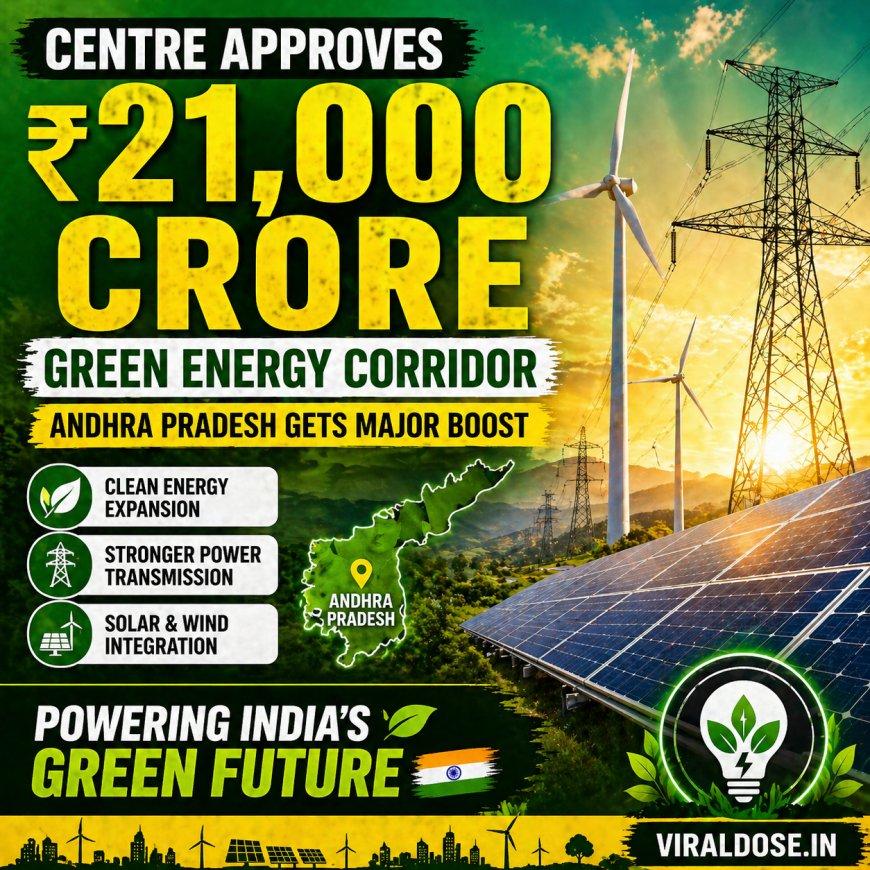
Centre Approves Another Huge Project in AP — Green Energy Corridor Worth Rs 21,000 Crore
Andhra Pradesh is on a roll. In yet another major boost for the state, the Central Government has approved a landmark Green Energy Corridor (GEC) project for Andhra Pradesh worth approximately Rs 21,000 crore — a giant leap in the state's ambition to become India's number one green energy powerhouse.
This approval comes as part of the Union Government's broader Green Energy Corridor Phase-III programme, which is designed to build a robust transmission backbone across India's most renewable-energy-rich states. For Andhra Pradesh — a state blessed with some of the country's finest solar and wind resources — this is a game-changing investment that will unlock the potential to deliver clean electricity to millions of homes and industries, and turbocharge the state's economy for decades to come.
Here's the full story.
What Is the Green Energy Corridor?
Before diving into what this means for AP, it helps to understand the big picture.
The Green Energy Corridor Project aims at synchronizing electricity produced from renewable sources, such as solar and wind, with conventional power stations in the grid. For evacuation of large-scale renewable energy, the Intra-State Transmission System (InSTS) project was sanctioned by the Ministry in 2015-16. It is being implemented by eight renewable-rich states — Tamil Nadu, Rajasthan, Karnataka, Andhra Pradesh, Maharashtra, Gujarat, Himachal Pradesh and Madhya Pradesh.
In simple terms: India has a massive and growing supply of solar and wind power — but without the right transmission infrastructure, that power can't reach the people who need it. The Green Energy Corridor is India's answer to that problem. It's a dedicated superhighway for clean electricity, connecting generation sites deep in sunny and windy regions to load centres in cities and industrial zones.
India is advancing its Green Energy Corridor with Phases 3 and 4 to evacuate 150 GW of renewable energy, addressing transmission bottlenecks. This expansion is crucial for achieving 500 GW of non-fossil power by 2030, requiring significant investment to enhance grid stability and capacity.
The Three Phases: AP's Journey So Far
Phase 1 — The Foundation
Phase 1, known as Intra-State Green Energy Corridor Phase 1, was first launched in 2015-16, with a total target of 9,700 circuit kilometres of intra-state transmission lines for power evacuation of approximately 24 GW of renewable energy across eight states including Andhra Pradesh. The project has an estimated budget of Rs 10,141.68 crore, funded through a 40% Central Grant by MNRE, a 40% loan from KfW Germany, and 20% equity by the State Transmission Utilities.
Andhra Pradesh was one of the original eight participating states, laying the early foundations of a clean energy grid.
Phase 2 — Scaling Up
Phase 2 was approved by the Cabinet Committee on Economic Affairs (CCEA) in January 2022, with a total target of 10,750 circuit kilometres of intra-state transmission lines and 27,500 MVA substations. The project cost is Rs 12,031.33 crore. It is expected to be complete by 2026-27.
Phase 3 — AP's Biggest Bet Yet
Now comes the big one. GEC Phase-III, proposed in the Union Budget for FY26, is estimated to cost around Rs 56,000 crore nationally, with the central government covering 40% of the expenses. Key beneficiary states include Gujarat, Rajasthan, Karnataka, Maharashtra, and Andhra Pradesh.
For Andhra Pradesh specifically, APTRANSCO Joint Managing Director Kirthi Chekuri announced that the corporation has submitted final proposals for the Green Energy Corridor Phase-3 to the Central Electricity Authority. The Rs 28,033 crore project aims to integrate 11 GW of solar power and 7,373 MW of pumped storage into the grid, adding 8,862 circuit kilometres of transmission lines and 9,500 MVA of capacity to support India's 2030 clean energy targets.
The Centre's approval for AP's share of this project — estimated at approximately Rs 21,000 crore — marks a historic milestone for the state's energy future.
Why Andhra Pradesh? Why Now?
The timing of this approval is no accident. Under Chief Minister N. Chandrababu Naidu, Andhra Pradesh has transformed itself into one of India's most aggressive pursuers of renewable energy investment.
Andhra Pradesh has set a target to generate 160 GW of green energy and attract Rs 10 lakh crore investments by 2029. CM Naidu revealed that investments of Rs 5.95 lakh crore have already flowed into the sector. Proposals and MoUs covering 90 GW of capacity have already been finalised.
At a power sector review meeting, CM Naidu emphasized the necessity for short, medium and long-term strategies to adapt to the ever-evolving global energy landscape. He cited the rapid expansion of renewable energy into everyday life, asserting that the future belongs to green energy.
Officials noted that projects worth Rs 3.19 lakh crore in the renewable energy sector have been initiated since June 2024.
But here's the challenge that makes the Green Energy Corridor so critical: while most of the state's renewable and pumped storage capacity is concentrated in Rayalaseema, demand is rapidly growing in coastal areas, which is home to green hydrogen hubs, data centres, and energy-intensive industries. Without a powerful transmission grid to bridge this gap, Andhra Pradesh's renewable energy boom risks being bottlenecked right at the point of greatest potential.
The Green Energy Corridor solves exactly that problem.
What the Rs 21,000 Crore Will Build
The approved project will fund a massive expansion of Andhra Pradesh's power evacuation and transmission infrastructure. Based on the state's proposals submitted to the Central Electricity Authority, the project includes:
Transmission Lines: Adding 8,862 circuit kilometres of new transmission lines — enough to stretch from Kanyakumari to Kashmir and back, nearly twice over.
Substation Capacity: Adding 9,500 MVA of substation capacity to handle the enormous volumes of green power that will flow through the new network.
Solar Power Integration: Connecting 11,000 MW of new solar capacity from the sun-drenched plains of Rayalaseema and Kurnool to the national grid and coastal demand centres.
Pumped Storage Integration: Linking 7,373 MW of pumped hydro storage projects — a critical technology that stores excess renewable power for use during peak demand hours, solving the intermittency problem that has historically limited solar and wind adoption.
The proposed corridor includes transmission lines and central substations to evacuate 11,000 MW from renewable sources and another 7,000 MW from pumped storage projects.
This isn't just infrastructure. It's the nervous system of a new green economy.
AP's On-the-Ground Execution: Already Moving
What makes this approval particularly exciting is that APTRANSCO isn't starting from scratch — work is already underway across the state.
APTRANSCO is currently executing 69 projects worth Rs 8,638 crore, which will add 14,046 MVA and 2,041 circuit kilometres to the existing network. Transmission losses dropped from 2.69% to 2.60% in 2024-25. Non-tariff revenue rose sharply to Rs 174.47 crore through Optical Ground Wire leasing. APTRANSCO also earned ISO 27001:2022 certification, while its Joint Meter Reading app, expected to save Rs 750 crore, won two national awards. This track record of execution is precisely what gives confidence that the Rs 21,000 crore approval will translate into real, on-the-ground results.
The Bigger Picture: AP's Clean Energy Investment Boom
The Green Energy Corridor approval doesn't exist in isolation. It's part of a much larger wave of clean energy investment crashing into Andhra Pradesh right now.
Just days ago, Andhra Pradesh Minister for IT and Electronics, Nara Lokesh, officially laid the foundation for private renewable energy firm ReNew Power's Rs 22,000 crore integrated energy project at Bethapalli village in Ananthapuram district. Once completed, with a generation capacity of around 2.8 GW — including 1.8 GWp solar and 1 GW wind — and a battery energy storage system of 2 GWh, this project will be one of the largest renewable energy complexes at a single location in India.
The minister stated that this project is directly aligned with Andhra Pradesh's Integrated Clean Energy Policy and contributes to India's 500 GW non-fossil fuel goal by 2030.
Meanwhile, NTPC Green Energy is stepping forward with investments amounting to Rs 1.85 lakh crore in Andhra Pradesh.
And at a foundation-laying for the ReNew Solar Ingot-Wafer Plant in Rambilli, Anakapalli district, IT Minister Nara Lokesh stated that the solar wafer and ingot manufacturing facility by ReNew Energy Global is a key step in positioning the state as the "Silicon Coast of India."
The state also aims to reduce the production cost of green hydrogen from Rs 460 per kilogram to Rs 160-170 per kilogram, facilitated by the development of a 25 GW Green Energy Corridor to ensure efficient energy transmission.
What This Means for AP's Economy
The economic ripple effects of the Green Energy Corridor go far beyond electricity bills.
Jobs: Building thousands of kilometres of transmission lines, hundreds of substations, and associated infrastructure will create tens of thousands of direct and indirect jobs across Andhra Pradesh — from civil engineers and electricians to truck drivers and local contractors.
Industrial Growth: Reliable, affordable, and clean electricity is one of the top factors companies consider when choosing where to invest. With this corridor in place, energy-intensive industries — including green hydrogen plants, data centres, semiconductor fabs, and EV battery manufacturing — will find AP far more attractive.
Reduced Electricity Costs: CM Naidu noted that while thermal electricity production costs around Rs 5-6 per unit, wind energy is generated at just Rs 4.6 per unit. A stronger transmission grid means more renewable power flowing into the grid at lower cost — which eventually translates to cheaper electricity for consumers and industries.
India's Climate Goals: The expansion of the Green Energy Corridor is crucial for achieving India's target of 500 GW of non-fossil fuel capacity by 2030, which requires a robust and stable grid to accommodate the intermittent nature of solar and wind energy.AP's contribution to this target is set to be enormous.
Project Snapshot: AP Green Energy Corridor
| Detail | Info |
|---|---|
| Project | Green Energy Corridor Phase-III — Andhra Pradesh |
| Total Investment | ~Rs 21,000 crore (AP share) |
| National GEC-III Budget | Rs 56,000 crore |
| Central Government Share | 40% of project cost |
| Implementing Agency | APTRANSCO |
| New Transmission Lines | 8,862 circuit kilometres |
| New Substation Capacity | 9,500 MVA |
| Solar Power to be Integrated | 11,000 MW |
| Pumped Storage to be Integrated | 7,373 MW |
| AP's 2029 Green Energy Target | 160 GW |
| Investments Secured So Far | Rs 5.95 lakh crore |
| Key Renewable Zones | Rayalaseema, Kurnool, Anantapur |
A State on the Cusp of History
Andhra Pradesh has been through a turbulent decade — bifurcation, political instability, financial pressures. But under Chandrababu Naidu's current tenure, the state is writing a new chapter, and clean energy is at the heart of it.
From the Kurnool Ultra Mega Solar Park — once the world's largest solar plant — to the newly approved Green Energy Corridor, to massive private investments from ReNew, NTPC, and dozens of other players, AP is quietly becoming what its CM has long envisioned: India's clean energy capital.
The Rs 21,000 crore Green Energy Corridor is not just a project. It's a statement of intent. And if execution matches ambition, Andhra Pradesh may well be the state that powers India's green future.
Stay tuned to ViralDose for the latest updates from Andhra Pradesh, Telangana, and across India. Follow our India News section and Viral Trending for breaking stories every day.
Also Read:
What's Your Reaction?
 Like
0
Like
0
 Dislike
0
Dislike
0
 Love
0
Love
0
 Funny
0
Funny
0
 Angry
0
Angry
0
 Sad
0
Sad
0
 Wow
0
Wow
0