
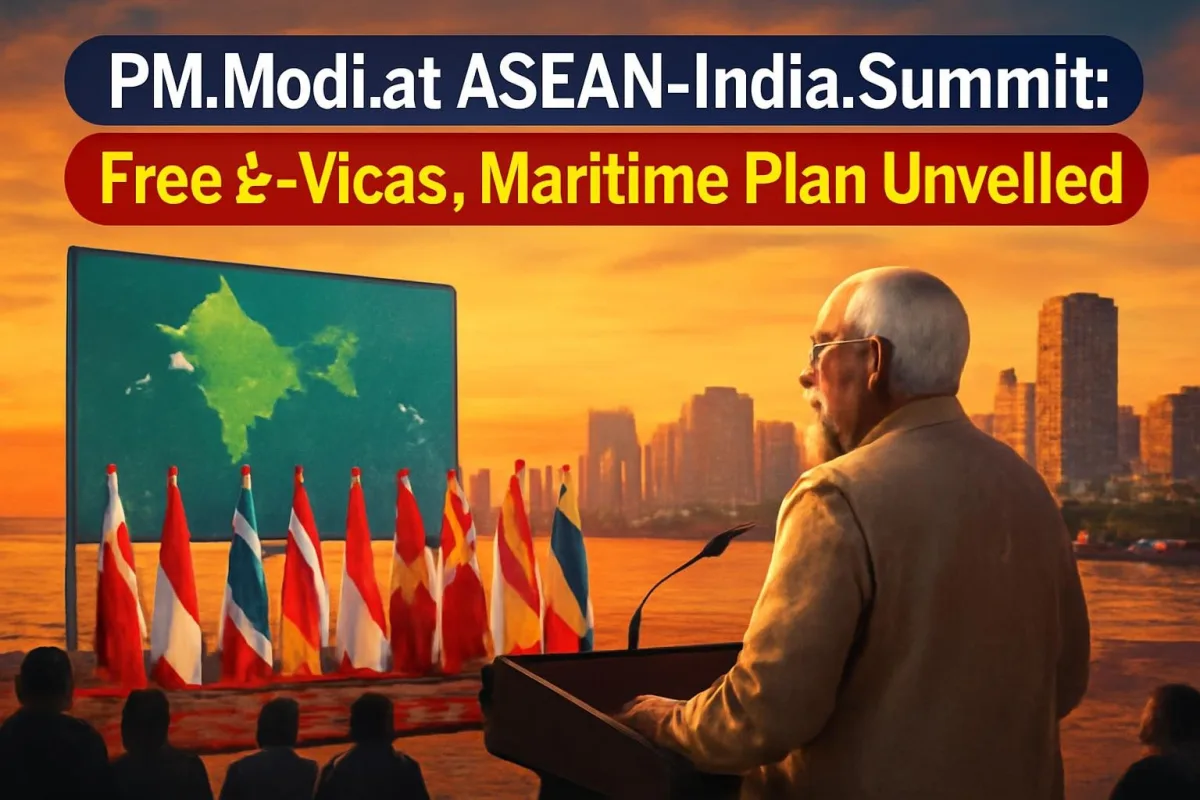
Prime Minister Narendra Modi used the 23rd ASEAN-India Summit in Manila on Tuesday, November 17, to put a long list of fresh proposals on the table, from free e-visas for tourists from ASEAN countries to a long-term plan for maritime cooperation. Speaking at the meeting hosted by the Philippines as this year's ASEAN chair, he said the world today needs peace, stability and predictability above all, and that the India-ASEAN future should be shaped by cooperation rather than competition.
Why this summit mattered
Modi travelled to Manila at the invitation of Philippine President Ferdinand R. Marcos Jr. The ASEAN-India Summit and the 21st East Asia Summit were both scheduled for the same day, while the Quad leaders also met in the Philippine capital, making November 17 one of the busiest diplomatic days of the year for New Delhi.
2026 has been marked as the ASEAN-India Year of Maritime Cooperation, and the summit reviewed progress under the Comprehensive Strategic Partnership and the ASEAN-India Plan of Action for 2026-2030. In his departure statement a day earlier, the Prime Minister had described ASEAN as central to India's Act East Policy and its MAHASAGAR vision for the Indian Ocean region.
Modi also congratulated President Marcos on the Philippines' chairship theme, "Navigating Our Future, Together", and extended good wishes to Singapore, which takes over as the next ASEAN chair.
What PM Modi said
The Prime Minister said India's commitment to ASEAN unity and centrality remains unwavering and that India's growth and ASEAN's prosperity are closely linked. He backed a free, open, inclusive and rules-based Indo-Pacific, and said ASEAN Community Vision 2045 and India's goal of Viksit Bharat 2047 can together play a significant role in meeting the region's shared aspirations.
He pointed out that India and ASEAN together account for nearly a quarter of the world's population, and that the relationship has grown beyond shared culture and heritage into areas such as digital technology, defence and space. He also urged both sides to co-create technology rather than simply consume it, and to invest jointly in skilling young people. Modi noted that this was his third visit to an ASEAN country this year.
The Act East numbers
Highlighting India's track record, Modi said that since 2014 India has taken up more than 100 initiatives to deepen people-to-people ties, completed nearly 250 Quick Impact Projects and offered more than 10,000 scholarships for skill development. Direct flights now connect India with nine ASEAN countries, helping tourism grow in both directions.
Nine new proposals at a glance
According to the official summary released by the Prime Minister's Office, Modi proposed the following:
- Maritime Cooperation Plan: a long-term ASEAN-India plan covering connectivity, scientific research, disaster management, Coast Guard cooperation, maritime domain awareness and the security of seafarers.
- Cyber forensics: a joint training programme for investigators.
- Nuclear energy: ASEAN-India technical exchanges on nuclear energy.
- Space: an ASEAN-India Space Hackathon.
- Critical minerals: cooperation in mining and critical minerals.
- Youth Connect: a youth summit, exchanges for young parliamentarians and start-up hackathons.
- Education: more scholarships for ASEAN students at Nalanda University.
- Creative economy: an ASEAN-India Creative Partnership Pavilion at WAVES 2027.
- Tourism: free e-visas for tourists from ASEAN countries.
Leaders also adopted an ASEAN-India Joint Statement on Cooperation in Disaster Management.
Key facts
| Event | 23rd ASEAN-India Summit |
| Date | November 17, 2026 |
| Venue | Manila, Philippines |
| ASEAN Chair 2026 | Philippines (theme: Navigating Our Future, Together) |
| Next ASEAN Chair | Singapore |
| Theme year | ASEAN-India Year of Maritime Cooperation |
| Headline offer | Free e-visas for ASEAN tourists |
| Outcome document | Joint Statement on Disaster Management Cooperation |
| Coming milestone | 35 years of dialogue relations in 2027 |
What it means for India
For ordinary Indians, the most visible changes are likely to come through travel, study and jobs. Free e-visas for ASEAN tourists could bring more visitors from countries such as Vietnam, Thailand, Malaysia and Indonesia to Indian destinations, supporting hotels, airlines and local businesses. More Nalanda University scholarships and youth exchanges also build long-term goodwill in a region where India competes for influence.
The maritime plan matters for India's security and trade. A large share of India's trade moves through Southeast Asian sea lanes, and closer Coast Guard cooperation and shared maritime awareness can help with everything from disaster response to tackling piracy and illegal fishing. The critical minerals and space proposals, meanwhile, fit India's push to secure supply chains for electronics, electric vehicles and clean energy.
Trade remains the area to watch. Officials on both sides have been reviewing the ASEAN-India Trade in Goods Agreement for some time, and India has said it wants a more balanced and business-friendly pact. No new timeline for that review was announced at Tuesday's summit.
What happens next
The proposals now move to officials, who will need to turn them into concrete programmes with dates and budgets. Next year carries extra weight for the relationship: 2027 marks 35 years of ASEAN-India dialogue relations and five years of the Comprehensive Strategic Partnership, which gives both sides a natural deadline to show results. Singapore's chairship will set the tone for that anniversary year.
For now, Manila has given New Delhi a chance to show that its Act East Policy is about practical delivery, from visas and scholarships to sea lanes and satellites.



Comments (0)