
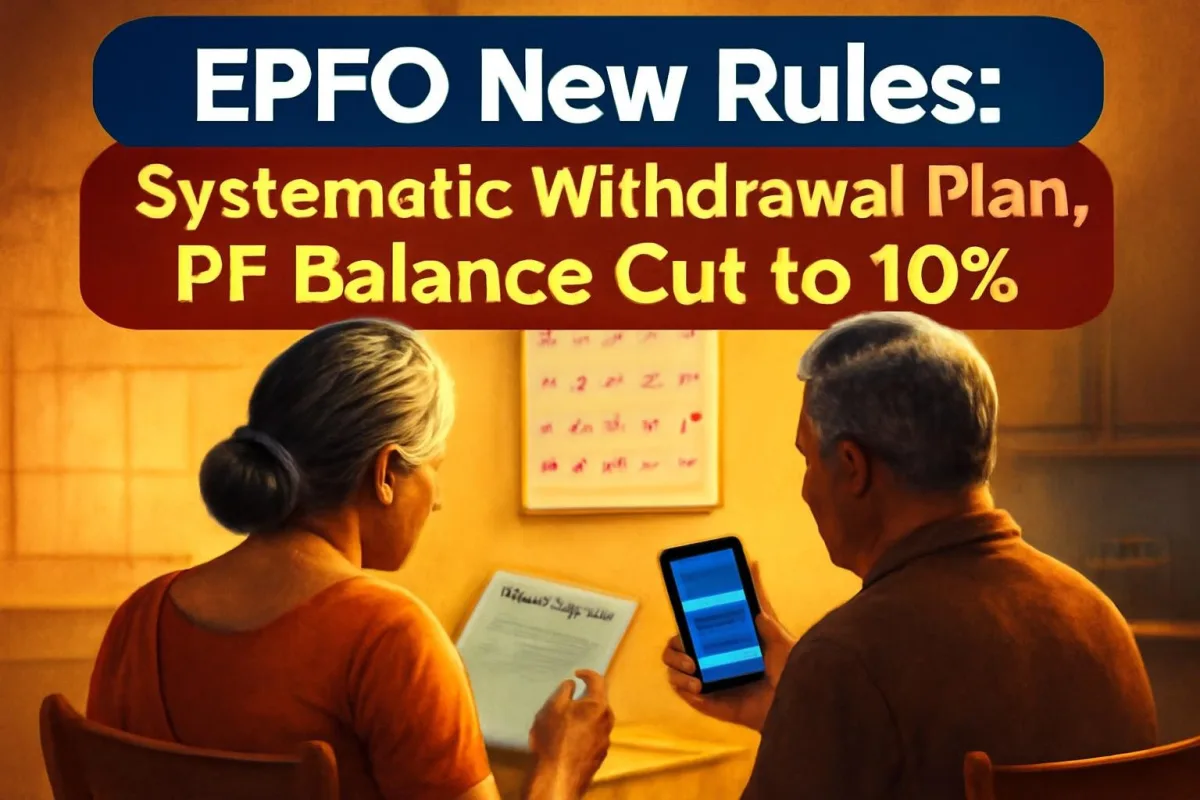
Retiring employees may soon not have to take their entire provident fund savings in one go. The Employees' Provident Fund Organisation (EPFO) has approved a Systematic Withdrawal Plan (SWP) that lets members draw their PF money in regular instalments, along with a set of changes that make it easier to access savings before retirement. The decisions were taken at the 240th meeting of EPFO's Central Board of Trustees (CBT), chaired by Union Labour Minister Dr Mansukh Mandaviya in New Delhi on November 19.
For crores of salaried Indians, these are among the most practical PF changes in years – touching how much you can withdraw, how long you have to wait after losing a job, and how your retirement money is paid out.
What Is EPFO's Systematic Withdrawal Plan?
Until now, most members settling their PF account at retirement received the whole corpus as a lump sum. Under the new plan, a retiring member can choose to receive the money in periodic instalments instead – monthly, quarterly or half-yearly, as per the member's preference, according to the Labour Ministry's official release.
The facility is entirely voluntary. Nobody will be forced to opt for instalments, and the ministry has said it may also be extended to eligible family members or beneficiaries. If a member dies while payouts are running, the nominee or dependant can either withdraw the remaining balance or keep receiving the instalments.
Business Standard reported that the plan could allow instalments for up to 20 years, with options such as a lump sum plus periodic payouts or an interest-only route, and that the remaining balance will keep earning the prevailing EPF interest rate. The ministry estimates that around 6.32 lakh EPF members aged above 55 with PF accumulations of more than ₹5 lakh will be the main beneficiaries in the first phase.
Other Key Decisions at the CBT Meeting
Minimum balance rule eased
The minimum balance that must stay in the account has been cut from 25% to 10%. Reports by Deccan Herald and Business Standard say this means members could withdraw up to 90% of their eligible balance for partial withdrawals once the new framework is notified, up from 75% now.
Faster final settlement after job loss
The waiting period for final withdrawal has been brought down from 12 months to 2 months. This effectively reverses the stricter rule introduced in October 2025, which had made unemployed members wait a full year before closing their PF account. The minimum wait for final pension withdrawal remains 36 months, as per Business Standard.
New investment avenue
The board also gave in-principle approval to invest up to 3% of fresh accretions in eligible Alternative Investment Funds (AIFs), initially through government-backed entities and within the existing investment ceiling.
Key facts at a glance
| Meeting | 240th CBT meeting, EPF |
| Date and place | November 19, 2026, New Delhi |
| Chaired by | Dr Mansukh Mandaviya, Union Labour Minister |
| New facility | Systematic Withdrawal Plan (voluntary) |
| Payout frequency | Monthly, quarterly or half-yearly |
| First-phase beneficiaries | About 6.32 lakh members above 55 with over ₹5 lakh |
| Minimum balance requirement | Cut from 25% to 10% |
| Final withdrawal wait after job loss | Cut from 12 months to 2 months |
| AIF investment | Up to 3% of fresh accretion (in-principle) |
| Claims auto-processed (CITES 2.0) | Up from 39% to 71% |
Faster Claims Under CITES 2.0
The meeting also reviewed EPFO's new claims platform, CITES 2.0, developed by C-DAC. According to the ministry, auto-processing of claims has jumped from 39% to 71%, the rejection ratio has fallen from 23% to 7.82%, and the average time to settle a claim has dropped from 11.15 days to just 2.57 days. Separately, 27 establishments surrendered their PF exemption and four had it cancelled, moving about ₹5,996 crore covering 1,44,437 members into EPFO's fold.
What It Means for PF Members
For someone close to retirement, the SWP offers something like a pension-style monthly income from their own PF money, while the untouched balance continues to earn interest. That can help retirees avoid the common mistake of spending or parking a big lump sum badly.
For younger members, the 10% minimum balance rule and the two-month settlement window mean faster access to money in emergencies or after a job loss. Tax experts, however, have pointed out that every early withdrawal also gives up years of compounding. EY India partner Puneet Gupta told Business Standard that tax treatment of the SWP is the key thing to watch.
When Will the New Rules Apply?
The changes are not live yet. The ministry said amendments to the EPF Scheme will be notified after approval, and a matching change in the Income Tax Act is being taken up with the Finance Ministry. Business Standard, citing people aware of the process, said the SWP is expected to take effect in about two months. Until the notification is issued, existing withdrawal rules continue to apply, so members should check the EPFO portal before filing any claim.





Comments (0)