
India and the United States have moved one step closer to a long-awaited trade agreement. Commerce and Industry Minister Piyush Goyal said on Thursday, October 15, that the first tranche of the India-US bilateral trade agreement (BTA) has been finalised and is now going through legal drafting and review. Speaking at the Shri Ram College of Commerce (SRCC) Centenary Conclave in Delhi, Goyal said India hopes to wrap it up soon, but will put it into operation only when Indian exporters get a fair edge over competing countries.
The comments are the clearest signal yet that months of negotiations between New Delhi and Washington are nearing the finish line, even though no signing date has been announced.
What Goyal Said
"US bilateral trade agreement first tranche has been finalised," Goyal told the audience at SRCC. He added that India hopes "to be able to finalize that soon and operationalise that once we get comparable advantage or competitive advantage over our peer countries."
That last condition is important. India's main concern has been tariff treatment in the US market. If competing exporters from other Asian economies enjoy lower duties in the US, Indian goods would struggle to compete. Goyal's remarks suggest India wants the deal's benefits to be meaningful in practice before it is switched on.
Officials on Both Sides Sound Positive
Commerce Secretary Rajesh Agrawal said the talks are in "a very good zone" and that both sides want to conclude and sign the agreement at the earliest. He said India is seeking preferential access to the US market so that its exporters can compete with other countries, and noted that the timing also depends on the overall US tariff structure, with parallel discussions going on in Washington.
US Ambassador to India Sergio Gor, speaking at the Bloomberg New Economy Forum, said the major issues have been settled and only smaller ones remain. He said Goyal and US Trade Representative Jamieson Greer are working through the details. "We are getting there. I am confident that we will have a trade deal here," Gor said.
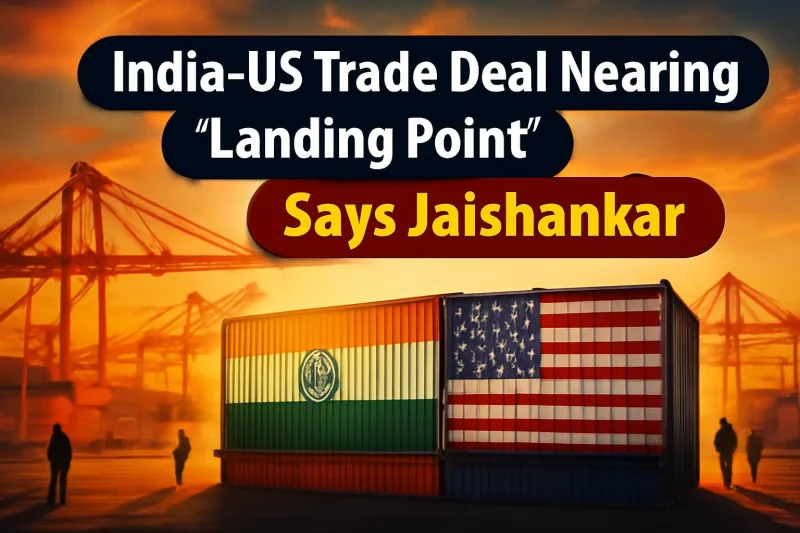
Earlier in the week, External Affairs Minister S Jaishankar had said the deal was nearing its "landing point". In early October, however, Greer had said both sides were working towards finalising the agreement but that it was not imminent, a reminder that the last mile can take time.
India-US Trade Deal: Key Facts
| Point | Details |
|---|---|
| Announcement | October 15, 2026, at SRCC Centenary Conclave, Delhi |
| Status | First tranche finalised; legal drafting and review underway |
| India's condition | Operationalise once India gets comparable or competitive advantage over peers |
| Indian exports to US (Apr–Sep 2026) | $50.81 billion, up 11.1% |
| Imports from US (Apr–Sep 2026) | $32.33 billion, up 26% |
| Trade surplus with US | $18.48 billion, down from $20.07 billion |
| Key negotiators | Piyush Goyal and USTR Jamieson Greer |
The Trade Numbers Behind the Talks
The US remains India's largest export market. In the first half of this financial year, from April to September 2026, Indian exports to the US rose 11.1% to $50.81 billion, up from $45.73 billion a year earlier. Imports from the US grew faster, by 26%, to $32.33 billion from $25.66 billion. As a result, India's trade surplus with the US narrowed to $18.48 billion from $20.07 billion.
A narrowing surplus has been one of Washington's priorities, and rising Indian purchases from the US could help smooth the path to a deal.
A Bumpy Road to This Point
Negotiations began in early 2025, but the relationship went through a rough patch. Washington imposed steep tariffs on Indian goods in 2025, and there were disagreements over H-1B visa fees and immigration policy. More recently, a US move restricting a green-card processing programme affected Indian IT firms. The signing is also expected to take into account the outcome of investigations under Section 301 of the US Trade Act.
Despite these frictions, trade officials on both sides have kept talking and say they remain committed to an agreement.
What It Means for India
For Indian exporters in sectors such as textiles, engineering goods, gems and jewellery, and seafood, lower and predictable US tariffs could make a real difference to orders and jobs. A deal would also give businesses more certainty while planning investments. For consumers, the effect is likely to be gradual, depending on which products see duty changes once the full text is public.
What Happens Next
Once legal drafting is complete, the text will need final approvals on both sides before it is signed. US Secretary of State Marco Rubio's planned visit to India could offer another opportunity to push the talks forward. Until the agreement is signed and its terms published, the exact tariff changes remain unknown.


Comments (0)