
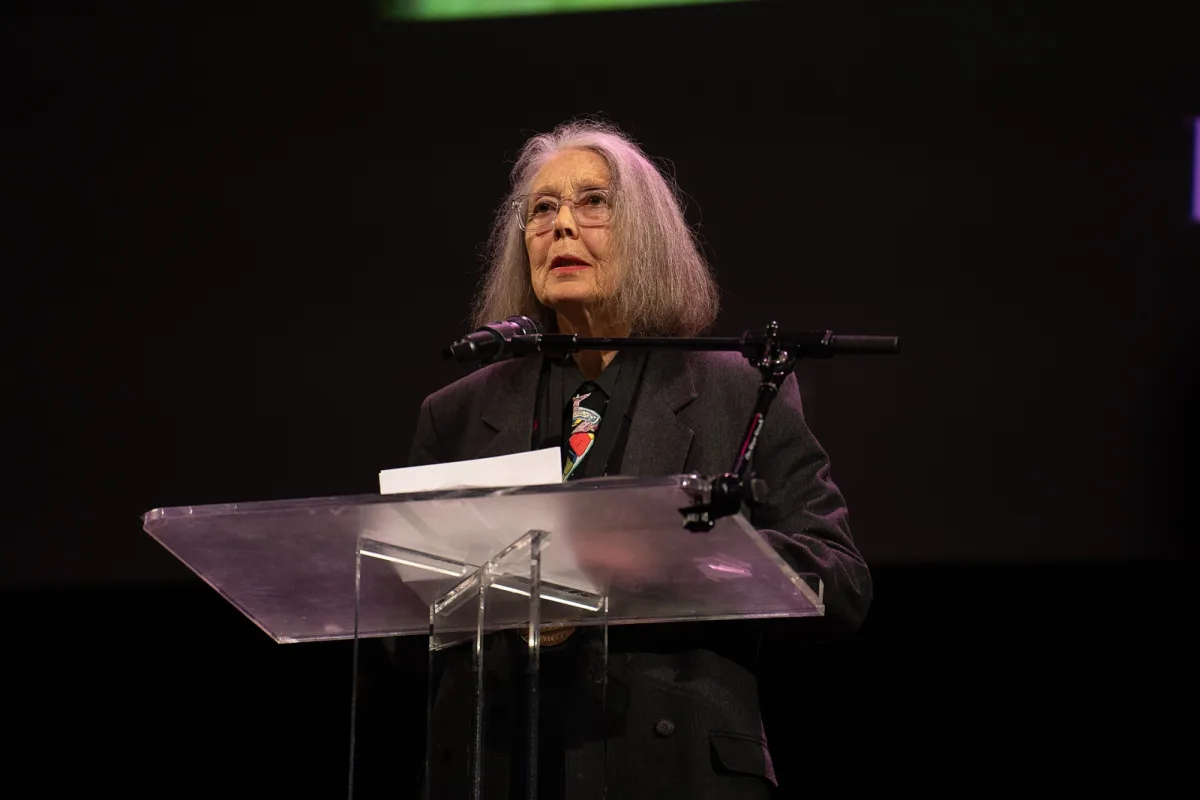
The phone rang in Iceland just before the world found out. Anne Carson, the Canadian poet, essayist and translator whose books read like nothing else on the shelf, was told on Thursday, October 8, that she had won the 2026 Nobel Prize in Literature. The Swedish Academy announced the award in Stockholm, honouring a writer who has spent five decades turning ancient Greek literature into startlingly modern forms.
Carson, 76, becomes the latest name on a list that stretches back to 1901, and one of the very few laureates whose work refuses to sit neatly in any one genre. Her books are poems, essays, novels, translations and art objects, sometimes all at once.
What the Swedish Academy said
The Academy honoured Carson "for her bold and inventive oeuvre that, in playful dialogue with the classical tradition, has created new forms for contemporary literature." It is a citation that captures exactly what her readers love about her: she treats Sappho, Sophocles and Euripides not as museum pieces but as living voices that can sit next to Marilyn Monroe, Emily Brontë and a broken-hearted narrator in a modern kitchen.
Anders Olsson, who chairs the Nobel Committee for Literature, described her work as sitting at the meeting point between a philologist's obsession with individual words and a poet's hunger for new meaning. He also pointed to her collaborations with visual artists, choreographers, and opera and theatre directors as proof of how freely she moves across art forms, and said her work since the 1990s has been of outstanding importance to the international literary scene.
Ingrid Carlberg, the Academy's permanent secretary, said she reached Carson by phone shortly before the public announcement. Carson was in Iceland at the time and, according to Carlberg, was taken by surprise but very happy.
Who is Anne Carson?
Carson was born in Toronto in 1950. Her love of ancient languages started early: a Latin teacher at her school began teaching her Greek during lunch breaks. She went on to study classics at the University of Toronto, completing her doctorate in 1981, and spent more than three decades teaching classics at universities in Canada and the United States, including McGill University and the University of Michigan.
That academic grounding shapes everything she writes. But instead of producing conventional scholarship, Carson uses the classics as a launch pad. Her translations of Sappho, Sophocles and Euripides are famous for their sharp, contemporary voice, and her original books often rebuild an old myth from the inside.
Her best-known books
| The Glass Essay (1995) | Long poem about a woman recovering from a broken relationship while visiting her mother, carrying the writing of Emily Brontë |
| Autobiography of Red (1998) | A novel in verse that reimagines the Greek myth of Geryon as a young man with red wings |
| The Beauty of the Husband (2001) | Subtitled "A Fictional Essay in 29 Tangos" |
| Nox (2010) | An accordion-folded book of photographs, letters and poetry written after the death of her brother |
| Antigonick (2012) | An illustrated reworking of Sophocles' Antigone |
| Red Doc> (2013) | Returns to the characters of Autobiography of Red |
| Wrong Norma (2024) | Prose poems paired with her own artwork; a National Book Award finalist |
Autobiography of Red remains the book most readers start with. It takes a minor monster from Greek myth, killed by the hero Herakles, and turns him into a shy, artistic boy in love. The result is tender, funny and devastating, and it introduced a whole generation of readers to the idea that poetry could tell a page-turning story.
Nox, meanwhile, is less a book than an object: a single long sheet folded inside a box, filled with fragments of a Latin elegy, family photographs and handwritten notes. Olsson called it "a creation as sculptural as it is literary."
A long list of honours
The Nobel caps a career already heavy with awards. Carson received a MacArthur Fellowship in 2000, the T.S. Eliot Prize in 2001 for The Beauty of the Husband, the Griffin Poetry Prize twice (2001 and 2014) and Spain's Princess of Asturias Award for Literature in 2020. Her 2024 book Wrong Norma was a finalist for the US National Book Award for Poetry.
The prize itself carries 12 million Swedish kronor, roughly US$1.2 million, and will be presented in Stockholm on December 10, the anniversary of Alfred Nobel's death.
Why it matters for readers in India
Carson is not a household name in India, but she has a devoted following among students of English literature, poetry readers and theatre makers. Her versions of Greek tragedies are regularly studied and staged, and her mix of scholarship and emotion has influenced younger poets around the world, including in India's growing English-language poetry scene.
For first-time readers, the Nobel is a good excuse to start. Autobiography of Red and The Glass Essay are the most accessible entry points, while her Sappho translation, If Not, Winter, shows how she treats ancient fragments with both precision and play. Expect Indian bookstores and online sellers to see a sudden spike in demand, as usually happens after a Nobel announcement.
What happens next
Carson will be invited to deliver a Nobel Lecture in the run-up to the award ceremony, a tradition every literature laureate follows. The lecture is often one of the most read texts of the year, and given Carson's love of unusual forms, many readers are already curious about what shape hers will take.
The 2026 Nobel season is still under way. After chemistry earlier this week and literature on Thursday, attention now turns to the Peace Prize and the economics prize, the final two announcements of the year.






Comments (0)