
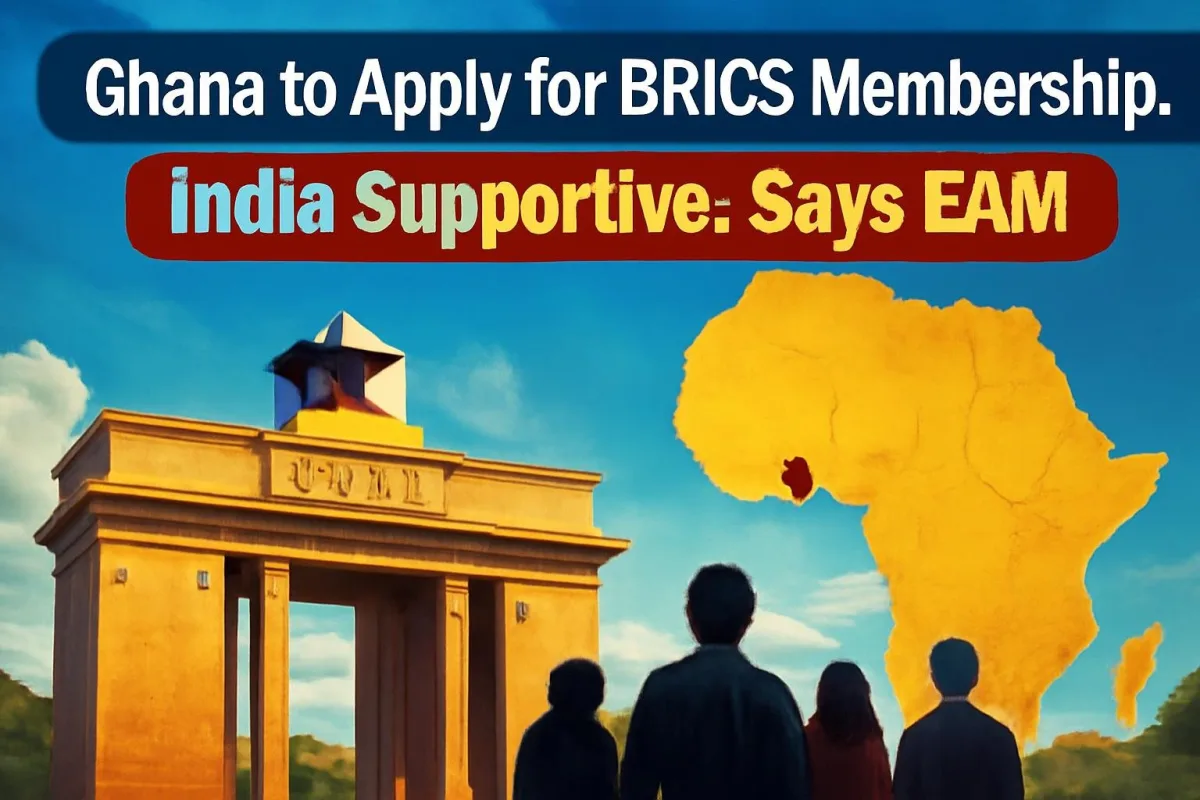
Ghana has decided to seek membership of BRICS, the bloc of major emerging economies that includes India, China, Brazil, Russia and South Africa. Foreign Minister Samuel Okudzeto Ablakwa announced in Accra this week that the Cabinet has approved the move, speaking at a joint media briefing with India's External Affairs Minister S Jaishankar, who is on a visit to the West African nation.
Jaishankar said New Delhi has been "very sympathetic and supportive" of Ghana's aspirations, while making it clear that any new membership is a matter for collective consideration by the group.
Why Ghana wants to join BRICS
Ablakwa linked the decision to President John Dramani Mahama's economic agenda, which the government calls the "New Economy". He said Ghana has moved past the stabilisation phase that followed its 2023-24 debt crisis and now wants a growth path that creates jobs, industrialises the economy and adds value to natural resources at home instead of exporting them raw.
The foreign minister said BRICS fits that vision because it would give Ghana more development options and more partners to work with as equals in what he called a multipolar world. He also spoke of "resource sovereignty", the idea that Ghana should have greater control over how its gold, cocoa, oil and other resources are developed.
Not a break with the West
Ablakwa was careful to stress that the bid does not mean Ghana is walking away from its traditional partners. The country remains a member of the IMF and the World Bank, and he noted that the African Export-Import Bank (Afreximbank) provided about USD 700 million in support during the financial crisis. Ghana, he said, will take "baby steps" towards a formal application and will seek the support of existing members.
Where India fits in
The announcement came during the first stop of Jaishankar's three-nation Africa tour, which also includes Cote d'Ivoire and Ethiopia. Ablakwa said Ghana's trade with India has grown sharply, from about USD 3 billion in 2024 to roughly USD 7 billion now, making India one of its most important economic partners.
The two sides discussed taking their Comprehensive Partnership to the "next level", with cooperation planned in pharmaceuticals, healthcare, mining, defence, railways and digital technology. They also signed agreements on agricultural research and training and on biodiversity. Jaishankar highlighted Indian investments in Ghana's pharma, medical services, poultry and renewable energy sectors.
| Country | Ghana (capital: Accra) |
| Decision | Cabinet approves bid to join BRICS |
| Announced by | Foreign Minister Samuel Okudzeto Ablakwa |
| Occasion | Joint briefing with EAM S Jaishankar in Accra |
| India's position | Supportive; decision rests with all members |
| India-Ghana trade | About USD 3 billion (2024) to about USD 7 billion (as cited by Ghana) |
| BRICS full members | Brazil, Russia, India, China, South Africa, Egypt, Ethiopia, Iran, Saudi Arabia, UAE, Indonesia |
How BRICS membership works
BRICS started as BRIC in 2009 and became BRICS when South Africa joined. It has since expanded to 11 full members with the entry of Egypt, Ethiopia, Iran, Saudi Arabia, the UAE and Indonesia, and it has created a separate category of partner countries that includes Nigeria, Malaysia, Thailand, Vietnam and others.
New members are admitted only by consensus, so Ghana will need the backing of every existing member. Officials in Accra have not given a date for the formal application, and it is not yet clear whether Ghana would first seek partner status, as several recent applicants have done.
What it means for India
For India, Ghana's interest is a sign of the bloc's continued appeal across Africa and the wider Global South, a constituency New Delhi has courted closely. Ghana is also an important source of gold for India, and Indian firms already have a presence in its pharma and healthcare sectors. A Ghana that is more closely tied to BRICS institutions, including the New Development Bank, could open new channels for Indian companies and lenders.
At the same time, India has generally favoured a cautious, consensus-based approach to expanding the bloc. Jaishankar's careful wording, supportive but leaving the decision to the group, reflects that balance.
What happens next
Ghana is expected to prepare its formal application and lobby existing members for support. Any decision on new members would typically be taken at a BRICS summit. Jaishankar, meanwhile, continues his Africa tour with stops in Cote d'Ivoire and Ethiopia.




Comments (0)