
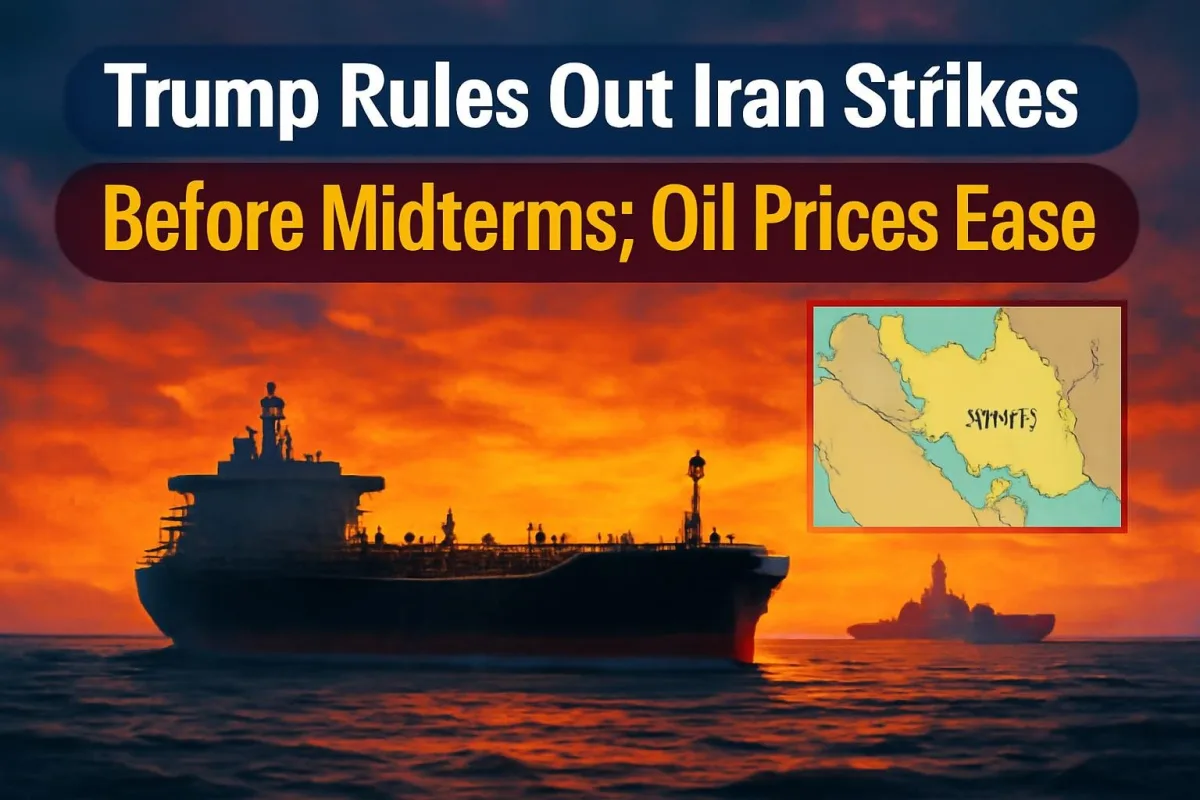
US President Donald Trump has said the United States will not attack Iran before the November 3 midterm elections, while keeping the naval blockade on Iranian ports "in full force." The pledge, posted on Truth Social on Thursday, October 8, briefly cooled oil markets: Brent crude, which had jumped to about $105 a barrel earlier in the day, slipped to around $103 after the post.
For India, which imports most of its crude and has thousands of nationals across the Gulf, the message offers some short-term relief, but it does not end the uncertainty hanging over the region.
What Trump said
In his post, Trump wrote that "we will not be attacking Iran at any time prior to the Midterm Elections." He also spoke of "productive conversations" with Tehran, without giving details, and pointed to about 22 million barrels of oil moving through the Strait of Hormuz in a single night as a sign that shipping was flowing again. Reuters also reported his remarks that talks with Iran were productive and that no strike would take place before the US vote.
The statement came on the same day The Atlantic reported that the White House had asked the Pentagon to prepare fresh strike options. A White House official responded that Trump "has all options available at any time," so the pledge is a political commitment rather than a formal change in policy.
Background: how the conflict reached this point
The US and Israel launched military operations against Iran on February 28 this year, and a ceasefire took effect on April 8. Since then there has been no announced US strike on Iran for several weeks, but Washington has kept a blockade on Iranian ports in place, and the Strait of Hormuz has remained tense.
Shipping attacks have not stopped. According to the UK Maritime Trade Operations (UKMTO) centre, there were nine attacks on vessels in the Gulf region in the first week of October alone, including a tanker hit by projectiles about 59 miles off Qatar on October 7. The conflict has also spilled into the Arabian Peninsula, with Yemen's Houthis firing missiles at Saudi airports in Abha and Riyadh this week.
Where talks stand
- Iran's Foreign Minister Abbas Araghchi said on Thursday that talks are continuing through intermediaries, and that Tehran is studying Washington's reply to its "seven-day plan" and will respond within a few days.
- US Vice President JD Vance told Reuters earlier this week that Iran should make a "meaningful" cut in its uranium enrichment capacity, which was read as a softer line than before.
- An Iranian official said Washington must lift the blockade of Iranian ports before the nuclear issue can be discussed.
- The US Treasury on Thursday sanctioned 17 more vessels it says belong to Iran's "shadow fleet."
Key numbers
| Trump's pledge | No attack on Iran before November 3 midterms |
| Date of post | October 8, 2026 (Truth Social) |
| Brent crude, Oct 8 high | About $105 a barrel |
| Brent after the post | About $103 a barrel |
| Brent peak this conflict | About $108 (mid-September) |
| Ceasefire in effect since | April 8, 2026 |
| Shipping attacks in October so far | 9 (UKMTO, as of Oct 7) |
| New US sanctions | 17 "shadow fleet" vessels |
What it means for India
Oil is the most direct link. India buys the bulk of its crude from abroad, and much of it passes near or through the Strait of Hormuz. Every few dollars added to the price of Brent feeds into the import bill, the rupee and, eventually, fuel and transport costs. A promise of no new US strikes for the next few weeks lowers the risk of a sudden spike, though prices are still far above where they were before the war.
The Reserve Bank of India raised the repo rate this week to 5.5%, its first hike since 2023, and inflation risks linked to energy prices are part of that backdrop. A calmer oil market would help the central bank and household budgets alike.
There is also a human angle. Millions of Indians live and work in the Gulf, and the government this week advised nationals in Saudi Arabia to stay alert after the Houthi strikes on airports. Indian seafarers make up a large share of crews on tankers in the region, and the continuing attacks on ships are a direct concern for their families.
What happens next
The next markers to watch are Iran's formal response to the US proposal, expected within days, and whether the blockade is eased as part of any deal. Analysts will also track whether attacks on shipping in the Gulf continue, since they can move oil prices regardless of what Washington says. Trump's pledge runs only until the midterms, so the period after November 3 will be the real test of whether the current pause becomes a lasting settlement.





Comments (0)