
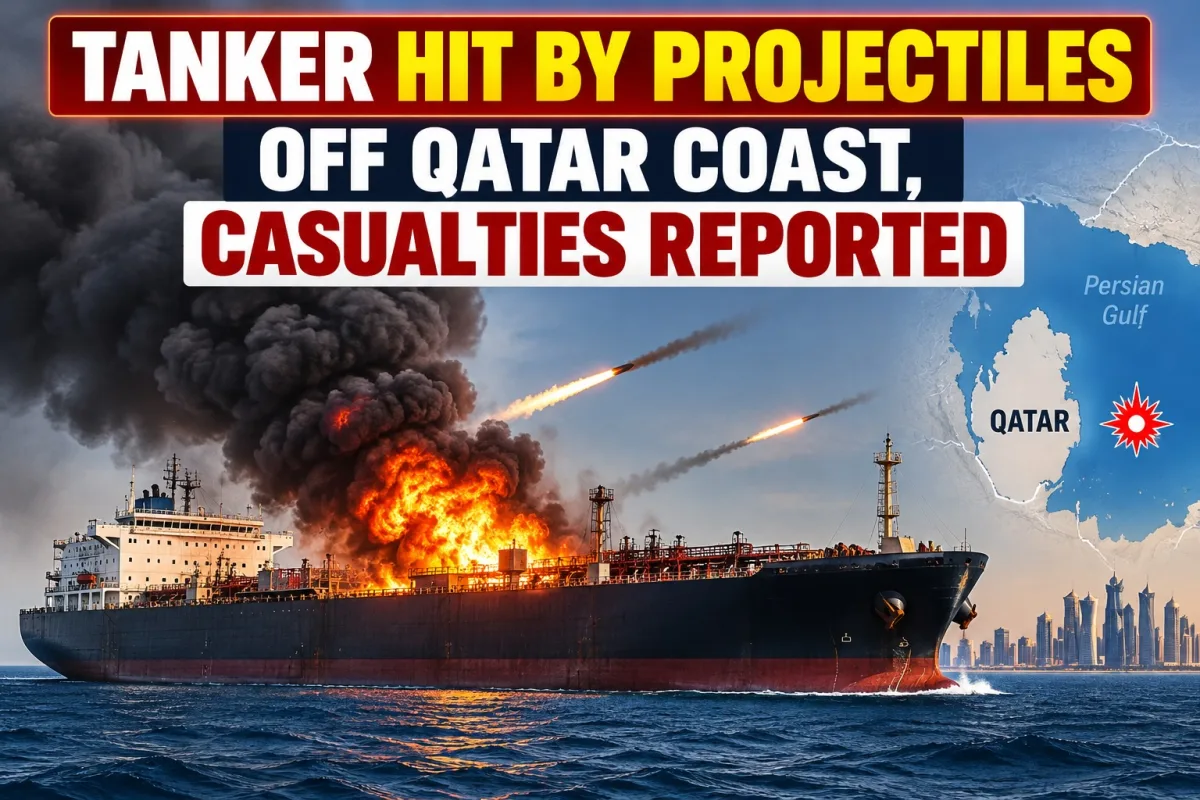
A tanker sailing in the Persian Gulf was struck by several projectiles off the northern coast of Qatar on Wednesday evening, the UK Maritime Trade Operations (UKMTO) centre said, adding that casualties had been reported on board. The attack happened around 1900 hours UTC on October 7, roughly 51 nautical miles (about 94 km) north of Madinat ash Shamal, inside Qatar's exclusive economic zone.
The strike is significant because it took place far from the Strait of Hormuz, the narrow chokepoint where most of this year's attacks on merchant shipping have been concentrated. It also comes just a day after another tanker with a largely Indian crew was hit near Oman.
What we know so far
UKMTO, which tracks security incidents for commercial shipping in the region, said the report had been verified and that "authorities are investigating". It did not say how many people were hurt or killed, and it has not released the name, flag, owner or cargo of the vessel.
No country or armed group has claimed responsibility, and Qatar has not made a public comment so far. Ships in the area have been advised to transit with caution, but no closure or formal rerouting order has been issued.
| Detail | What is confirmed |
| Time | Around 1900 UTC, Wednesday, October 7, 2026 |
| Location | About 51 nautical miles north of Madinat ash Shamal, Qatar |
| Vessel | A tanker; name, flag and cargo not disclosed |
| Casualties | Reported, numbers not released |
| Responsibility | Not claimed; under investigation |
| Source of alert | UK Maritime Trade Operations (UKMTO) |
Why this attack stands out
Since the US-Israel war on Iran began on February 28, Iran has effectively choked traffic through the Strait of Hormuz, while Washington has kept up a blockade of Iranian ports. Before the war, about 125 large commercial vessels moved through the strait every day, carrying roughly a fifth of the world's crude oil and liquefied natural gas.
Most of the strikes on merchant ships have been in and around Hormuz. UKMTO said on Tuesday that it had already recorded nine attacks on tankers in the strait in October alone. An attack deep inside the western Gulf, close to Qatar's waters, suggests that the danger zone for shipping could be widening.
The location is also sensitive because Qatar is one of the world's biggest LNG exporters, and its Ras Laffan energy hub lies on the same northern coast. Ras Laffan already suffered missile damage earlier in the conflict.
The India angle: a day after the MT On Peace attack
For India, the news lands on top of an attack that hit much closer to home. On Tuesday, the Panama-flagged tanker MT On Peace was struck by a projectile while passing through the Strait of Hormuz off Oman. Twelve of its 19 crew members were injured. Seventeen Indian nationals were on board, and 11 of them were among the injured. They were evacuated with help from Omani authorities and are being treated in Khasab, Oman.
India's Ministry of External Affairs condemned that attack, called for an immediate halt to strikes on shipping and civilian infrastructure, thanked Oman for its help and urged that free navigation through international waterways be restored as soon as possible.
Indian seafarers are among the largest groups of sailors working on merchant ships worldwide, which means almost every major incident at sea in the Gulf carries a risk to Indian lives. Families of sailors, shipping companies and recruitment agencies in India are watching these alerts closely.
What it means for fuel and trade
India imports most of its crude oil and a large share of its LNG, and a big portion of it comes from the Gulf. Every new attack raises worries about delays, higher insurance costs and pricier freight. So far, though, there is no clear evidence that this particular strike has moved oil prices or shipping rates.
In fact, ship-tracking data from Kpler showed Middle East crude exports touching about 18.3 million barrels a day in late September – slightly above pre-war averages – as exporters found ways to keep cargo moving despite the risks.
What happens next
Investigators are expected to establish what kind of projectiles were used and where they came from. Details about the ship, its crew and the number of casualties should become clearer once the owner or flag state comments. Indian authorities will be checking whether any Indian nationals were on board.
Shipping companies, meanwhile, will be reassessing routes and security arrangements across the wider Gulf, not just the Strait of Hormuz. We will update this story as official information comes in.





Comments (0)