
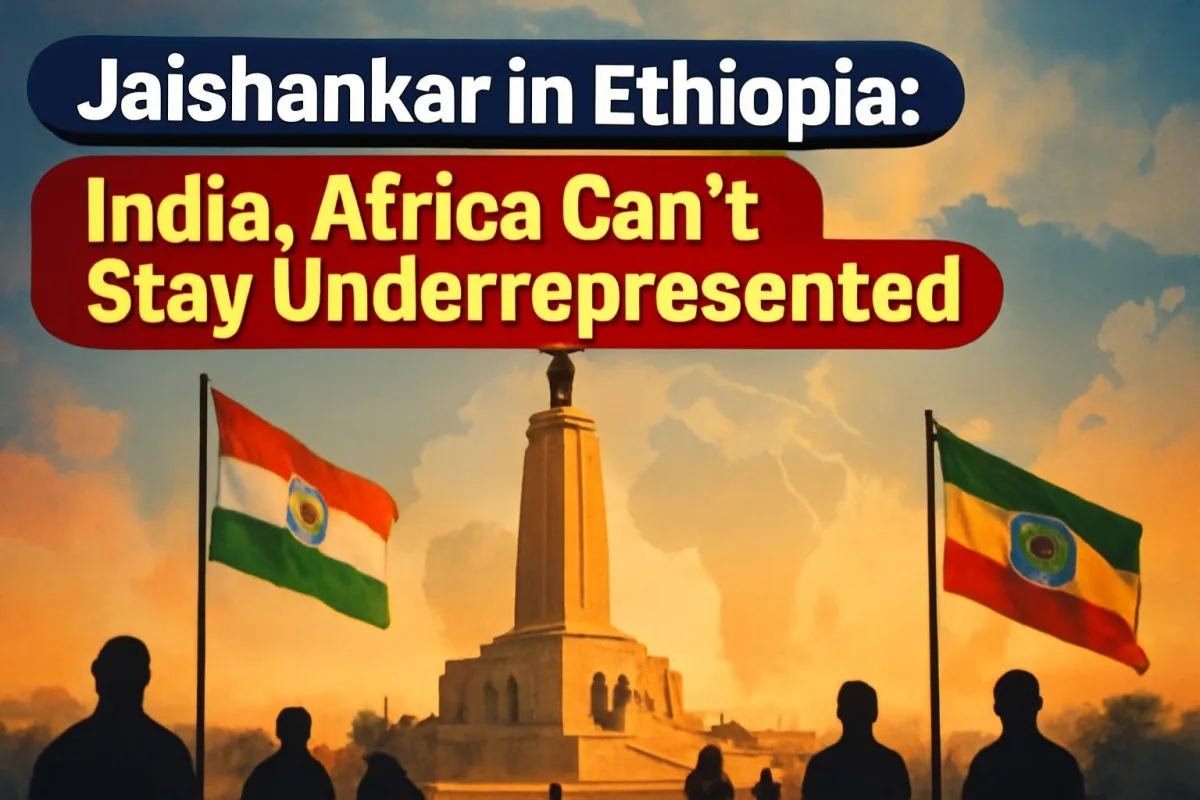
External Affairs Minister S. Jaishankar has used the final stop of his Africa tour to make a pointed case for reforming the United Nations Security Council. Speaking at the Adwa Victory Memorial Museum in Addis Ababa, Ethiopia, he said India and Africa "cannot remain under represented" in global decision-making and called for fair African representation in both permanent and non-permanent seats.
The speech wrapped up a three-nation visit that also took him to Ghana and Côte d'Ivoire, and it set out how India sees its partnership with the continent: more trade, more local capacity and a louder shared voice in global institutions.
Where and Why Adwa Matters
The choice of venue was deliberate. The Adwa museum commemorates Ethiopia's 1896 victory over Italian forces at the Battle of Adwa, a rare defeat of a European colonial army in Africa. Jaishankar said that victory inspired anti-colonial movements around the world and resonated with India's own freedom struggle, linking the two regions' histories before turning to the present.
Key Points From Jaishankar's Speech
1. Security Council Reform
The minister was blunt about the UN's top body. "The current Council neither delivers effectively nor represents fairly. And the two shortcomings are clearly interconnected," he said. He backed African representation in both categories of membership and said reform was being held back by forces that prefer the status quo, without naming them.
2. Who Decides the Future
Framing the issue as a Global South concern, he asked, "The essential question remains: who gets to decide our future?" He argued that countries that make up a large share of the world's population cannot be left out of the rooms where key decisions are taken.
3. Fair Trade and Industrialisation
Jaishankar said developing countries' right to industrialise should not be undermined by markets being flooded with cheap goods or by restrictions on market access, a remark widely read as a reference to unfair trade practices that hurt young manufacturing sectors.
4. Capabilities, Not Dependencies
"Partnerships of the future must help create capabilities, not promote dependencies," he said, positioning India's development model in Africa as one built around skills, infrastructure and local ownership.
India-Africa Ties by the Numbers
| Venue | Adwa Victory Memorial Museum, Addis Ababa, Ethiopia |
| Tour | Ghana, Côte d'Ivoire and Ethiopia |
| India's rank among Africa's trade partners | Fourth largest |
| Bilateral trade | Close to USD 100 billion |
| Indian-supported projects completed | More than 220 |
| Value of those projects | About USD 4.5 billion |
| G20 milestone | African Union made a permanent G20 member during India's 2023 presidency |
Jaishankar listed examples of Indian-backed work across the continent: a metro rail project in Mauritius, hydropower in Rwanda, the Democratic Republic of Congo, Zambia and Burundi, drinking-water pipelines in Tanzania, and power transmission lines in Côte d'Ivoire, Togo, Sudan and Benin.
The G20 Link
He reminded his audience that India used its 2023 G20 presidency to push for permanent membership of the African Union in the grouping, which was secured at the New Delhi summit. New Delhi often points to that outcome as proof that it can turn its Global South advocacy into concrete results, and Jaishankar suggested the same approach should now be applied to the Security Council.
He also said India's goal of becoming a developed nation by 2047 and the African Union's Agenda 2063 offer complementary paths, and urged Indian companies to invest more in Africa and to cooperate on food security, agriculture and sustainable development.
What It Means for India
India has campaigned for years for a permanent seat on the Security Council. The Council today has 15 members: five permanent members with veto power and ten non-permanent members elected for two-year terms. Reform needs broad support in the UN General Assembly, and the 54 African countries form the largest regional bloc there. Building common ground with Africa is therefore central to India's own ambitions.
For Indian businesses, the tour points to opportunity. With trade already near USD 100 billion, sectors such as pharmaceuticals, IT services, agriculture, energy and infrastructure are seen as areas where Indian firms can expand.
What Happens Next
- Intergovernmental negotiations on Security Council reform continue at the UN in New York, where India and African nations are expected to coordinate positions.
- Follow-up on trade, development and investment proposals discussed during the visits to Ghana, Côte d'Ivoire and Ethiopia.
- Indian industry is likely to be nudged towards new investments in African markets, in line with the minister's call.
With this tour, Jaishankar signalled that India wants to be seen as a partner that stands alongside Africa on global reform, not only as a trader and aid giver.





Comments (0)