
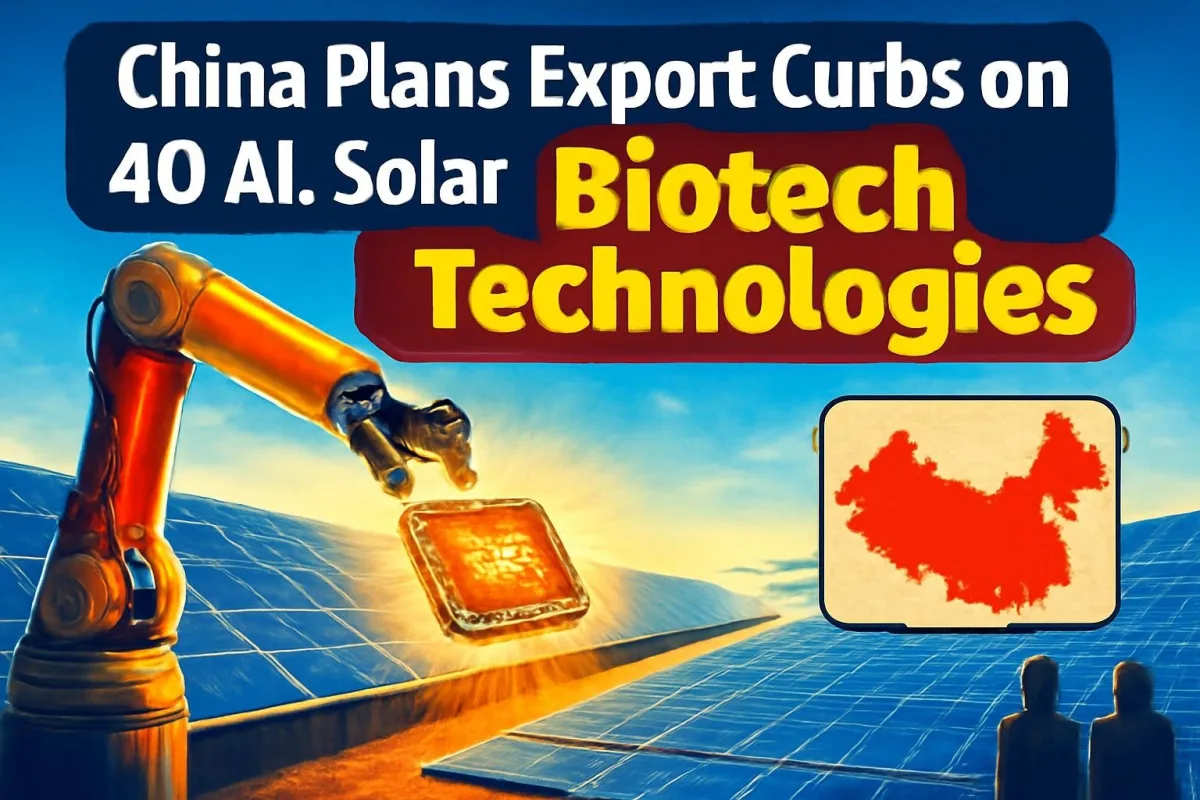
China has moved to keep some of its most valuable industrial know-how at home. On October 16, its Ministry of Commerce (MOFCOM) and Ministry of Science and Technology released a draft plan, Joint Announcement No. 48 of 2026, that would bar the export of 14 technologies and put licence restrictions on 26 more in artificial intelligence, biomedicine and solar power. A temporary rule that took effect the same day already requires companies to register planned transfers of these technologies before they go abroad.
What is on the list
The draft revises China's Catalogue of Technologies Prohibited or Restricted from Export. It covers 40 technologies in total: 23 in artificial intelligence, 12 in photovoltaics and 5 in biomedicine. According to MOFCOM, 14 of them would be banned outright and 26 would need an export licence.
Proposed export bans
- Production technology for perovskite and perovskite-silicon tandem solar cells and modules above set size and efficiency thresholds.
- Processes for making ultra-thin silicon wafers of 70 micrometres or less.
- AI-driven malicious code generation and mutation technologies.
- Proprietary cell and gene therapy technology platforms.
Proposed export restrictions
- Engineering for polysilicon production lines of 30,000 tonnes or more a year.
- Advanced crystal-pulling and wafer-cutting processes, and high-performance TOPCon, back-contact and heterojunction cell processes.
- AI-assisted vulnerability discovery technologies.
- New target discovery and validation methods for cell and gene therapies.
Technologies already in the public domain through open-source releases or academic papers are excluded. MOFCOM has also said that offering AI services through APIs, apps, websites or SaaS does not fall under the large AI model export controls.
Key facts at a glance
| Detail | Information |
|---|---|
| Issued by | MOFCOM and Ministry of Science and Technology, China |
| Document | Joint Announcement No. 48 of 2026 |
| Date | October 16, 2026 |
| Technologies covered | 40 (23 AI, 12 solar, 5 biomedicine) |
| Proposed bans | 14 technologies |
| Proposed restrictions | 26 technologies |
| Public comments | Until November 15, 2026 |
| In force now | Pre-export registration for listed technologies |
The registration rule already in force
While the bans and licences are still only proposals, the registration step applies immediately. Exporters must log covered deals in MOFCOM's online Technology Trade Management Information System, giving details of the buyer, destination, intended use and estimated value. It covers transferring ownership of a technology abroad, licensing it for overseas use, and changes that make a foreign entity the owner or controller. It also applies to deals already under way but not yet completed.
MOFCOM has said the measures are driven by national security concerns, noting that solar technologies are increasingly used in aerospace and defence, and that they do not target any particular country or company.
What it means for India
The solar part of the list matters most for India. The country is trying to build a full domestic solar supply chain, from polysilicon and wafers to cells and modules, with support from production-linked incentive schemes. Many of these plants rely on Chinese equipment, process know-how and on-site technical help. The draft does not stop exports of finished solar cells and modules, but analysts quoted by industry publication pv magazine warn that technology licensing, overseas production-line set-up, equipment exports and on-site support could all face hurdles.
That could mean delays and higher costs for new upstream factories, especially for next-generation technologies like perovskite-silicon tandem cells, which promise higher efficiency. On the other hand, it may strengthen the case for Indian manufacturers and research labs to develop their own processes rather than depend on imported know-how.
The AI and biotech parts of the list are narrower. Since API and app access to AI models is not covered, Indian users of Chinese AI services should see no direct change.
What happens next
China is accepting public comments until November 15, after which it will finalise the revised catalogue. Once it takes effect, the banned items will be off-limits for export and the restricted ones will need licences. Companies with planned technology tie-ups in China should register transfers now and watch for the final list, while governments and industry groups abroad, including in India, assess the impact on their manufacturing plans.






Comments (0)