
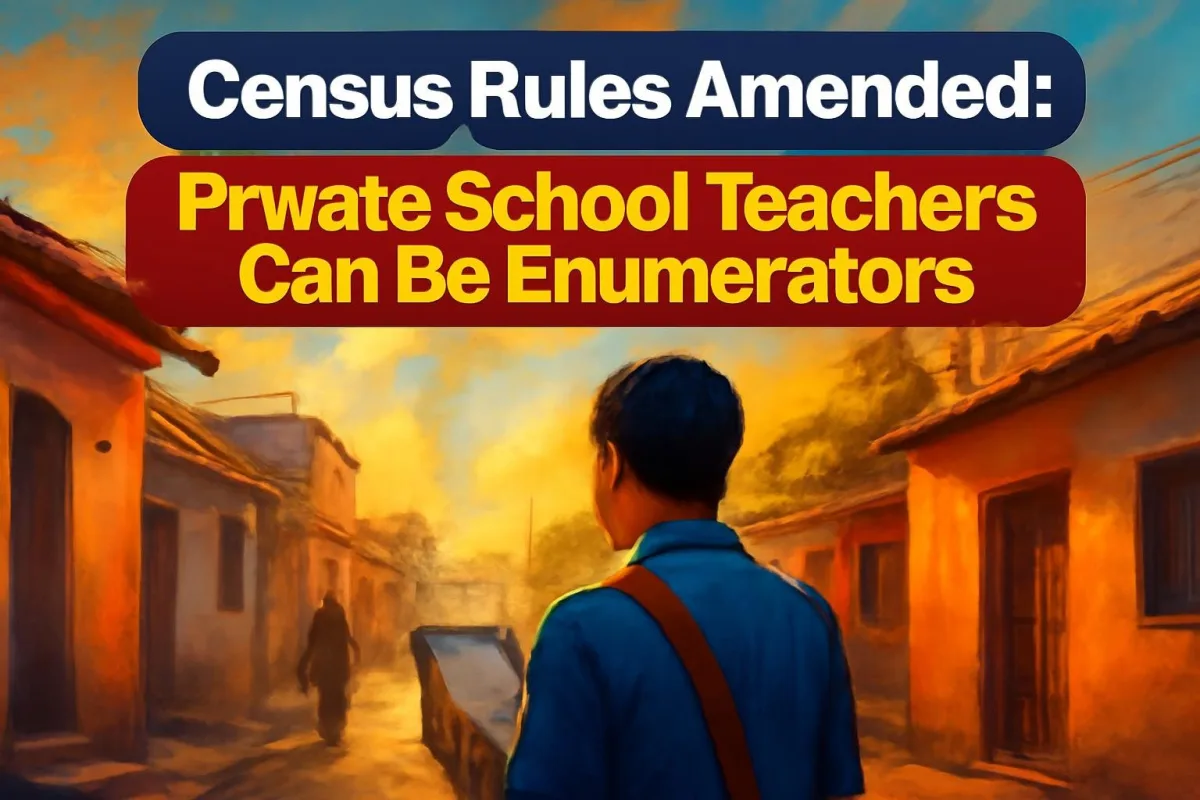
The Centre has quietly but significantly widened the pool of people who can be drafted for Census duty. Through the Census (Amendment) Rules, 2026, notified in the Official Gazette on Friday, October 16, teachers at aided and unaided private schools, along with clerks and officials of banks, public sector undertakings and private companies, can now be appointed as enumerators for the upcoming Census 2027.
The change comes as states gear up for one of the largest administrative exercises in the world, and after several high courts questioned whether private school staff could be pulled into census work under the old rules.
What exactly has changed
The notification, numbered G.S.R. 896(E), has been issued under Section 18(1) of the Census Act, 1948, and signed by Registrar General of India and Census Commissioner Mritunjay Kumar Narayan. It replaces the entries against serial number 5 in the table under Rule 3 of the Census Rules, 1990 – the entry that spells out who can serve as an enumerator.
Earlier, the list leaned heavily on government and local body employees, which in practice meant government school teachers carried much of the load. The amended entry now covers three broad groups:
- Teachers of educational institutions run by the government, local authorities, or aided or unaided private bodies, societies and trusts.
- Clerks and officials of the Central or state government, local authorities, PSUs, statutory bodies, banks, companies, institutions, societies and trusts.
- Any other person whom the state government or Union Territory administration considers suitable.
The rules came into force on the date of their publication in the Gazette. This is the fifth amendment to the 1990 rules, which were earlier revised in 1994, 2009, 2018 and 2022.
Key facts at a glance
| Rules | Census (Amendment) Rules, 2026 |
| Notification | G.S.R. 896(E), Ministry of Home Affairs |
| Date in force | October 16, 2026 (Gazette publication) |
| Issued by | Mritunjay Kumar Narayan, Registrar General of India |
| Legal basis | Section 18(1), Census Act, 1948 |
| Rule changed | Rule 3, serial number 5 (enumerators), Census Rules, 1990 |
| New groups covered | Private school teachers, bank, PSU and company staff, any suitable person |
| Census budget | Rs 11,718 crore approved by the Union Cabinet |
Why the Centre needed this
A national headcount needs lakhs of enumerators who go door to door, and Census 2027 will be India's first digital census, with data collected on mobile apps. That means a large, trained and tech-comfortable field force has to be in place across cities and villages.
The bigger trigger, though, was litigation. Over the past months, private school managements went to court against district officials who sought their staff for census work. The Punjab and Haryana High Court stayed Haryana government communications seeking details of private school teachers, after a petition argued that Section 4A of the Census Act covers local authorities and not private unaided schools. Earlier, in May, the Allahabad High Court stayed similar directions in Gautam Budh Nagar, and the Nagpur bench of the Bombay High Court also held that staff of aided or unaided schools could not simply be deputed for such work.
By writing private institutions and companies directly into the rules, the Centre is trying to give states a clearer legal footing. Whether that settles the matter will depend on how courts read the amended rules alongside the parent Act.
What it means for teachers and employees
If you work at a private school, a bank branch or a company, you could now receive a written appointment order from your district census office. Once appointed, enumerators are treated as public servants for the duration of census work, and refusing duty without a lawful excuse can attract penalties under the Census Act.
A few practical points for anyone who receives an order:
- Make sure the appointment comes in writing from the competent authority, usually the District Magistrate or district census officer.
- Attend the training sessions – the digital census relies on mobile apps and every enumerator will need to be comfortable with them.
- If you have a genuine difficulty, such as serious illness, put it in writing to the appointing authority before duty begins.
For employers, it means planning for staff to be released for training and field days, and keeping records of requisitions received.
For government school teachers, who have long complained that census and election work eats into teaching days, the wider pool could mean a slightly lighter load this time.
What happens next
Census 2027 is the eighth census since Independence and was originally due in 2021 before the pandemic pushed it back. It runs in two stages – house-listing and housing census, followed by population enumeration. The snow-bound regions, including Ladakh and parts of Jammu and Kashmir, Himachal Pradesh and Uttarakhand, completed their round in September, while the main exercise for most of the country is expected in early 2027.
States will now begin drawing up enumerator lists under the new rules. Expect more clarity from district administrations in the coming weeks, and possibly fresh challenges from school associations who still feel the move overreaches.




Comments (0)