
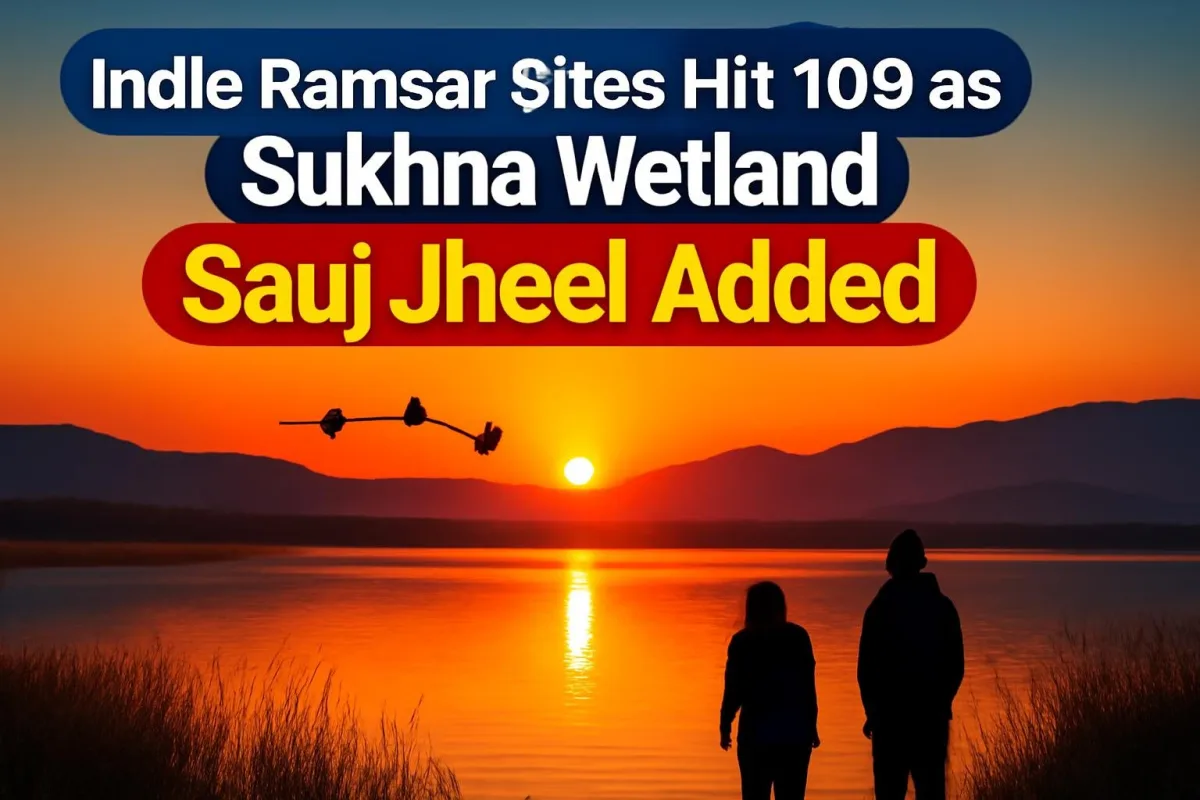
India's list of wetlands of international importance has grown to 103. Union Environment Minister Bhupender Yadav announced on Thursday, October 15, that Sukhna wetland in Chandigarh and Sauj Jheel in Uttar Pradesh's Mainpuri district have been designated Ramsar sites. Sukhna becomes Chandigarh's first, while Mainpuri is now the only district in the country with two.
What the minister said
In a post on X, Yadav said the additions reaffirm India's ongoing efforts to conserve its wetland ecosystems. "This milestone highlights the importance PM Shri Narendra Modi ji's government has been placing on wetlands," he wrote. India's network has expanded quickly in the last decade, from 26 sites in 2014 to 101 in August this year, when Glaw Lake in Arunachal Pradesh's Kamlang Tiger Reserve was added.
Sukhna wetland: Le Corbusier's lake
Sukhna, listed as Ramsar Site No. 2602, is a man-made reservoir created in 1958 by damming the Sukhna Choe, a seasonal stream flowing down from the Shivalik foothills. It was part of architect Le Corbusier's plan for Chandigarh and is today the city's favourite spot for morning walks, boating and sunsets. The lake has about 3 sq km of open water, sits next to the Sukhna Wildlife Sanctuary and lies on the Central Asian Flyway, a major migration route for birds wintering in India. It also supports species such as the Black Pond Turtle.
The lake has faced siltation, falling water levels and construction pressure in its catchment over the years. In 2020, the Punjab and Haryana High Court declared it a living legal entity, giving it legal rights to protection.
Sauj Jheel: Sarus Crane country
Sauj Jheel, Ramsar Site No. 2603, is a shallow floodplain lake in the Ganga basin and part of the Saman wetland complex in Mainpuri. It is an Important Bird Area that can host over 30,000 waterbirds and supports the vulnerable Sarus Crane, Uttar Pradesh's state bird. The Mainpuri-Etawah belt is among the best places in India to see the tall, red-headed cranes. With Saman Bird Sanctuary already listed in 2019, Uttar Pradesh now has 14 Ramsar sites.
| Key fact | Details |
|---|---|
| Announced on | October 15, 2026, by Environment Minister Bhupender Yadav |
| New sites | Sukhna wetland (Chandigarh), Sauj Jheel (Mainpuri, UP) |
| Ramsar site numbers | 2602 (Sukhna), 2603 (Sauj Jheel) |
| India's total | 103 Ramsar sites |
| Sites in 2014 | 26 |
| Uttar Pradesh total | 14 |
| State with most sites | Tamil Nadu |
What Ramsar status means
The Ramsar Convention, signed in the Iranian city of Ramsar on February 2, 1971, is a global treaty for the conservation and wise use of wetlands. India joined in 1982; its first sites were Chilika Lake in Odisha and Keoladeo National Park in Rajasthan. A wetland must meet at least one of nine criteria, such as regularly supporting 20,000 or more waterbirds, to be listed. Countries that designate a site commit to a management framework to protect it.
At home, wetlands are governed by the Wetlands (Conservation and Management) Rules, 2017, and supported through the National Plan for Conservation of Aquatic Ecosystems. The Amrit Dharohar scheme, announced in the 2023-24 Budget, promotes eco-tourism and local livelihoods around Ramsar sites.
What it means for people
For residents and visitors, Ramsar tags usually bring more attention to bird-watching, nature walks and eco-tourism, along with stricter checks on encroachment and pollution. Wetlands also matter far beyond tourism: they recharge groundwater, soak up floodwater, filter pollution and support fishing and farming communities. Experts often point out, though, that a listing is only a first step; real protection depends on management plans, funding and enforcement on the ground.
How to visit
Sukhna Lake is open to the public through the day and is easy to reach from anywhere in Chandigarh; early mornings between November and February are the best time for spotting winter migrants. Sauj Jheel lies in Mainpuri district of Uttar Pradesh, in the same wetland complex as Saman Bird Sanctuary, so birders can plan to cover both in a single trip. Visitors are urged not to litter, feed birds or play loud music near the water.
What happens next
Chandigarh and Uttar Pradesh will now need to prepare or update management plans for the two sites. With winter migration about to begin, birders can expect both wetlands to draw crowds over the coming months.





Comments (0)