
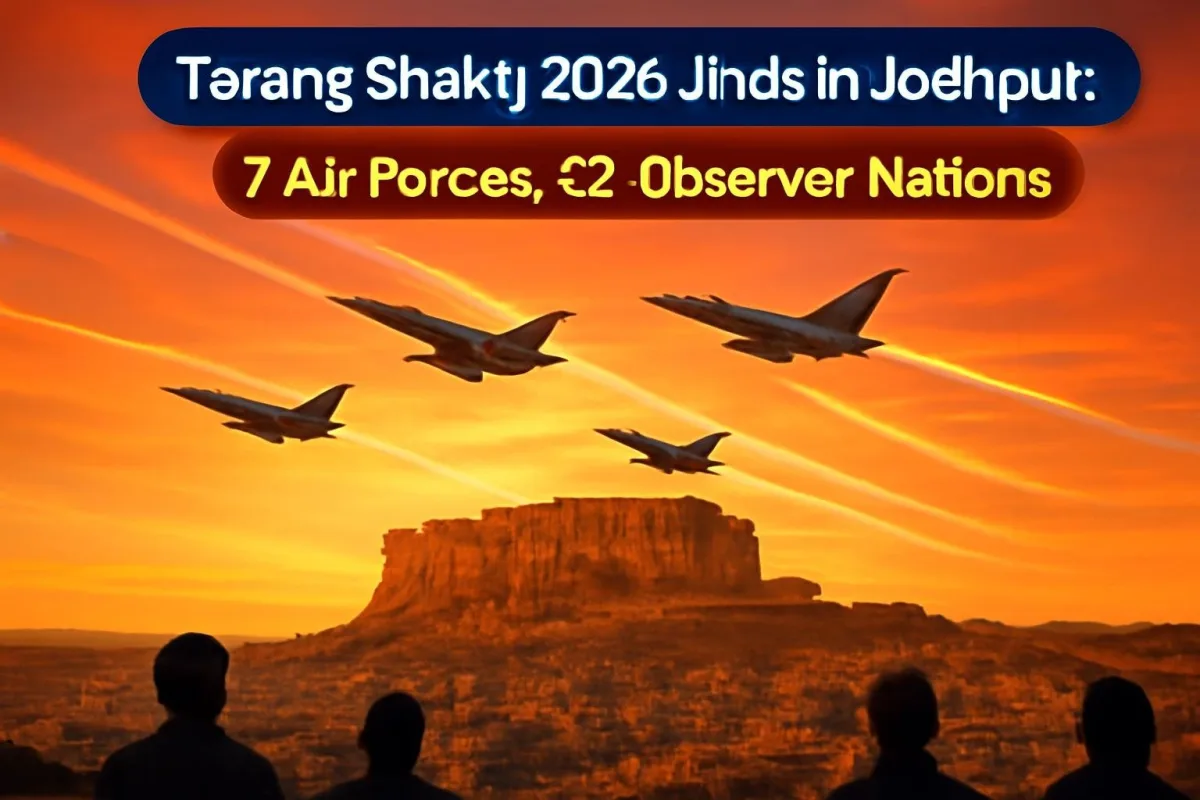
The skies over western Rajasthan have finally gone quiet. Exercise Tarang Shakti 2026, the Indian Air Force's biggest multinational air exercise, concluded at Air Force Station Jodhpur on October 12 after more than two weeks of combined flying. Seven partner air forces flew alongside the IAF, while 32 countries sent observers, the Ministry of Defence said in a statement on Monday.
Held under the theme "Power in Partnership", the second edition ran from September 26 to October 12 and coincided with the IAF's 94th anniversary.
Who Took Part
The seven "friendly foreign countries" that sent contingents were Australia, Bangladesh, France, Germany, Sri Lanka, the United Arab Emirates and the United States. Their aircraft ranged from frontline fighters to heavy transport and air-to-air refuelling tankers.
| Key Fact | Detail |
|---|---|
| Exercise | Tarang Shakti 2026 (second edition) |
| Host | Indian Air Force |
| Main base | Air Force Station Jodhpur, Rajasthan |
| Dates | September 26 to October 12, 2026 |
| Theme | Power in Partnership |
| Participating air forces | Australia, Bangladesh, France, Germany, Sri Lanka, UAE, USA |
| Observer nations | 32 |
| Indigenous platforms showcased | LCA Tejas, LCH Prachand |
| Open Day visitors | Over 20,000 |
The Aircraft in the Sky
Reports ahead of the exercise said the US contingent brought the F-35 Lightning II, while France flew Rafale jets supported by A400M transport aircraft and an MRTT tanker. The UAE fielded F-16s, Bangladesh sent a C-130J, and Australia and Germany contributed transport aircraft. On the Indian side, Rafale, Su-30MKI, Mirage-2000, Jaguar, MiG-29 and Tejas fighters were part of the mix.
What the Exercise Involved
Over the two-plus weeks, crews flew complex joint missions covering counter-air operations, air defence, reconnaissance, airlift and air-to-air refuelling. The goal was simple to state but hard to achieve: get pilots, mission planners and ground crews from very different air forces to plan and fly together smoothly.
The ministry noted that the exercise went well beyond flying. Foreign contingents went on industrial tours to see India's growing aerospace and defence manufacturing base, joined yoga sessions and heritage visits, and swapped cultures at an International Night. An Open Day at Jodhpur drew more than 20,000 visitors, many of them students, who got a close look at the aircraft and the people who fly them.
Defence Minister Rajnath Singh visited Jodhpur on October 10 for key events of the exercise. Addressing the gathering, he said the global security order is changing fast and that India's armed forces are going through a fundamental transformation guided by self-reliance. "Atmanirbhar Bharat does not mean isolating India from the world," he said, explaining that it means building the capacity at home to design, build, maintain and upgrade critical defence technology.
Why Tarang Shakti Matters for India
Lessons from Operation Sindoor: The ministry linked the exercise directly to the role of air power in Operation Sindoor, saying it showed the IAF's ability to carry out precise and calibrated operations. Multinational drills like this help sharpen that edge by exposing crews to different tactics and procedures.
Made-in-India on display: The participation of the Tejas light combat aircraft and the Prachand light combat helicopter gave partner nations a first-hand look at Indian-designed platforms, which matters as India pushes to grow defence exports.
Diplomacy in the air: With 32 observer nations in attendance, Tarang Shakti has quickly become one of the region's most watched air exercises, signalling India's growing role as a security partner.
Why Jodhpur?
Jodhpur is one of the IAF's most important bases in the western sector. Its vast desert airspace, clear weather for most of the year and long runways make it ideal for large-package air exercises involving dozens of aircraft from different countries. The base has also hosted several bilateral drills with partner air forces in the past.
How It Has Grown Since 2024
The first edition in 2024 was held in two phases, at Sulur in Tamil Nadu and at Jodhpur. This year's edition was concentrated at Jodhpur and adjoining bases, and drew a larger observer group, a sign of growing global interest in training with the IAF.
What Happens Next
Foreign contingents will now fly back to their home bases, while the IAF studies the lessons learned. With the exercise establishing itself as a regular fixture, planning for the next edition is expected to begin soon, and more partner air forces could be invited to fly in it.




Comments (0)