
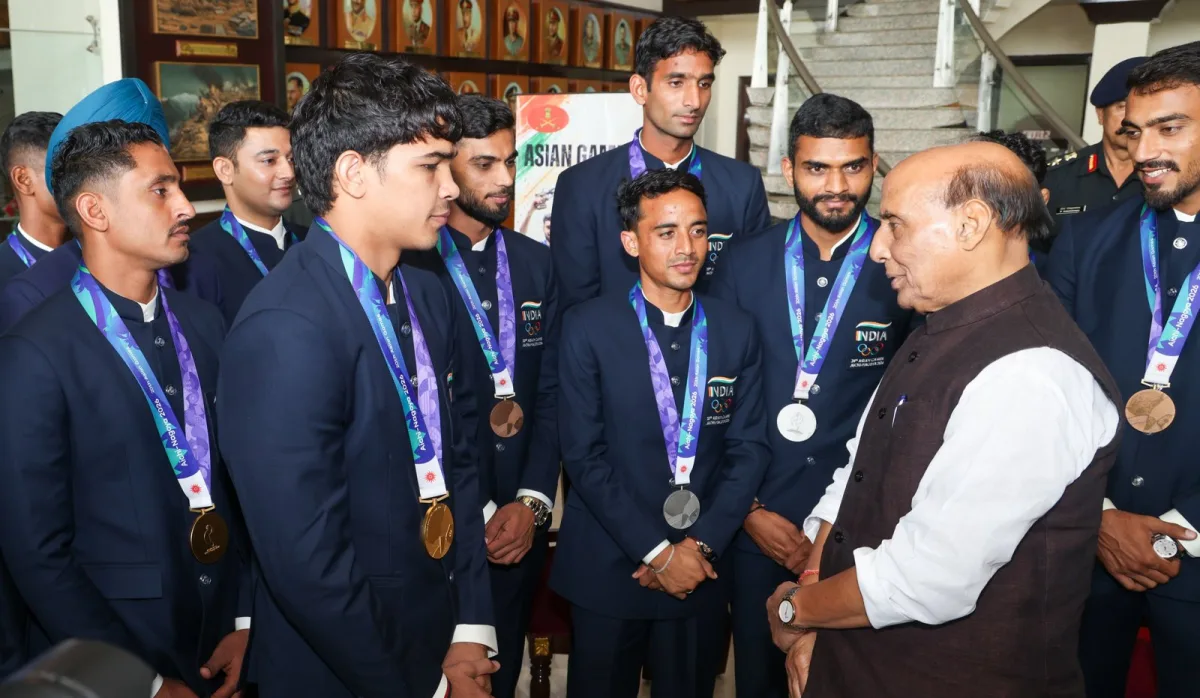
Defence Minister Rajnath Singh on Monday (October 12) honoured the soldier-athletes of India's armed forces who brought home a record 27 medals from the 2026 Asian Games in Japan. At a felicitation event in New Delhi, he credited their success to discipline and grit, and set a clear next target: a bigger, better-planned push for the Los Angeles 2028 Olympics.
The services haul of six gold, 11 silver and 10 bronze is the best ever by India's military athletes at the continental Games. It also made up nearly a third of India's overall tally of 85 medals, which helped the country finish fourth on the medal table.
A record that carried India's medal table
According to the Defence Ministry, 92 athletes from the Army, Navy and Air Force competed across 19 disciplines at the Games, hosted by Japan's Aichi-Nagoya region. India's full contingent won 21 gold, 27 silver and 37 bronze medals.
Put simply, roughly one in every three Indian medals at these Games was won by someone in uniform. The services' share came to about 32 per cent of the total and 28.57 per cent of India's golds – six of the 21. The Indian Army alone accounted for 20 of those medals, its best showing at an Asian Games, with its gold count doubling from the 2023 Hangzhou edition.
| Event | Felicitation of services medal winners, 2026 Asian Games |
| Date and venue | October 12, 2026, New Delhi |
| Services medals | 27 (6 gold, 11 silver, 10 bronze) |
| Services athletes | 92 across 19 disciplines |
| India's total | 85 medals (21 gold, 27 silver, 37 bronze), 4th place |
| Services share | About 32% of all medals, 28.57% of golds |
| Present | Rajnath Singh, Pralhad Joshi, Army chief Gen Dhiraj Seth |
The stand-out performers
Several of the medals were history-making, not just podium finishes.
Neeru Dhanda: trap shooting's new benchmark
Naib Subedar Neeru Dhanda was the star of the group with two gold medals and a silver. She became the first Indian woman to win gold in the women's trap event at the Asian Games – a breakthrough in a discipline where India has long chased consistency on the continental stage.
Gulveer Singh: three individual medals
Distance runner Naib Subedar Gulveer Singh won two silvers and a bronze. That made him the first Indian male track-and-field athlete to collect three individual medals at a single edition of the Asian Games.
Sawan Barwal ends a 44-year wait
Havildar Sawan Barwal's silver in the men's marathon came with a national record of 2:11:37. More importantly, it ended India's 44-year wait for an Asian Games marathon medal.
Sarvesh Kushare clears a 56-year gap
Naib Subedar Sarvesh Kushare also delivered a landmark result, winning India's first men's high jump medal at the Games in 56 years.
What Rajnath Singh told the athletes
Speaking to the medal winners, the Defence Minister said the journey to a podium is built on early-morning training, gym sessions, injuries and recovery, and the hard balance between unit duties and sporting preparation – often while living far from family.
He also had a message for those who competed but came home without a medal. Real defeat, he said, lies only in giving up, and every participant had in some way made the country and the forces proud.
Rajnath Singh singled out the Army's Mission Olympic Wing for spotting talent early and giving athletes scientific training and world-class facilities. He also thanked coaches, support staff, physiotherapists, nutritionists and families, stressing that no champion is made alone. Union Minister Pralhad Joshi and Chief of the Army Staff General Dhiraj Seth were among those present.
Why it matters for Indian sport
The services have always been a backbone of Indian athletics, boxing, shooting and rowing, but this edition showed how central they have become. When a third of a national medal tally comes from one system, it says something about the value of structured, full-time support – steady jobs, coaching, nutrition and sports science under one roof.
For young athletes in smaller towns, the forces remain one of the most reliable pathways to elite sport. Results like these are likely to strengthen the case for expanding that model, and for more civilian programmes to borrow from it.
What happens next: the road to LA 2028
The minister called for a focused, systematic approach to the 2028 Los Angeles Olympics and urged coaches and support staff to keep guiding athletes with dedication and professionalism. He asked the athletes to set higher goals and aim for an even stronger showing in Los Angeles.
He also reiterated the government's stated aim of not just increasing participation, but establishing India as a leading force in world sport through better infrastructure, modern training facilities and more opportunities for athletes. The immediate test is a busy Olympic qualification cycle over the next two years – and the services, on this evidence, will again be carrying a big share of India's hopes.





Comments (0)