
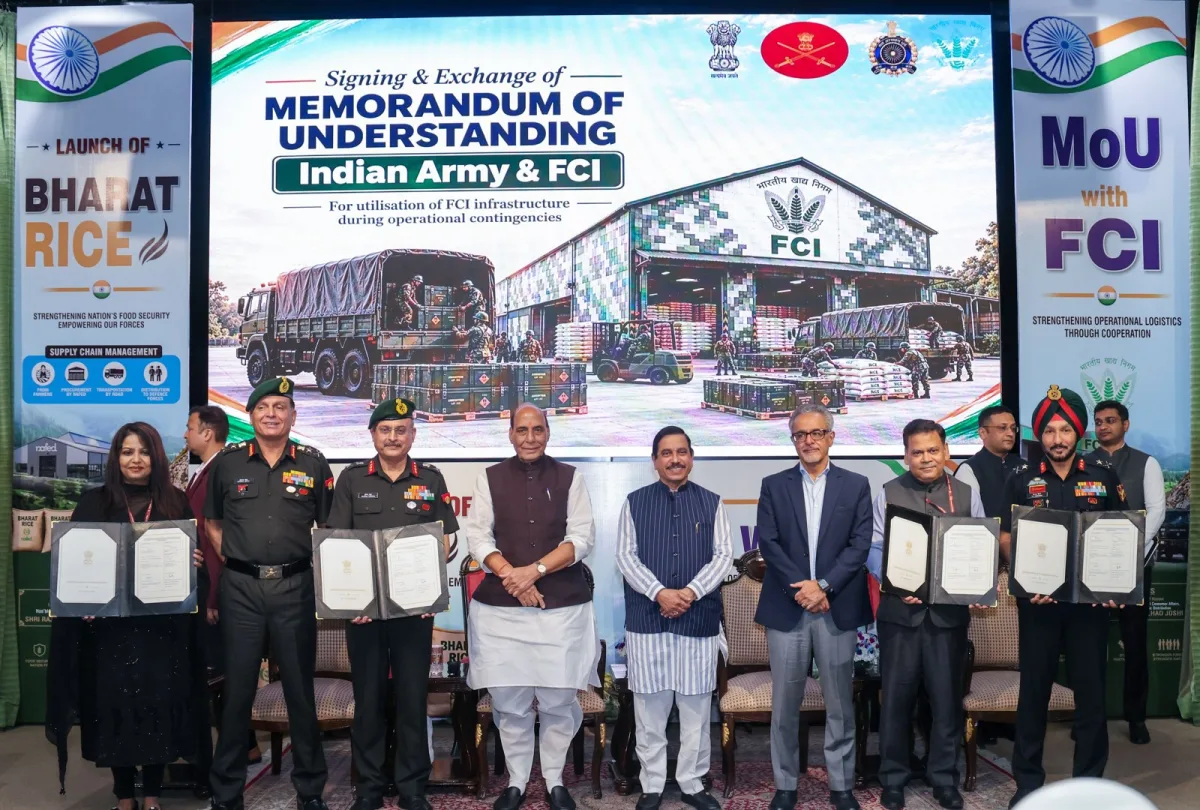
Soldiers posted at India's most remote outposts, from Ladakh to the North East, will soon be eating better-quality rice delivered straight to their supply depots. The Indian Army on Monday (October 12) launched "Bharat Rice" for its troops at the Manekshaw Centre in New Delhi, in the presence of Defence Minister Rajnath Singh and Union Food and Public Distribution Minister Pralhad Joshi.
At the same event, the Army signed a memorandum of understanding (MoU) with the Food Corporation of India (FCI) that lets it use FCI's warehouses, manpower and handling equipment during operational emergencies – a quieter but potentially more significant change for military logistics.
What is Bharat Rice?
Bharat Rice is a dedicated rice supply for soldiers, driven by the Army's Directorate General of Supply and Transport. The Defence Ministry says the initiative grew out of continuous feedback from troops and is aimed at improving the quality of rations.
Under the plan, paddy will be milled to set defence specifications and supplied through NAFED (the National Agricultural Cooperative Marketing Federation of India) during the financial year 2026-27. The rice will go through quality checks and is meant to be free of foreign matter and adulteration, with a minimum of broken, damaged or discoloured grains.
Two practical changes stand out for troops on the ground:
- Direct delivery: The rice will be delivered directly to Army supply depots, including those in remote parts of Ladakh and the North East. Depots will no longer have to collect it from local FCI godowns.
- Smaller bags: It will be packed in 10 kg and 30 kg bags, which are far easier to lift and carry, especially at forward posts where rations are often moved by hand.
The launch follows about 18 months of coordination between the Army, FCI, NAFED and the Department of Food and Public Distribution.
| Initiative | Bharat Rice for Indian Army troops |
| Launched | October 12, 2026, Manekshaw Centre, New Delhi |
| Supplied through | NAFED, during FY 2026-27 |
| Packaging | 10 kg and 30 kg bags |
| Delivery | Directly to Army supply depots, incl. Ladakh and North East |
| FCI MoU validity | Five years, extendable by mutual consent |
| Prep time | About 18 months of inter-agency coordination |
The FCI pact: warehouses for wartime
The MoU with FCI gives the Army a formal framework to use identified FCI storage, labour and material-handling equipment when an operational contingency arises. Coordination will happen between the Army's supply and transport units and FCI's regional and divisional offices, and will be built into operational logistics plans.
In practice, this means extra storage space, faster movement and distribution of rations, stores and equipment, and the ability to stock supplies closer to operational areas at short notice. The Defence Ministry said lessons from several operations, including Operation Sindoor, showed the need for logistics that can kick in quickly and keep running for a long time.
What Rajnath Singh said
The Defence Minister described Bharat Rice as a bond of trust that starts in a farmer's field and ends on a soldier's plate, calling it an expression of the "Jai Jawan, Jai Kisan" spirit. The initiative may look small, he said, but it will bring real relief to soldiers who carry rations into remote and difficult terrain.
He argued that operational readiness depends not only on weapons but on a soldier's physical health, mental stability, morale and endurance, and called soldiers' welfare an integral part of national security. Modern wars, he said, are decided as much by supply chains, storage and transport networks as by the frontline – and the strategic analysis of Operation Sindoor suggests warning times in future conflicts could be very short.
Comparing it to fighter jets landing on expressways and Border Roads Organisation roads serving local residents, he said FCI godowns would now also become part of the Army's supply chain – a "dual-use" approach to national infrastructure. Pralhad Joshi said it was a matter of pride for his department to provide high-quality rice to the soldiers who defend the country.
Why this matters
Rice is a staple for a large part of the Army, and complaints about ration quality in far-flung posts have surfaced for years. Better grain, sensible bag sizes and direct delivery address the everyday side of soldiering that rarely makes headlines.
The FCI deal is the bigger strategic story. FCI already runs one of the largest food storage networks in the country, including modern silos and warehouses in strategically important regions. Plugging that network into military planning gives the Army ready-made capacity without building new depots from scratch.
What happens next
Supplies under Bharat Rice will roll out through NAFED over the rest of 2026-27, with quality checks built into the chain. The Army has also taken other recent steps on rations, including extra rations for Agniveers and bringing ration scales on par across the three services, while the introduction of organic rations has been suggested. How smoothly the first deliveries reach high-altitude depots this winter will be the real test.



Comments (0)