
Defence Minister Rajnath Singh launched a sharp attack on the Congress and its allies on Friday, October 16, accusing them of trying to engineer a "Bangladesh-style" regime change in India by turning young people's anger over the electoral roll revision into street confrontation. Speaking to reporters in Lucknow, the senior BJP leader said the youth of the country were being used as pawns in what he called the politics of anarchy.
His remarks come as Delhi braces for another day of protests demanding the removal of Chief Election Commissioner Gyanesh Kumar, with prohibitory orders in force around Connaught Place.
What Rajnath Singh said
Rajnath Singh alleged that the Congress and parties allied with it, both directly and through organisations backing them, were trying to channel the energy of young Indians into political confrontation. He claimed that some opposition figures had openly said at press conferences that they drew inspiration from Bangladesh for regime change – a reference to the 2024 uprising in Dhaka that ended Sheikh Hasina's government.
According to the minister, such talk showed the agitation was not really about electoral reform or the Special Intensive Revision (SIR) of voter lists. He described it as a bid to grab power by spreading disorder and to weaken the country's democratic institutions. Constitutional bodies, he said, cannot be sacrificed for political interests, and democracy does not permit attacks on institutions.
Turning to Leader of Opposition Rahul Gandhi, Singh said he should respect the people's mandate and introspect on his political role. The country, he added, needed to choose dialogue and nation-building over confrontation.
Key facts at a glance
| Who | Defence Minister Rajnath Singh (BJP) |
| Where | Press conference in Lucknow, Uttar Pradesh |
| When | Friday, October 16, 2026 |
| Target | Congress, INDIA bloc allies and Rahul Gandhi |
| Core allegation | Using youth protests to push "Bangladesh-style" regime change |
| Protest issue | SIR of electoral rolls and demand to remove CEC Gyanesh Kumar |
| Delhi situation | Section 163 BNSS orders around Connaught Place; traffic curbs from 3 pm |
Background: why Delhi is on edge
Over the past week, opposition parties, student groups and civil society organisations have staged protests in the capital alleging irregularities in the SIR of electoral rolls. They argue the exercise lacks transparency and could knock eligible voters off the lists. The protests have increasingly focused on the Chief Election Commissioner, with demonstrators demanding Gyanesh Kumar's resignation.
A new outfit, the Cockroach Janta Party (CJP), has emerged as one of the more visible faces of the street protests. Two of its leaders were sent to judicial custody after entering Jantar Mantar on October 13, and its founder Abhijeet Dipke and other activists were detained near the same spot on October 14 before being released. The CJP called a "Lehra do Tiranga" flag march at Central Park in Connaught Place for Friday.
The New Delhi Municipal Council said Central Park would stay closed on Friday and Saturday for administrative reasons, while Delhi Police said Connaught Place is not a designated protest site. Prohibitory orders under Section 163 of the Bharatiya Nagarik Suraksha Sanhita, which bars large gatherings, are in force, and traffic restrictions around Connaught Place were announced from 3 pm. Police said they could allow a small group to wave the flag and sing the national anthem at a suitable location. Dipke hit back by asking why the police had a problem with people waving the Tiranga.
The legal track
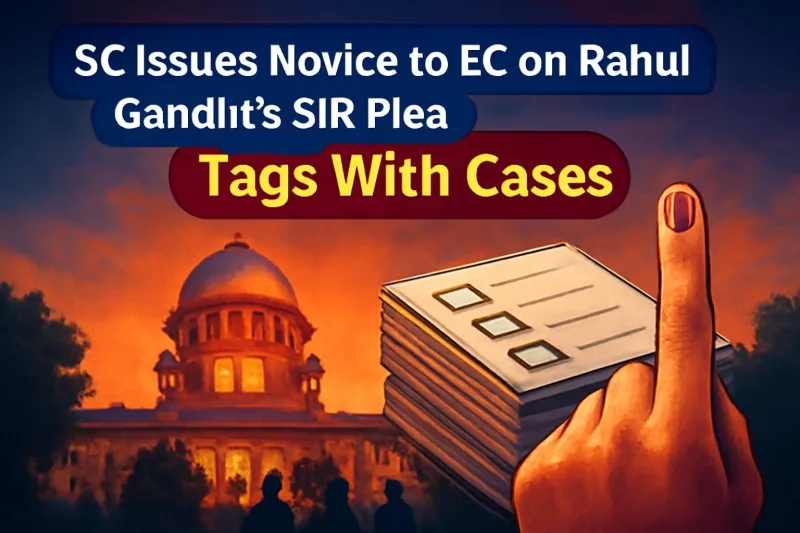
The political fight is running alongside a legal one. On Thursday, the Supreme Court issued notice to the Election Commission on a plea filed by Rahul Gandhi over the SIR and tagged it with similar pending cases. Rajnath Singh referred to the court's observations to argue that respect for the law is essential to maintain order.
What it means for readers
The war of words marks a clear escalation. By invoking Bangladesh, the BJP is framing the protests as a threat to stability rather than a debate over voter lists, while the opposition insists it is defending citizens' right to vote. With elections due in several states, including Uttar Pradesh in 2027, the battle over who gets counted on the electoral rolls is likely to stay at the centre of national politics. At the time of writing, the Congress had not issued a formal response to the defence minister's remarks.
What happens next
All eyes are now on Friday's flag march in Delhi and how police handle it. The Supreme Court hearings on the SIR petitions will also shape the next phase of the dispute, while the Election Commission has separately announced a Special Summary Revision of rolls in 17 states and Union Territories, with draft rolls due on November 12.
Comments (0)