
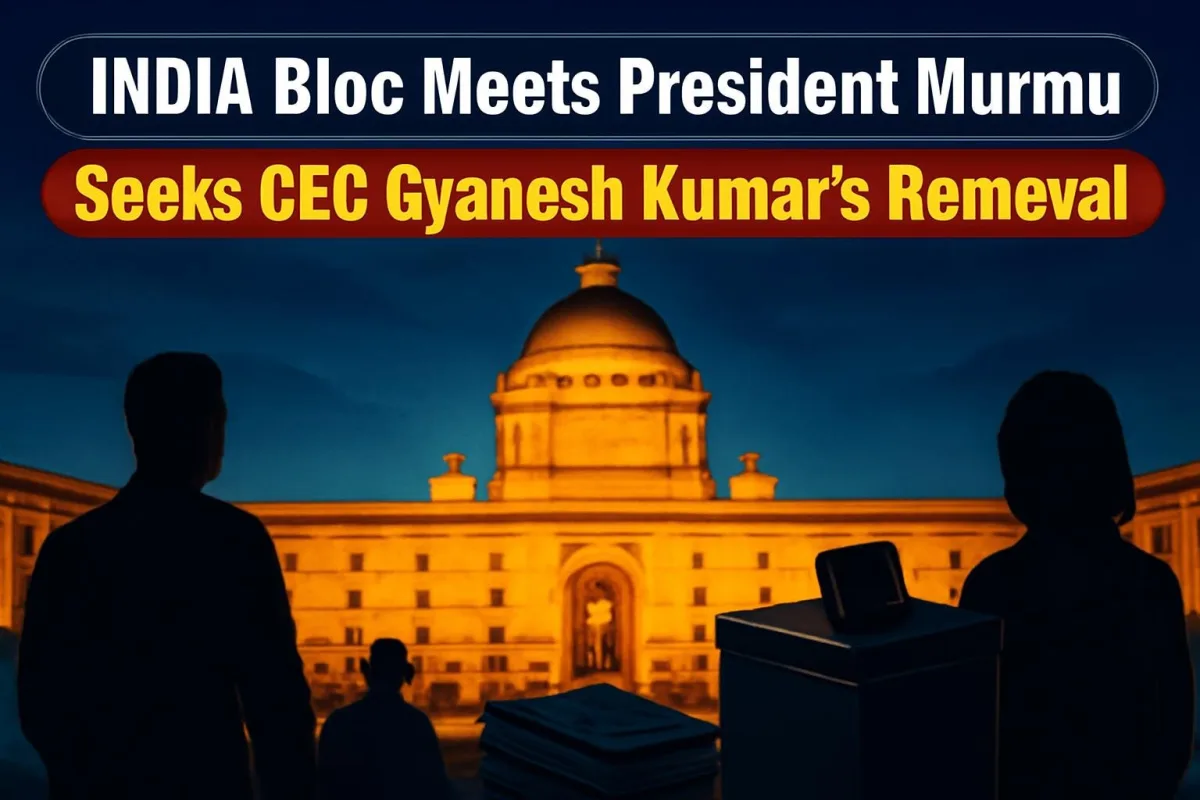
The opposition's week-long battle with the Election Commission reached Rashtrapati Bhavan on Friday night. A ten-member INDIA bloc delegation led by Congress president Mallikarjun Kharge and Lok Sabha Leader of Opposition Rahul Gandhi met President Droupadi Murmu around 8 pm on October 9 and handed her a memorandum seeking the removal of Chief Election Commissioner Gyanesh Kumar. Within hours, the meeting itself had become a fresh flashpoint, with Rahul Gandhi's account of what the President said drawing a sharp rebuttal from the BJP.
Who Met the President
The delegation was one of the broadest the opposition has fielded this year. Alongside Kharge and Rahul Gandhi, reports named Trinamool Congress chief Mamata Banerjee, CPI(M) general secretary M.A. Baby, CPI general secretary D. Raja, Samajwadi Party's Rajeev Rai, NCP (SP) leader Supriya Sule, Jammu and Kashmir Chief Minister Omar Abdullah, RJD's Manoj Jha and VCK chief Thol. Thirumavalavan. The appointment was confirmed by the President's office on Friday morning, after three straight days of street protests by opposition MPs in the capital.
Before the meeting, opposition leaders marched from Parliament towards the Election Commission but were stopped by Delhi Police at Vijay Chowk, where they staged a sit-in. Priyanka Gandhi Vadra, K.C. Venugopal, Gaurav Gogoi and Mahua Moitra were among those present.
What the Memorandum Demands
The joint memorandum puts the Special Intensive Revision (SIR) of electoral rolls at the centre of the opposition's complaint. Accounts shared by different leaders vary slightly in wording, but the core demands reported across outlets are:
- Removal of CEC Gyanesh Kumar over what the opposition calls "vote chori" (vote theft) during the SIR process.
- Suspension of the SIR and restoration of voters' names the opposition says were wrongly deleted from the rolls.
- A return to paper ballots in place of electronic voting machines.
- Wider electoral reforms, including, according to some leaders, a review of recent election results and of the 2023 law governing the appointment and protection of election commissioners.
Trinamool MP Derek O'Brien briefed reporters on the memo after the meeting and said the bloc would continue its agitation until its demands were addressed.
Rahul Gandhi's Account Sparks a Row
Speaking outside Rashtrapati Bhavan, Rahul Gandhi described the meeting as "unbelievable". He said he had expected the President to deny that vote theft was happening, but that she did not dispute the delegation's points and instead asked them to provide proof of "election chori". He added that the bloc would submit its evidence. Kharge said the President listened attentively and indicated she would look into the matter, while Mamata Banerjee said the delegation had agreed to send supporting material.
No statement was issued by the President's office on the contents of the meeting, and the Election Commission did not respond publicly to the memorandum on Friday.
BJP Calls the Claim "a Lie"
The BJP hit back the same evening. Party spokesperson and Rajya Sabha MP Sudhanshu Trivedi called Rahul Gandhi's version of events "unfortunate and bizarre" and said, "He is lying." Trivedi accused the Congress leader of turning every constitutional body into a victim of his politics and said the claim "reeks more of politics than truth". The exchange means the Election Commission dispute has now pulled the office of the President into a political slanging match, something both sides usually avoid.
| Key Fact | Details |
|---|---|
| Date and time | Friday, October 9, 2026, around 8 pm |
| Venue | Rashtrapati Bhavan, New Delhi |
| Delegation size | 10 INDIA bloc leaders |
| Led by | Mallikarjun Kharge and Rahul Gandhi |
| Main demand | Removal of CEC Gyanesh Kumar |
| Linked issue | Special Intensive Revision (SIR) of electoral rolls |
| BJP response | Sudhanshu Trivedi called Rahul's account "a lie" |
| Next protest | Jantar Mantar, Delhi, October 10 |
Why This Matters for Voters
For ordinary voters, the dispute is about something very practical: whether their names are on the electoral roll. The SIR is meant to clean up voter lists by removing duplicate, dead or shifted entries, but the opposition argues that the exercise has struck off genuine voters on a large scale. The Election Commission has maintained that its orders have legal backing and that internal differences among commissioners, which have been reported in the media, are part of normal decision-making.
The President has no direct power to sack the Chief Election Commissioner. Under the Constitution, the CEC can be removed only in the manner and on the grounds applicable to a Supreme Court judge, which requires a motion passed by a special majority in both Houses of Parliament. That is why some opposition leaders have also floated the idea of an impeachment-style motion, though the numbers in Parliament make that an uphill task.
What Happens Next
The street pressure continues on Saturday. The Cockroach Janta Party and student groups including AISA have called a protest at Jantar Mantar on October 10. Delhi Police have refused permission for the gathering, citing short notice and law-and-order concerns, and heavy deployment is expected around central Delhi, with some Metro stations and trains affected. The INDIA bloc says it is compiling the evidence the President asked for, and the next test will be whether that dossier is formally submitted and how Rashtrapati Bhavan and the Election Commission respond.

Comments (0)