
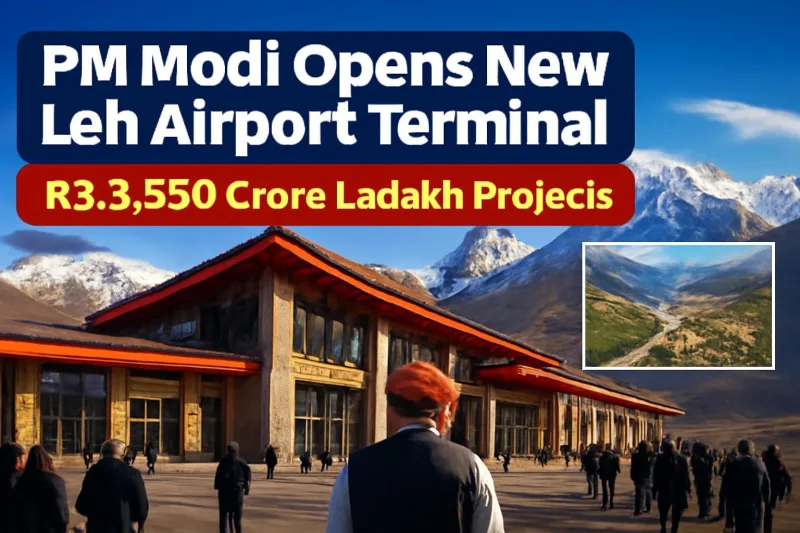
The next round of talks between the Centre and Ladakh's two main civil society groups will be held in Leh on October 15, with the powers of a proposed elected body and constitutional safeguards for the Union Territory at the top of the agenda. A high-level team from the Ministry of Home Affairs (MHA) will travel to Leh to meet leaders of the Leh Apex Body (LAB) and the Kargil Democratic Alliance (KDA), with the sub-committee meeting shifting from New Delhi to Leh this time.
What is on the table
The core question is how Ladakh will be governed. Since it became a Union Territory without a legislature in 2019, groups in both Leh and Kargil have been demanding a democratic set-up and protection for land, jobs and culture. At the October 15 meeting, both sides are expected to focus on the shape of a UT-level elected body and the safeguards it would come with.
According to reports, the MHA panel may present a draft proposal, especially on safeguards under a possible new Article 371K. Such a provision could create a special model for Ladakh, giving an elected body legislative, financial and executive powers over subjects like land, culture, language, forests, natural resources and the environment. Any final agreement would need a constitutional amendment passed by Parliament.
Ladakh talks: key facts
| Date | October 15, 2026 |
| Venue | Leh, Ladakh |
| Centre | Ministry of Home Affairs sub-committee |
| Ladakh groups | Leh Apex Body (LAB) and Kargil Democratic Alliance (KDA) |
| Main agenda | Powers of a UT-level elected body, Article 371-style safeguards |
| Previous round | September 9, 2026, New Delhi |
| Pending task | Written replies to nine MHA queries |
Where the talks stand
The dialogue has moved forward in stages this year. At a meeting in New Delhi on May 22, LAB and KDA reached an in-principle understanding with the Centre on three broad points: restoring democracy in Ladakh, constitutional safeguards modelled on Articles 371A, 371F and 371G (which cover Nagaland, Sikkim and Mizoram), and a UT-level elected body with real powers.
The September 9 sub-committee meeting in Delhi went a step further. Both sides agreed that the new body would be directly elected by the people, rather than made up of members from Ladakh's hill councils. The Ladakh administration also shared a draft seeking views on the formal name of the new legislative and executive bodies, how powers would be divided between the hill development councils and the UT body, and which district-level functions should stay local.
The MHA then sent nine questions to the Ladakh groups. LAB chairman Chering Dorjay Lakruk has said the body's answers are ready and were finalised with help from a legal adviser in New Delhi. He has also said LAB expects the government to share its own draft on the elected assembly and Article 371K at the Leh meeting.
What LAB and KDA want
LAB wants the new assembly to be modelled on Puducherry, including control over the home department and police. The KDA, led by figures such as Sajjad Kargili, has pushed the MHA to put a full draft of the UT-level body on the table, with legislative, financial and executive powers spelled out, and has asked that there be no further delay.
Climate activist Sonam Wangchuk, Ladakh Buddhist Association president Gelong Stanzin Dorjay, Ladakh's Lok Sabha MP and leaders of the Kargil Hill Development Council are among those expected to be part of the discussions, according to reports.
Why these talks matter
Ladakh is one of India's most strategically sensitive regions, sharing borders with both China and Pakistan. It is also ecologically fragile, and many residents fear that without legal protection, outside investment and large projects could change the region's land ownership and environment. The anger over these issues turned tragic on September 24, 2025, when protests in Leh turned violent and four people were killed. The anniversary was marked last month with markets shut across the town.
For people in Ladakh, a working agreement could mean an elected government that answers to them on everyday matters such as jobs, land use and local development. For the Centre, a deal would bring political stability to a frontier region where trust has been badly shaken.
The hill council question
Another issue in the background is local self-government. The UT administration has notified seven district hill development councils, up from just two in Leh and Kargil. The Kargil council currently has an elected body, but the Leh council's term ended in October last year. How powers are shared between these councils and a new UT-level body is one of the details still to be worked out.
What happens next
If the MHA does present a draft at the Leh meeting, the Ladakh groups are likely to take it back to their members before giving a formal response. Key details such as the name of the new body, the number of seats and the exact list of its powers have not yet been made public. Even after an agreement, the plan would need a constitutional amendment and a law in Parliament before Ladakh votes for its new elected body. For now, October 15 is being seen as a crucial test of whether months of dialogue can turn into a concrete blueprint.
Comments (0)