
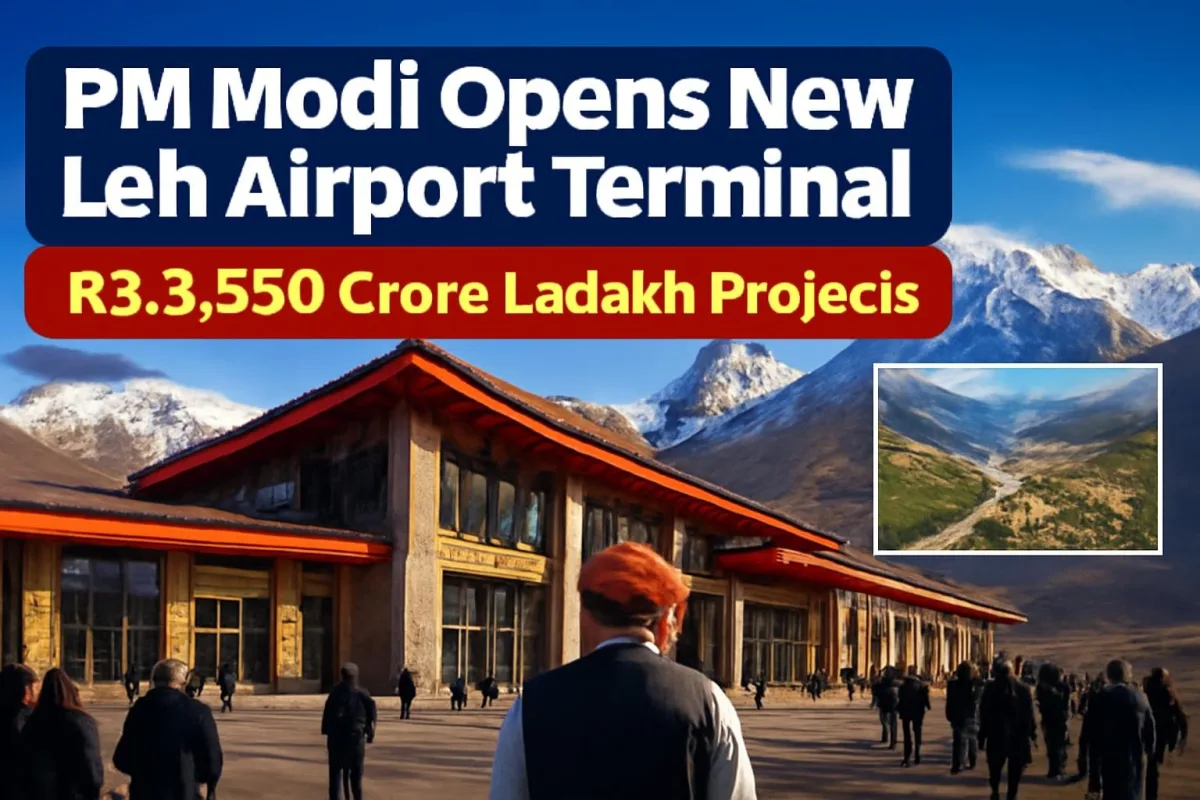
Ladakh got a new airport terminal, an all-weather alternative road link to the rest of India and a set of power, water and heritage projects on Thursday, October 15, as Prime Minister Narendra Modi inaugurated and dedicated projects worth about Rs 3,350 crore in the Union Territory via video conference. Calling it "a big day for Ladakh", the Prime Minister said the projects would make travel easier and give fresh momentum to development in the high-altitude region.
The centrepiece is the new passenger terminal at Kushok Bakula Rimpochee Airport in Leh, which more than triples the airport's annual passenger capacity, and the 298-km Nimmu-Padum-Darcha road through the Zanskar Valley.
New Leh airport terminal: bigger, greener, built for the cold
Leh's airport is the main gateway to Ladakh for tourists, residents and the armed forces, and its old terminal had long struggled with peak-season crowds. The new terminal, built at a cost of over Rs 600 crore, spreads across about 23,800 square metres and can handle 35 lakh (3.5 million) passengers a year, compared with around 10 lakh earlier.
The building is designed for Ladakh's harsh winters. PM Modi described it as the country's first terminal to combine geothermal heating with solar energy, and its architecture includes elements of Ladakh's Buddhist cultural heritage. For travellers, this should mean more flights, less crowding and a more comfortable wait at one of the world's highest commercial airports.
Nimmu-Padum-Darcha road: Zanskar opens up
The second big project is the 298-km Nimmu-Padum-Darcha road, built by the Border Roads Organisation at a cost of around Rs 2,500 crore. It links Nimmu near Leh with Darcha in Himachal Pradesh, passing through Padum in the remote Zanskar Valley and over the high Shinkun La pass.
The road gives Ladakh a third road connection to the rest of the country, in addition to the Srinagar-Leh and Manali-Leh highways. According to the Prime Minister, it can cut some journeys that used to take 12 hours to about three hours. Besides faster military movement in a sensitive border region, it is expected to give Zanskar's villages much easier access to hospitals, schools and markets.
Power, water and a petroglyph park
The package also includes projects that may matter more to Ladakhis in their everyday lives:
- Hanu hydro project: The 9 MW Hanu Small Hydroelectric Project, along with the 66 kV double-circuit Dah-Hanu-Khaltsi transmission line, to improve power supply and grid reliability.
- Project Him Sarovar: 40 water bodies in 40 villages, aligned with Mission Amrit Sarovar, to store snowmelt and release it for irrigation during the sowing season, when shortages are common.
- Petroglyph Conservation Park: India's first such park, at Sindhu Ghat in Leh, to protect prehistoric rock carvings and promote responsible heritage tourism.
Key facts at a glance
| Date | Thursday, October 15, 2026 |
| Total value | About Rs 3,350 crore |
| Airport terminal | 23,800 sq m, 35 lakh passengers a year |
| Airport | Kushok Bakula Rimpochee Airport, Leh |
| Road | Nimmu-Padum-Darcha, 298 km, built by BRO |
| Hydropower | 9 MW Hanu Small Hydroelectric Project |
| Water bodies | 40 under Project Him Sarovar |
| Heritage | Petroglyph Conservation Park, Sindhu Ghat |
What PM Modi said
The Prime Minister said the government's effort was to build modern infrastructure in Ladakh while taking full care of its fragile environment. He spoke about developing the region as a hub for winter and adventure tourism, and said more than 40 border settlements are being upgraded under the Vibrant Villages Programme. He noted that the number of homestays in the region has grown from about 150 to nearly 3,000.
Modi also said a Centre of Excellence is being set up in Leh so that young people can get quality education and access to new technologies without having to leave Ladakh, and pointed to a new sports policy aimed at better training facilities. He highlighted the expansion of BharatNet and high-speed internet in remote areas.
What it means for travellers and residents
For tourists, the most visible change will be at Leh airport, where a bigger terminal should ease summer rush and make winter travel more comfortable. For residents of Zanskar, the new road could be life-changing, easing the isolation of a valley that has long depended on a few difficult routes, especially in winter. Better power and water storage will also help farmers in villages that depend on the short summer growing season.
What happens next
Airlines are expected to plan more services to Leh as capacity grows, and the new road should see civilian traffic grow over the coming seasons. The Centre's focus on Ladakh is also unfolding alongside its ongoing dialogue with the region's leaders on their demands, an issue that will continue to shape the political mood in the Union Territory, which was carved out of the former state of Jammu and Kashmir in 2019.




Comments (0)