
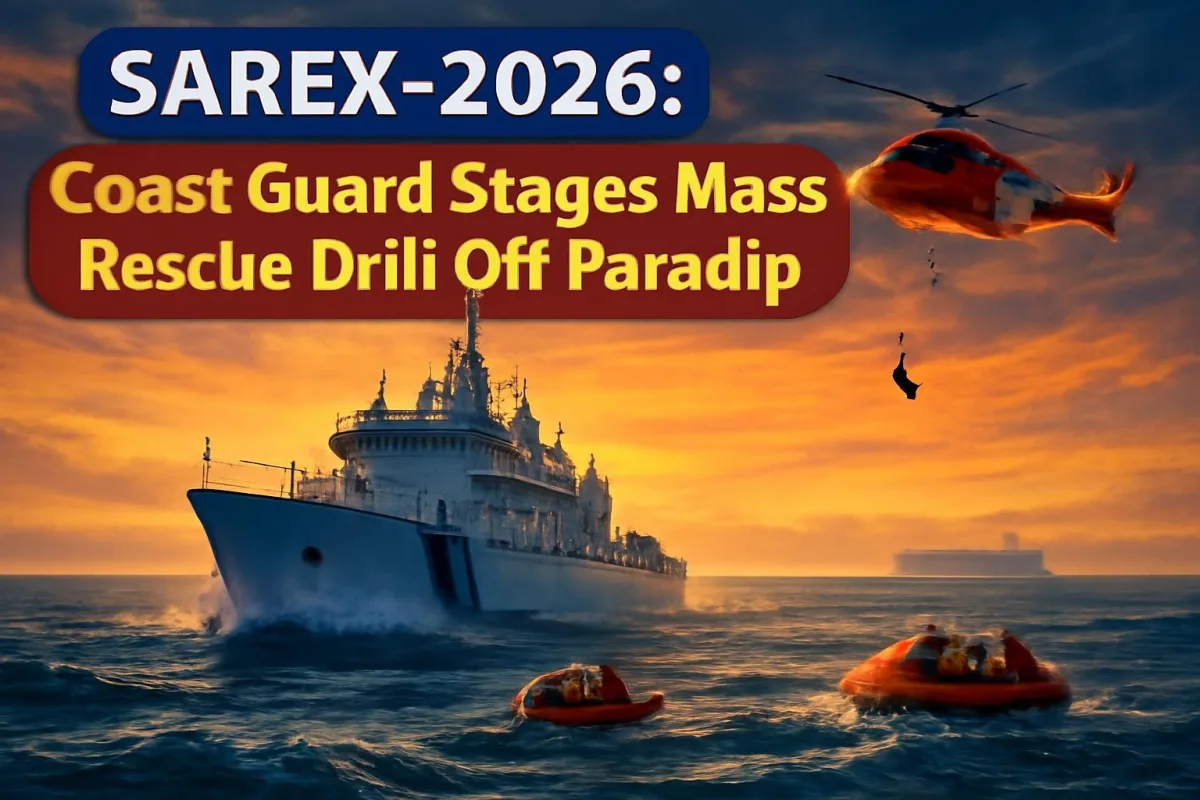
A passenger aircraft with 228 people on board ditches in the Bay of Bengal, slams into a container ship and sets it on fire. That was the scenario the Indian Coast Guard set for itself on Thursday, October 8, 2026, as it staged SAREX-2026, the 12th National Maritime Search and Rescue Exercise, off the coast of Paradip in Odisha. Ships, aircraft and helicopters from the Coast Guard, Navy and Air Force joined civil agencies in the drill, watched by delegates from 30 friendly countries.
Minister of State for Defence Sanjay Seth inaugurated the exercise at Paradip, saying it was meant to give "a new direction to maritime safety, coordination, and preparedness."
The scenario: two emergencies at once
Rescue exercises usually test one type of disaster at a time. SAREX-2026 deliberately combined two. In the simulation, the aircraft ditched near Paradip Port and its fuselage struck the container vessel MV Zumba, causing structural damage and a fire on board. Rescuers had to pull survivors out of the water, fight the fire and manage casualties at the same time, while different agencies competed for the same boats, helicopters and medical teams.
The goal was to test how quickly the Coast Guard can bring all available resources to one spot, how well the different services talk to each other, and whether standard operating procedures hold up under pressure.
Who took part
The exercise brought together one of the largest line-ups for a national rescue drill:
| Exercise | SAREX-2026 (12th National Maritime SAR Exercise) |
| Location | Off Paradip, Odisha, Bay of Bengal |
| Inaugurated by | MoS Defence Sanjay Seth |
| Coast Guard ships | 15 |
| Aircraft and helicopters | Coast Guard Dornier aircraft, ALH and Chetak helicopters; IAF C-130J and Mi-17 |
| Indian Navy | Two ships |
| Foreign participation | Delegates from 30 countries |
| Simulated scenario | Aircraft with 228 people ditches, hits container ship MV Zumba |
Civil and state agencies were also part of the drill, including the Shipping Corporation of India, the Directorate General of Shipping, Customs, the Fisheries department, Marine Police, the Paradip Port Authority and the Odisha state administration.
Board meeting and national rescue awards
On the eve of the exercise, the 24th meeting of the National Maritime Search and Rescue (NMSAR) Board was held under the chairmanship of Coast Guard Director General Paramesh Sivamani. The board reviewed preparedness across India's search and rescue region, which covers about 4.6 million square kilometres of the Indian Ocean, and discussed faster handling of distress alerts, vessel tracking and better coordination between agencies. The Director General stressed that lessons from past rescues and joint drills must translate into faster response at sea.
The National Maritime Search and Rescue Awards 2026 were also presented. Merchant vessels MV Jabal Ali 9 and MV Aisopos, fishing vessel IFB Joy Maa Kaliganga, Coast Guard Ship Sachet and the Beypore Coastal Police Station were among those honoured for rescue work.
Satellite help for distress alerts
Officials highlighted the progress of India's satellite-based distress alert system, which has moved from older low-earth and geostationary satellite systems to the newer MEOSAR network. The ISRO-supported MEOLUT ground system has reached full operational capability, which means distress beacons from ships, aircraft and fishing boats can be detected and located faster.
Why it matters for India
India's coastline and its vast search and rescue region see heavy traffic from merchant ships, fishing boats and flights crossing the Indian Ocean. Real emergencies are frequent: less than two weeks before the exercise, the Coast Guard responded to the flooding tanker MT Seagull 9 about 37 nautical miles from Paradip, sending a ship and a Dornier aircraft before a port tug towed the vessel to safety.
For fishermen in Odisha, Andhra Pradesh, West Bengal and Tamil Nadu, better coordination means a faster response when boats capsize during cyclones or engine failures. For India's diplomacy, hosting observers from 30 nations reinforces its image as a first responder in the Indian Ocean, in line with the government's SAGAR and MAHASAGAR maritime outreach.
What happens next
The Coast Guard will review the performance of each agency and update its procedures based on the findings. SAREX is held every two years, and lessons from this edition are expected to feed into regional cooperation with neighbouring coast guards in the Indian Ocean.




Comments (0)