
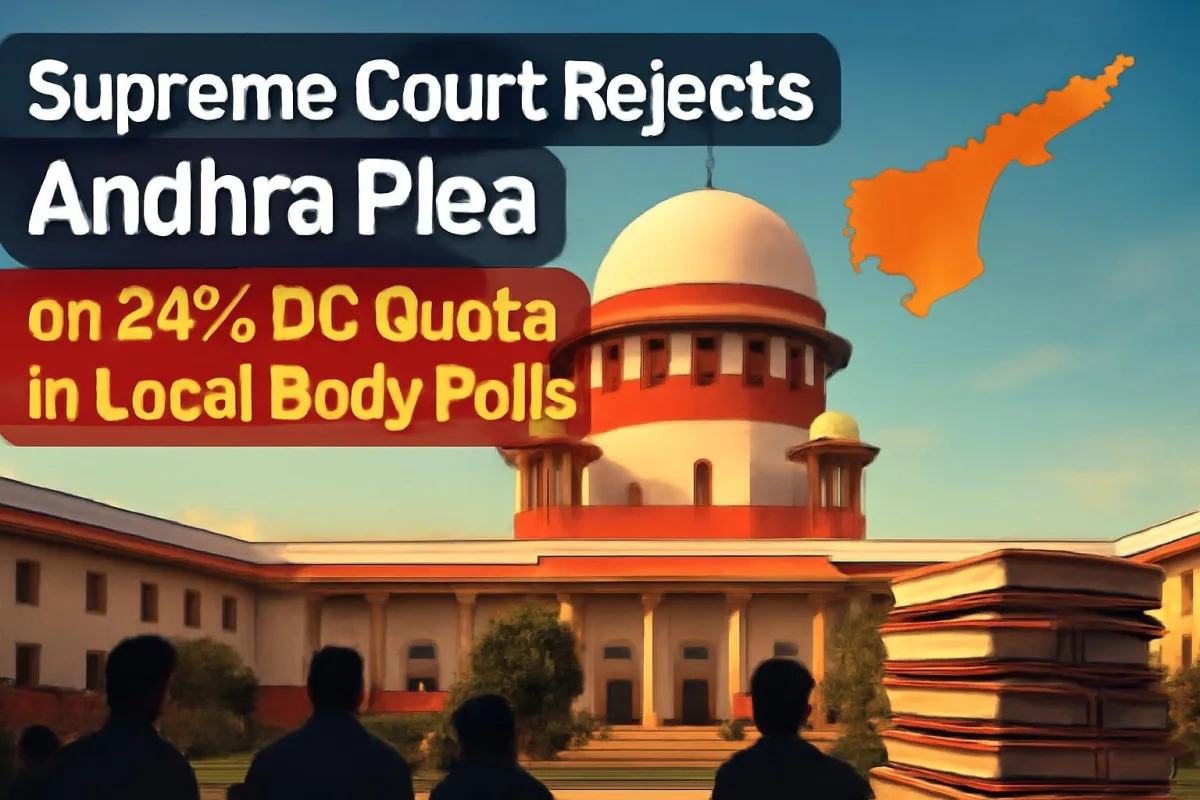
The Andhra Pradesh government's effort to give Backward Classes 34% reservation in local body elections has hit a wall in the Supreme Court. On Friday, 9 October, a bench of Justice Dipankar Datta and Justice Sheel Nagu dismissed the state's appeal against an Andhra Pradesh High Court order that had struck down the quota, leaving the government to rethink its plan just as the State Election Commission gets ready to announce polls.
What the Supreme Court said
The state had challenged the High Court verdict through a special leave petition, State of Andhra Pradesh v. Thandava Yogesh. Senior Advocate Mukul Rohatgi, appearing for Andhra Pradesh, argued that there was no reason for the High Court to treat the state's data as unreliable.
The bench was not convinced. Justice Datta asked the state to show how the data it relied on, drawn from a family survey, could be considered relevant for fixing local body reservations, and asked under what law the exercise had been carried out. He described the High Court's approach as "very reasonable" before the court declined to interfere.
Background: why the High Court struck down the quota
On 1 October, the Andhra Pradesh High Court set aside two government orders, G.O. Ms. No. 105 and G.O. Rt. No. 1065. Together they provided 34% reservation for BCs in rural local bodies and 33.33% in urban local bodies.
The High Court found that once Scheduled Caste, Scheduled Tribe and BC reservations were added up, the total crossed the 50% ceiling laid down by the Supreme Court in the 1992 Indra Sawhney judgment. It held that the state had not carried out the kind of rigorous empirical exercise needed to justify going beyond that limit, and questioned the data used to arrive at the 34% figure.
The case also turned on how far the state legislature's enabling power under Articles 243-D(6) and 243-T(6) of the Constitution, which allow reservation for backward classes in panchayats and municipalities, can stretch.
Key facts at a glance
| Court | Supreme Court of India |
| Bench | Justice Dipankar Datta, Justice Sheel Nagu |
| Date of ruling | 9 October 2026 |
| Case | State of Andhra Pradesh v. Thandava Yogesh |
| Orders quashed by High Court | G.O. Ms. No. 105 and G.O. Rt. No. 1065 (1 October 2026) |
| BC quota proposed | 34% rural bodies, 33.33% urban bodies |
| Main issue | Total reservation crossing the 50% ceiling without empirical data |
Political fallout: YSRCP targets Naidu government
The verdict quickly turned into a political fight. YSR Congress Party leaders and former ministers Chelluboyina Venugopala Krishna and Dharmana Prasada Rao, speaking in Rajahmundry, said the ruling exposed the coalition government's failure to build a legally sound framework for the quota.
They pointed out that 34% BC reservation was a promise in the ruling alliance's election manifesto and argued that the government knew about the 50% ceiling but did not complete the statutory and constitutional groundwork. Venugopala Krishna also asked why Chief Minister N. Chandrababu Naidu, an NDA partner, had not pushed Prime Minister Narendra Modi and Home Minister Amit Shah for constitutional protection for the quota.
Dharmana Prasada Rao demanded an apology to BC communities and called for a proper empirical survey by a legally constituted commission rather than household data collection. The YSRCP also demanded that local body elections be held with the promised 34% quota in place.
What it means for voters in Andhra Pradesh
For BC communities, who form a large share of the state's population, the ruling means the higher quota will not be in place unless the government builds a fresh, legally defensible case. For aspiring local leaders, it adds uncertainty about which seats will be reserved and for whom.
More broadly, the order is a reminder that states across India, including neighbouring Telangana, which has also been debating BC quotas in local bodies, need solid, purpose-built data before they cross the 50% line.
What happens next
With the Supreme Court refusing to step in, the High Court order stands. Reports suggest the State Election Commission is likely to announce the local body election schedule as early as next week. The government will now have to decide whether to go ahead with reservations within the 50% limit or begin a fresh, commission-led empirical study to justify a higher quota, which would take time.
Either way, the BC quota is set to be the dominant political issue as Andhra Pradesh heads into its local body elections.


Comments (0)