
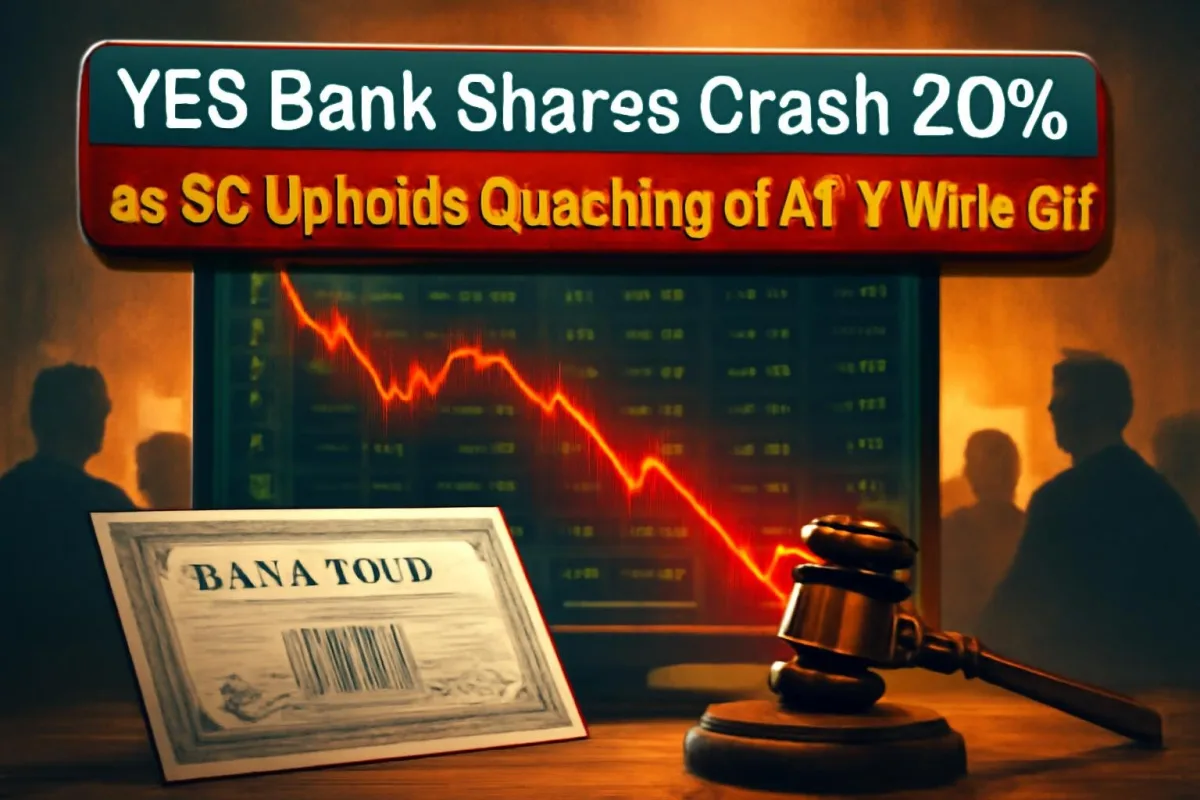
YES Bank shares crashed as much as 20% on Thursday, October 15, after the Supreme Court dismissed appeals against a Bombay High Court judgment that had quashed the bank's write-off of Rs 8,415 crore worth of Additional Tier-1 (AT-1) bonds during its 2020 rescue. The ruling by a Bench of Justices Dipankar Datta and Augustine George Masih is a major win for thousands of bondholders who saw their investments wiped out six years ago, and a serious headache for the private lender.
The appeals had been filed by YES Bank, the Reserve Bank of India and the Centre. The Bench said it had decided the matter on merits and found no reason to interfere with the High Court's January 2023 verdict.
YES Bank share price: what happened on Thursday
The stock went into freefall soon after the verdict. On the NSE, YES Bank hit an intraday low of Rs 16.96, down 20%, and was trading around 14% lower at Rs 18.21 in the last half hour of trade, eventually ending the session more than 14% down. The fall came on a day when the broader market rallied strongly, with the Sensex jumping more than 1,500 points, which made the sell-off in YES Bank stand out even more.
What are AT-1 bonds, and why were they written off?
AT-1 bonds are perpetual debt instruments that banks issue to shore up their core capital. They pay a higher interest rate than regular bonds because they carry more risk: under certain conditions, they can be written down if the bank runs into trouble.
YES Bank raised Rs 3,000 crore through such bonds in December 2016 and Rs 5,415 crore in October 2017, with coupon rates of 9.5% and 9%. In March 2020, as the bank's finances collapsed under bad loans and governance concerns, the RBI placed it under a moratorium and framed the YES Bank Reconstruction Scheme, 2020, under which State Bank of India and other lenders injected fresh capital. As part of that rescue, the AT-1 bonds worth Rs 8,415 crore were permanently written down to zero.
Many bondholders, including retail investors who said they had been sold these bonds as safe, fixed-return products, challenged the write-off. In January 2023, the Bombay High Court quashed it. The bank, the RBI and the government took the matter to the Supreme Court, which has now upheld the High Court's view.
Key facts at a glance
| Court | Supreme Court of India |
| Bench | Justices Dipankar Datta and Augustine George Masih |
| Date of ruling | Thursday, October 15, 2026 |
| Appeals by | YES Bank, RBI and the Centre |
| Amount involved | Rs 8,415 crore of AT-1 bonds |
| Bond issues | Rs 3,000 crore (Dec 2016), Rs 5,415 crore (Oct 2017) |
| Coupon rates | 9.5% and 9% |
| Share reaction | Intraday low Rs 16.96, down 20% |
| Earlier verdict | Bombay High Court, January 2023 |
What it means for YES Bank and its investors
The ruling revives the bank's obligation on the bonds, along with interest due to bondholders. How much the bank will actually have to pay, and when, will depend on how the judgment is executed, and that uncertainty is what spooked the market. No detailed estimate of the financial impact had been reported from the bank by the end of the trading day.
Japan's Sumitomo Mitsui Banking Corporation (SMBC), which owns close to 25% of YES Bank, will also be watching closely, since it is not yet clear whether this liability was factored into its assessment when it bought into the lender.
Market experts were cautious. Avinash Gorakshakar of Avinash Mentor Research Services told Business Standard the ruling was completely unexpected and that the stock was unlikely to recover until management explained how it would deal with the obligation. Vipin Kumar of Globe Capital Market said the long-term chart looked weak and warned that a decisive close below Rs 16 could drag the stock towards Rs 12 in the near term.
Why this ruling matters beyond YES Bank
The verdict is also significant for India's banking system as a whole. AT-1 bonds are an important tool for banks to raise capital, and the case had become a test of how far regulators can go in imposing losses on such investors during a rescue. The ruling is likely to push banks and regulators to be far clearer about the risks when these bonds are sold, and could influence how future bank reconstructions are designed.
For retail investors, the case is a reminder that high-yield bank bonds are not the same as fixed deposits. Before buying AT-1 or other perpetual bonds, read the terms carefully, especially the write-down and loss-absorption clauses.
What happens next
All eyes are now on YES Bank's management, which is expected to tell stock exchanges how it plans to account for and settle the revived bond obligation. Any statement from the RBI on the impact on the bank's capital position will also be closely tracked. Until there is clarity, analysts expect the stock to remain volatile.




Comments (0)