
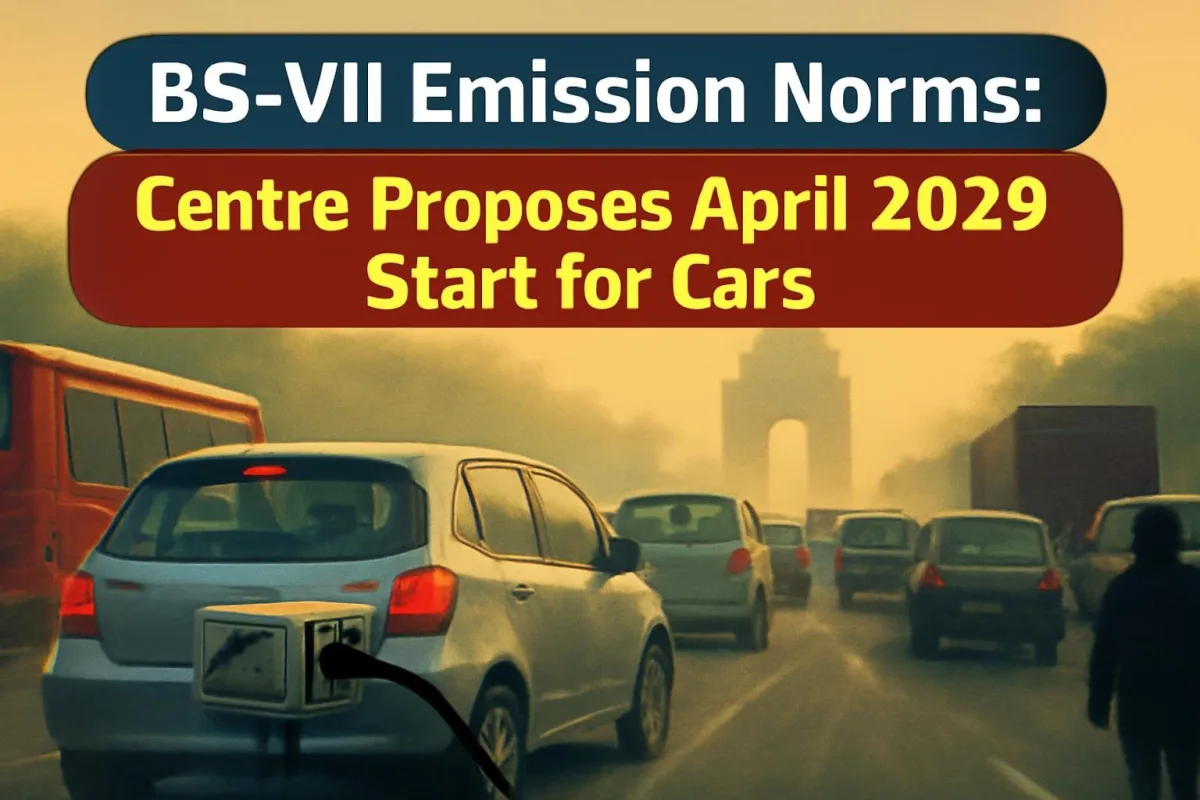
India is preparing its next big step on vehicle pollution. The Ministry of Road Transport and Highways (MoRTH) has issued draft notifications proposing Bharat Stage VII (BS-VII) emission norms, starting with passenger cars manufactured from April 1, 2029, and heavy-duty vehicles such as trucks and buses from April 1, 2031. The drafts were reported on October 14 and 15, 2026.
The proposals go further than any earlier BS standard. For the first time, they bring in rules on brake dust, tyre wear and electric vehicle battery durability, along with tougher real-world testing.
Background: from BS-VI to BS-VII
India currently follows BS-VI norms, which came into force nationwide in April 2020 after the country skipped BS-V entirely. BS-VI sharply cut permitted levels of nitrogen oxides and particulate matter, especially for diesel vehicles. BS-VII is designed to tighten the system further and bring Indian rules closer to Europe's Euro 7 standards.
The drafts propose amendments to the Central Motor Vehicles Rules, 1989. Reports say the public has 30 days to send comments before the ministry finalises them.
Proposed timeline
| Passenger cars (M1) – phase 1 | April 1, 2029: exhaust limits, evaporative emissions, fuel and energy consumption, EV battery durability |
| Passenger cars – phase 2 | April 2031: brake particle emissions, tyre abrasion and particle rules across powertrains |
| Passenger cars – phase 3 | April 2035: further requirements |
| Heavy-duty vehicles (trucks, buses) | From April 1, 2031, with added requirements in April 2033 and April 2035 |
| Durability (some heavy vehicles) | Compliance for up to 15 years or 8.75 lakh km |
| Public comments | 30 days from publication of the draft |
What is new in BS-VII
1. Real-world testing
Carmakers will have to show that vehicles meet limits not only in the laboratory but also on actual roads through real driving emissions tests that measure gases and particle numbers. On-board systems would monitor emissions and fuel or energy use over the vehicle's life, and vehicles already in use could be checked.
2. Brake and tyre pollution
A growing share of urban particulate pollution comes from brake pads and tyres rather than exhaust pipes. BS-VII would regulate these for the first time, and because electric vehicles also produce brake and tyre particles, the rules would apply to EVs as well. Exact limits are yet to be notified.
3. EV battery durability
Electric cars would need to meet minimum battery durability standards from 2029, giving buyers more assurance about how batteries hold up over time. Some thresholds are still to be notified.
4. Environmental Vehicle Passport
The draft proposes an "Environmental Vehicle Passport", which would give owners information on their vehicle's emissions, fuel consumption and battery health.
What it means for buyers in India
For car buyers, the immediate impact is nil: nothing changes until 2029. Over the longer term, cleaner technology usually adds cost. When BS-VI arrived, many entry-level diesel models were dropped and prices of several cars rose. Industry observers expect BS-VII to push up costs again, especially for petrol and diesel models that need upgraded after-treatment systems.
The bigger benefit is for public health. Indian cities regularly rank among the most polluted in the world, and vehicles are a major contributor in urban areas. Tackling brake and tyre particles, which BS-VI ignored, could help cut fine dust on busy roads.
Some automobile executives have voiced concern that the compliance work could divert engineering resources from new launches and EV development, so the industry is likely to press for clarity on test procedures and timelines during the consultation.
Should you change your buying plans?
Not yet. Any car bought today will continue to be legal to drive after BS-VII arrives, since emission norms apply to new vehicles manufactured after the deadline, not to vehicles already on the road. Buyers planning a purchase in the next two years do not need to wait. Those looking further ahead may simply see more electric and hybrid options, and possibly higher prices for some petrol and diesel models, as the 2029 date approaches.
What happens next
Automakers, component suppliers, tyre makers and the public can now send their views on the drafts. After considering them, the ministry is expected to issue final notifications, followed by detailed testing procedures and compliance protocols for each vehicle category. Manufacturers will then have a few years to re-engineer their models before the first deadline in April 2029.




Comments (0)