
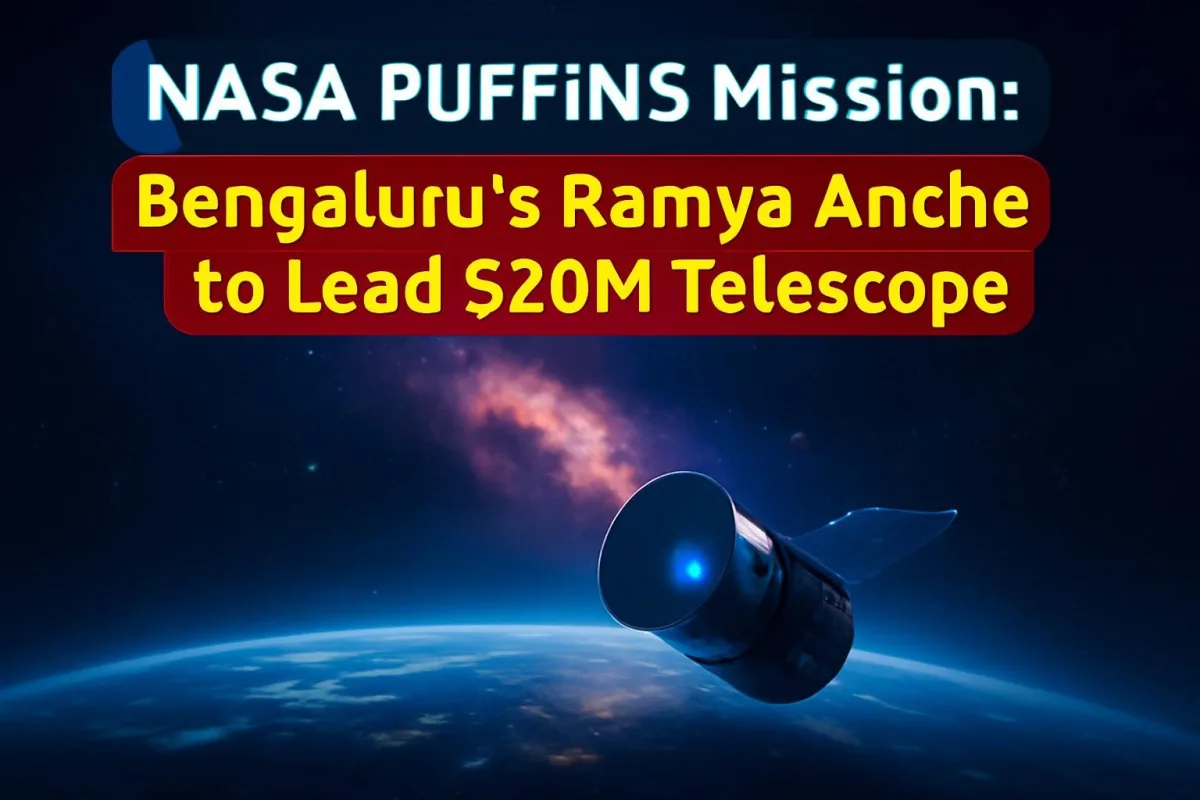
An Indian-origin astronomer is about to lead one of NASA's newest space missions. NASA has awarded $20 million to a University of Arizona-led team for PUFFINS, a small ultraviolet telescope that will study the tiny dust grains floating between stars – and the mission's principal investigator is Ramya Anche, a Bengaluru-born scientist who trained at the Indian Institute of Astrophysics.
The selection, announced this week under NASA's Astrophysics Pioneers programme, puts an Indian-trained researcher at the head of a mission that could help answer a question astronomers have chased for more than half a century.
What is PUFFINS?
PUFFINS stands for Polarimetry in the Ultraviolet to Find Features in INterStellar dust. It is a SmallSat – a compact, relatively low-cost spacecraft – carrying a telescope roughly 10 inches across, about the size of a large dinner plate.
From low-Earth orbit, it will look at starlight that has passed through clouds of interstellar dust. Dust grains do more than dim the light; they also polarise it, changing the direction in which the light waves vibrate. By measuring that polarisation across a range of ultraviolet wavelengths – a technique called spectropolarimetry – scientists can work out what the grains are made of, how they are shaped and how they behave.
The ultraviolet part matters. The smallest grains, under about 50 nanometres, barely show up in optical or infrared light. In UV, they leave a fingerprint. According to the University of Arizona and McDonald Observatory, spectropolarimetry has not been flown in space in nearly three decades.
Mission at a glance
| Full name | Polarimetry in the Ultraviolet to Find Features in INterStellar dust |
| Funding | $20 million from NASA |
| NASA programme | Astrophysics Pioneers |
| Principal investigator | Ramya Anche, Steward Observatory, University of Arizona |
| Science PI | B-G Andersson, McDonald Observatory, UT Austin |
| Telescope size | About 10 inches |
| Targets | At least 70 stars |
| Orbit | Low-Earth orbit |
| Target launch | 2030 (early design phase now) |
Who is Ramya Anche?
Anche hails from Devanahalli on the outskirts of Bengaluru and did her schooling and early research in India, including PhD training at the Indian Institute of Astrophysics (IIA) in Bengaluru. She later moved to the United States and joined the University of Arizona's Steward Observatory, where she is now an assistant research professor.
Her work focuses on astronomical polarimetry, optical design, high-contrast imaging and space telescopes. Notably, she led the winning PUFFINS proposal while she was still a postdoctoral researcher – a rare achievement for an early-career scientist.
"PUFFINS will change how we understand the dust between stars," Anche said in the university's announcement. Science PI B-G Andersson said the mission could help crack a puzzle in interstellar medium physics that has lasted more than 50 years.
The India connection goes beyond one name
The team is a mix of early-career and senior scientists from several countries. Along with the University of Arizona and McDonald Observatory, the partner list includes the Inter-University Centre for Astronomy and Astrophysics (IUCAA) in Pune and the Indian Institute of Astrophysics, alongside institutions in Austria, the Netherlands, Korea, Sweden and South Africa. Corporate partners Ascending Node Technologies and SFL Missions will help build the spacecraft.
For Indian students eyeing astronomy, the story is a reminder that IIA, IUCAA and similar institutes are producing researchers who go on to lead global projects – and that Indian institutions are increasingly part of these collaborations rather than spectators.
Why studying space dust matters
Interstellar dust may sound dull, but it is the raw material of planets. Stars and planetary systems form inside dusty clouds, and the same grains carry many of the elements that end up in rocky worlds like Earth. Understanding the smallest grains helps explain how that process starts.
PUFFINS will also map how dust properties change across the sky, from stellar nurseries and reflection nebulae to the Magellanic Clouds, the Milky Way's small neighbouring galaxies.
There is a longer-term payoff too. NASA's planned Habitable Worlds Observatory, meant to hunt for Earth-like planets around other stars, may carry its own UV spectropolarimeter. Data from PUFFINS is expected to help define what that instrument should do.
What happens next
PUFFINS is in its early design phase, with launch targeted for 2030. It is the second Astrophysics Pioneers mission led by the University of Arizona, after Pandora, which launched in January. Over the next few years the team will finalise the instrument design, build and test the spacecraft and pick its target stars.




Comments (0)