
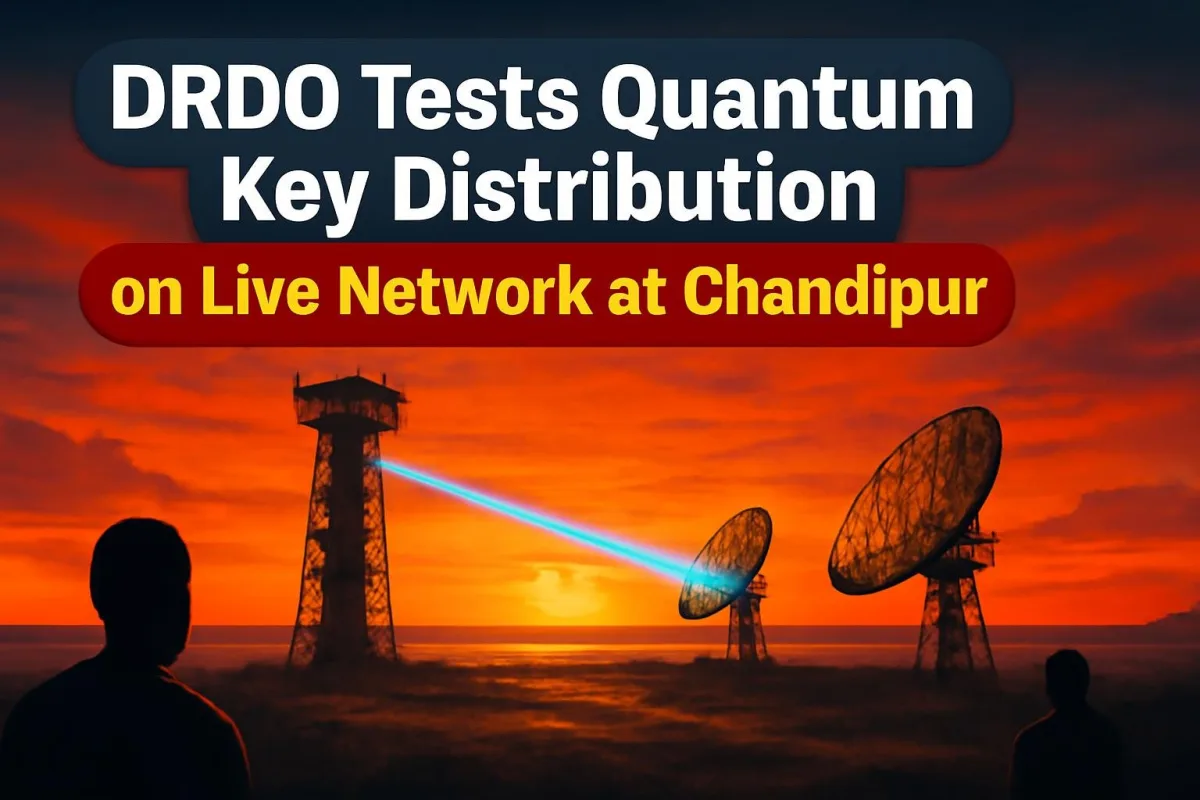
The Defence Research and Development Organisation (DRDO) has tested a Quantum Key Distribution (QKD) platform on a live operational network at the Proof & Experimental Establishment (PXE) in Chandipur, Odisha. DRDO announced the result on Wednesday, October 14, saying the system was used to secure real-time observations and telemetry from artillery and armoured weapon trials.
It is one of the clearest signs yet that quantum-secured communication in India is moving out of the laboratory and into day-to-day defence work. The platform was developed under DRDO's Microelectronic Devices, Computational Systems & Cyber Security (MCC) cluster, with Bengaluru-based Taqbit Labs as the production partner.
What exactly was tested
PXE Chandipur is DRDO's main range for testing guns, shells and armoured systems. During those trials, sensors send a constant stream of sensitive data, such as how a weapon performed, where a round landed and how a system behaved under stress. That information needs to reach analysts quickly and without being intercepted.
DRDO configured the QKD platform on the live network that serves PXE's dynamic test ranges and used it to protect this stream of observations and telemetry. In DRDO's words, securing real-time critical data from weapon testing is an apt use case for the technology.
| Technology | Quantum Key Distribution (QKD) platform |
| Developed by | DRDO's MCC cluster |
| Production partner | Taqbit Labs, Bengaluru |
| Test site | Live network, dynamic test ranges, PXE Chandipur, Odisha |
| Use case | Securing telemetry from artillery and armoured weapon trials |
| Announced | October 14, 2026 |
How quantum key distribution works, in simple terms
Every encrypted message depends on a secret key. If someone steals the key, they can read the message. Ordinary encryption keeps keys safe by relying on maths problems that are extremely hard for today's computers to solve. The worry is that powerful quantum computers could one day crack some of those problems.
QKD takes a different route. Instead of relying on hard maths, it shares the encryption key using the quantum states of light particles. Quantum physics says that measuring such a state disturbs it. So if an eavesdropper tries to intercept the key, the disturbance shows up, and the two parties know the key has been compromised before they use it.
- The sender and receiver exchange a key encoded in quantum states of light.
- They compare a sample of the results to check for disturbance.
- If the error level is low, the key is accepted; if it is high, the key is thrown away.
- The accepted key is then used with standard encryption to protect the actual data.
This is why DRDO describes the approach as offering very strong security with built-in eavesdropping detection, a feature that conventional cryptography does not have.
Building on earlier trials
Wednesday's test follows military field trials of a fibre-based QKD system that DRDO and Taqbit Labs completed in July this year. That system used an entanglement-based approach, and DRDO said at the time that it laid the foundation for larger, multi-hop quantum networks.
DRDO also noted that free-space QKD, which sends quantum signals through the air instead of optical fibre, avoids the cost and disruption of laying cables in difficult terrain or crowded cities. That matters for a country with long mountain borders, deserts and island territories.
The work is tied to DRDO's network of 15 Industry-Academia Centres of Excellence at IITs, IISc and other universities, which support research in areas such as quantum technology.
Why this matters for India
Secure communication is the backbone of modern defence. Missile tests, troop movements and weapon performance data are all prime targets for spying. Testing QKD on a working range, rather than in a controlled lab, shows that the technology can handle real operational conditions.
QKD is also a dual-use technology. Once it matures, the same approach can protect banking networks, telecom backbones, power grids and government communication. That links this test to India's wider push into quantum technology under the National Quantum Mission, which aims to build home-grown capability in quantum computing, communication and sensing.
There is a strategic angle too. Countries that master quantum-secure networks early will be better placed when quantum computers become strong enough to threaten today's encryption. Having an Indian company as the production partner also helps build a domestic supply chain rather than relying on imported equipment.
What happens next
DRDO has not yet shared a timeline for wider deployment. The next logical steps would be longer links, more nodes and integration with the armed forces' existing communication networks. With field trials now completed on more than one network, the focus is likely to shift to scaling up and bringing costs down so that quantum-secured links can be used beyond test ranges.






Comments (0)