
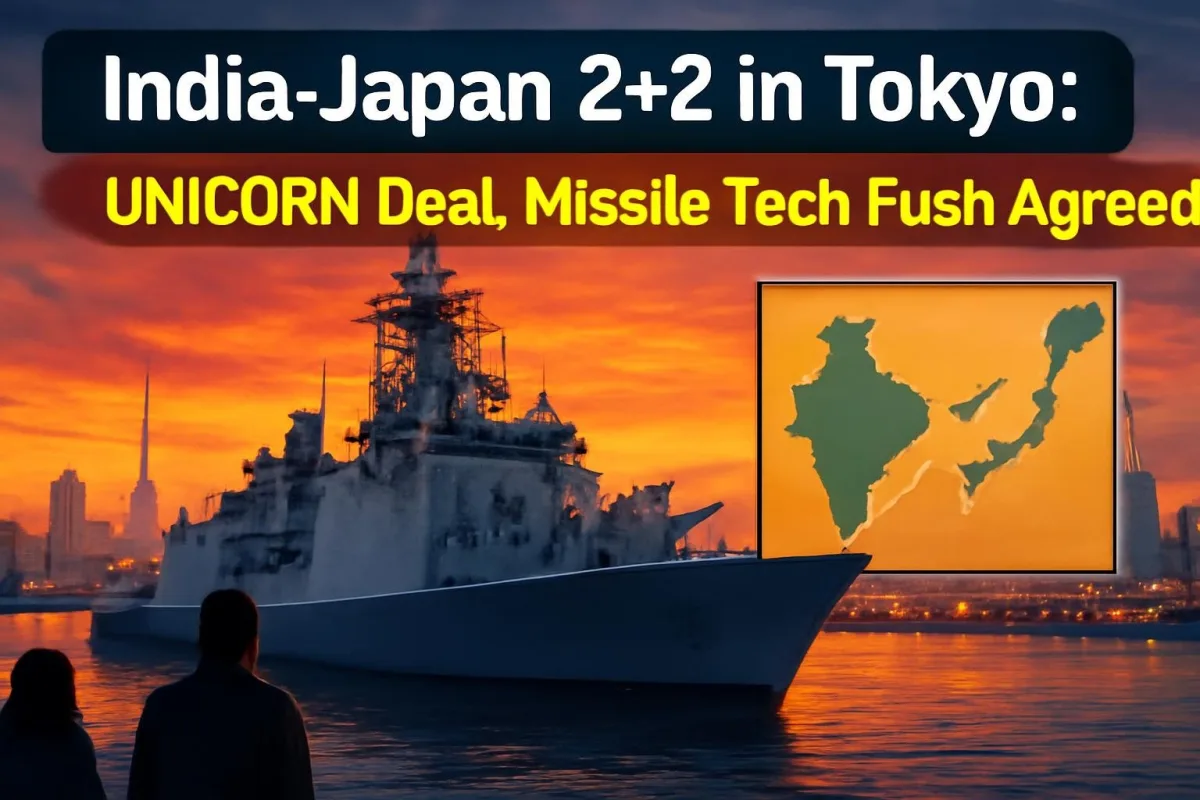
India and Japan agreed on Thursday, 19 November, to speed up work on underwater and missile technologies and to push their naval antenna project, UNICORN, towards an early deal. The decisions came at the fourth India-Japan 2+2 ministerial dialogue in Tokyo, where Defence Minister Rajnath Singh and External Affairs Minister S Jaishankar met Japan's Defence Minister Shinjiro Koizumi and Foreign Minister Toshimitsu Motegi.
The talks came just two days after the Quad leaders met in Manila. They show two of Asia's biggest democracies moving past joint statements and into shared hardware, training grounds and repair docks.
Why the Tokyo 2+2 matters
The 2+2 format puts the foreign and defence ministers of both countries in one room. India holds this kind of dialogue with only a few close partners. The Tokyo round was the fourth with Japan, and it began with a review of the Joint Declaration on Security Cooperation that the two countries signed in August 2025.
Jaishankar set out the bigger picture. He said the cooperation aims to support "a multipolar Asia and a multipolar world". He also spoke about a "growing tendency to weaponise connectivity, resources, services, supply chains and market shares", a concern both countries have raised as global trade has become less predictable.
Key outcomes of the dialogue
Niche technologies and the UNICORN project
Rajnath Singh said the two sides had agreed to "accelerate cooperation in the area of niche underwater and missile technologies". The most concrete industrial item is UNICORN, short for Unified Complex Radio Antenna. It is a Japanese antenna mast system used on Japanese warships, and it is being taken forward for the Indian Navy under a "Design with Japan, Make in India" approach. Both sides said they want the UNICORN agreements wrapped up quickly. If that happens, it would be one of the most significant pieces of defence equipment cooperation between the two countries so far.
Maritime security and ship repair
The ministers agreed to move quickly on a recently signed Memorandum of Arrangement on Maritime Security Cooperation. It covers maritime and air domain awareness, search and rescue, and an information-sharing arrangement. They also want an early agreement on reciprocal ship repair. Under that deal, Japanese vessels could be serviced in Indian yards, and Indian vessels in Japanese yards. Work on mine countermeasures will also be stepped up.
Training together
Japan's Defence Minister Koizumi said that Japan's Ground Self-Defense Force will, for the first time, use an Indian firing range for training in 2027. He called it "a major step strategically". The range has not been named. The ministers also noted that Japanese Air Self-Defense Force fighters had joined the bilateral air exercise Veer Guardian in India for the first time this year.
| Event | 4th India-Japan 2+2 Ministerial Dialogue |
| Date and venue | 19 November 2026, Tokyo |
| India | Rajnath Singh (Defence), S Jaishankar (External Affairs) |
| Japan | Shinjiro Koizumi (Defence), Toshimitsu Motegi (Foreign Affairs) |
| Technology | Faster cooperation on underwater and missile tech |
| Naval project | Early conclusion of UNICORN antenna agreements |
| Maritime | Security MoA follow-up, ship repair arrangement, mine countermeasures |
| Training | Japan's GSDF to use an Indian firing range in 2027 |
| Milestone ahead | 75 years of diplomatic ties in 2027 |
The Yokosuka visit
Earlier on Thursday, Rajnath Singh went with Koizumi to the Japan Maritime Self-Defense Force base at Yokosuka and toured the Mogami-class frigate JS Natori. The Mogami class is one of Japan's newest frigate designs. Indian interest in Japanese shipbuilding has been growing, and the visit drew attention for that reason. Separate bilateral meetings between each minister and his counterpart were also held alongside the main dialogue.
What it means for India
The outcomes are practical. A ship repair pact gives Indian shipyards steady, high-value work and keeps friendly navies operating in the Indian Ocean. Domain awareness and information-sharing would give the Navy a clearer view of vessel movements across a busy and contested sea. UNICORN would give Indian warships a modern communications mast developed with a partner that has been very cautious about defence exports.
For ordinary readers, the larger point is supply chains. When Jaishankar warns against weaponising resources and markets, he is pointing to the risk that one country could squeeze others by controlling key inputs. Closer India-Japan work on technology and manufacturing is meant to reduce that risk for both.
"Ensuring that maritime trade, which is at the heart of international commerce, functions smoothly is imperative," Jaishankar said. India moves most of its trade by sea, so that line matters to Indian exporters and importers.
What happens next
The next steps are clear on paper: sign the UNICORN agreements, finalise the ship repair arrangement and put the maritime security MoA into action. Japan's ground forces are due to train in India in 2027, the same year the two countries mark 75 years of diplomatic relations. That anniversary is likely to bring more high-level visits. Much now depends on how quickly the defence ministries and shipyards turn these commitments into contracts and working equipment.





Comments (0)