
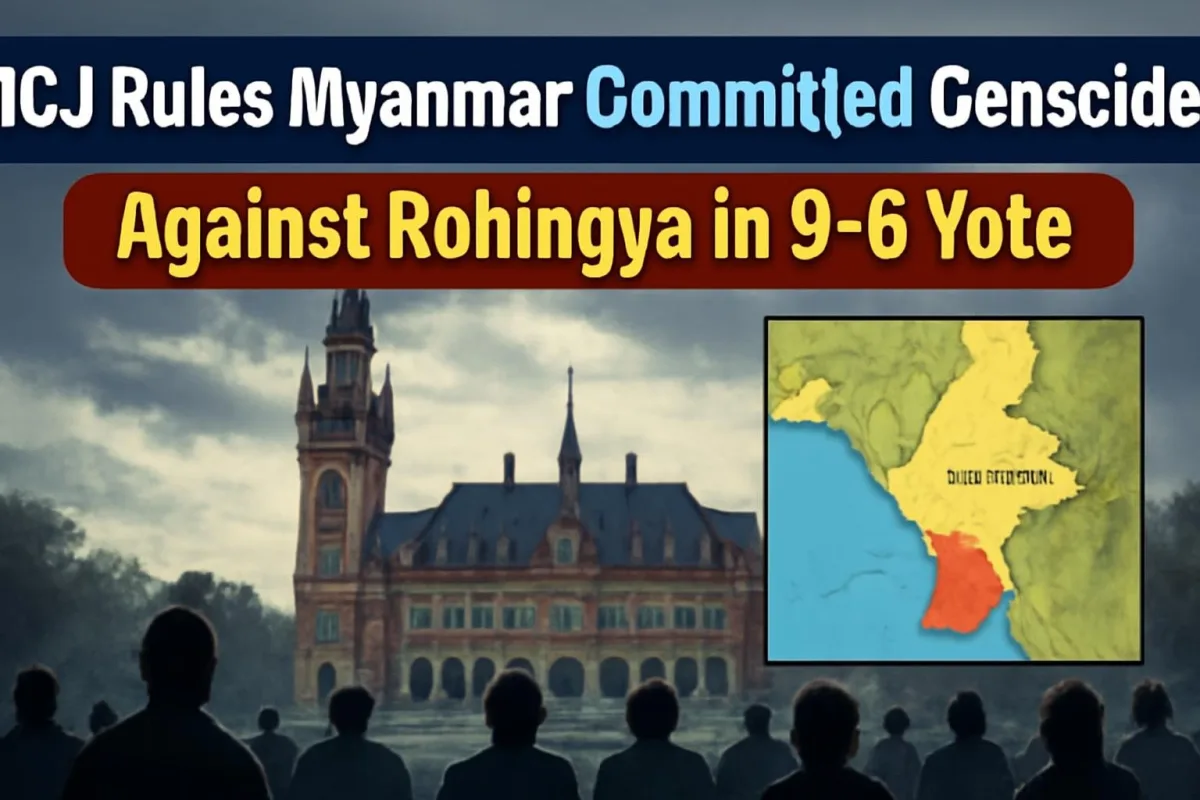
The International Court of Justice ruled on Thursday, 19 November, that Myanmar committed genocide against its Rohingya Muslim minority. The UN's top court in The Hague reached the finding by a 9-6 vote of its 15 judges. It is the first time the court has found a state directly responsible for genocide, and it ends a case The Gambia filed in 2019.
ICJ President Yuji Iwasawa read the judgment over about three hours. He said Myanmar's security forces killed thousands of Rohingya civilians in northern Rakhine State, carried out widespread sexual violence and used extreme violence against children.
Background: the 2017 crackdown
In August 2017, after a Rohingya insurgent group attacked police posts, Myanmar's military launched what it called a "clearance campaign" in Rakhine State. Villages were burned, and survivors reported mass killings and rape. More than 700,000 Rohingya fled across the border into Bangladesh within months. About 1.2 million Rohingya now live in Bangladesh, mostly in crowded camps around Cox's Bazar.
Myanmar has always argued that the operation was a legitimate counter-insurgency response. The Gambia, a small West African nation, took the case to the ICJ under the 1948 Genocide Convention. Under that treaty, any member state can bring a case against another.
What the court found
The court's majority said that genocidal intent was the only reasonable inference from Myanmar's actions, meaning an intent to destroy a substantial part of the Rohingya as a group. It held that three kinds of genocidal acts were proven: killing members of the group, causing serious bodily or mental harm, and imposing measures to prevent births.
The judges also found that Myanmar:
- Failed in its duty to prevent genocide, even though it knew or should have known about the serious risk.
- Failed to punish those responsible, holding no prompt and independent investigations and handing out only minimal court-martial penalties.
- Failed to pass domestic laws giving effect to the Genocide Convention.
The court did not uphold every claim. It found that Facebook posts linked to the military were plainly anti-Rohingya, but said the evidence did not prove direct and public incitement to genocide. It also did not conclusively find that Myanmar had deliberately imposed living conditions meant to physically destroy the group.
| Case | The Gambia v. Myanmar (Genocide Convention) |
| Court | International Court of Justice, The Hague |
| Judgment date | 19 November 2026 |
| Vote | 9-6 on the genocide finding |
| Case filed | 2019, by The Gambia |
| Rohingya refugees in Bangladesh | About 1.2 million, mostly in Cox's Bazar |
| Reporting deadline | Myanmar to report on restitution within two years |
Reparations ordered
The court said Myanmar must make reparation for its wrongful acts. That includes allowing displaced Rohingya to return safely, voluntarily and with dignity, and reuniting families. Myanmar must also return or replace lost property, search for the missing, give the dead dignified reburial according to Rohingya traditions, provide physical and psychological rehabilitation, and protect the community from discrimination. Myanmar must report back to the court within two years. Where full restitution is impossible, it must set out how compensation will be paid. The Gambia had also asked for full citizenship for the Rohingya, but that was its request, not part of the remedies described in reports of the ruling.
How the world reacted
Rohingya activist Yasmin Ullah, part of The Gambia's delegation, called it "a day of justice". Amnesty International described the ruling as a historic recognition of the atrocities. Human Rights Watch said Myanmar should swiftly comply and end its oppression of the Rohingya. Sheikh Hasina, Bangladesh's prime minister during the 2017 exodus, said Bangladesh had played a central role in gathering evidence from the camps. Myanmar's government had not issued an immediate response in early reports.
Why it matters for India and the region
India is next door to both Myanmar and Bangladesh and has a Rohingya population of its own, so the verdict is close to home. The ruling raises pressure on Myanmar's military government to create safe conditions for return, which is the key question for Bangladesh as it hosts more than a million refugees. It also sets a legal benchmark that will be cited in other genocide cases still before the ICJ, including South Africa's case against Israel and Ukraine's case against Russia.
What happens next
ICJ judgments are final and binding, but the court has no police force. If Myanmar does not comply, the matter can be taken to the UN Security Council, where the veto powers of permanent members often decide what happens. Rights groups are already calling for sanctions on Myanmar's military. Myanmar's two-year reporting deadline will be the first real test of whether the ruling changes anything on the ground.




Comments (0)