
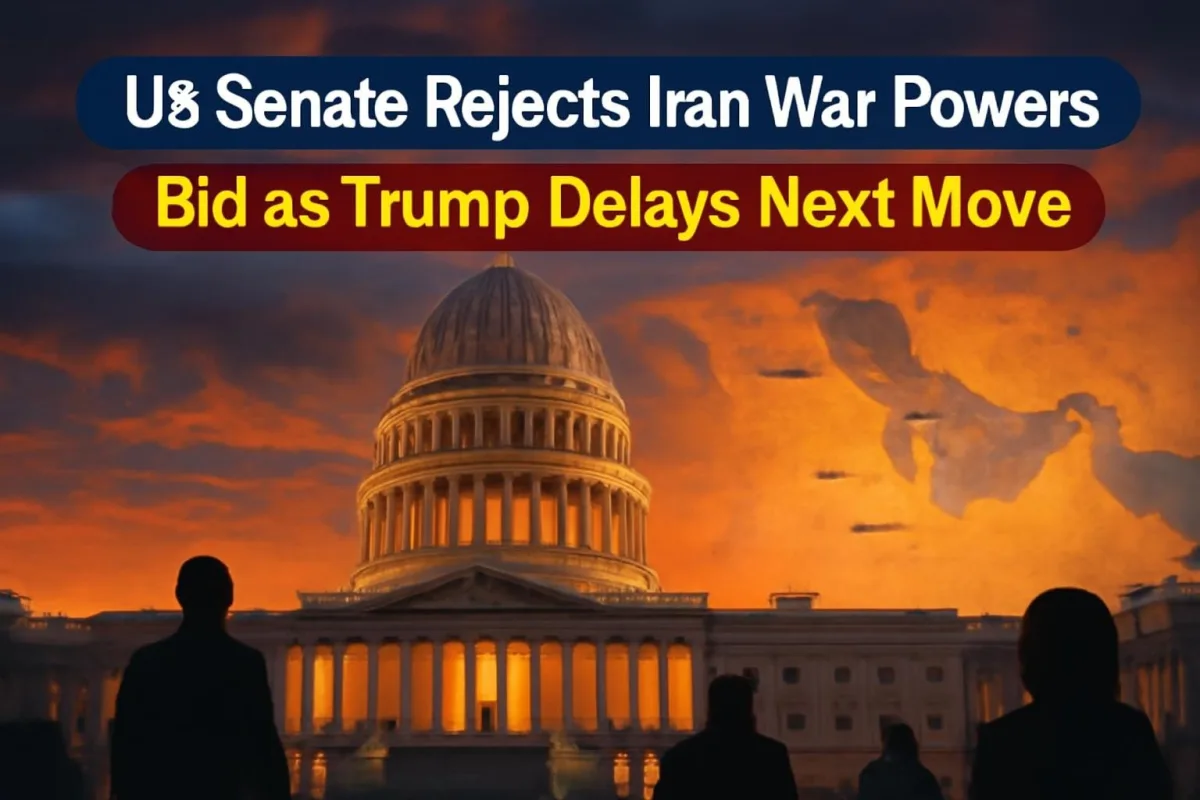
The United States Senate has narrowly voted down a resolution that would have forced American forces out of hostilities with Iran, keeping President Donald Trump's hands free in a conflict that is now about nine months old. The 48-51 vote on Thursday came as Trump signalled he is in no rush to decide his next move, saying the picture may become clearer only after the new year begins.
For India, which depends heavily on Gulf oil and on the safe passage of ships through the Strait of Hormuz, the message from Washington is that the uneasy stalemate is likely to drag on for weeks, if not months.
What the Senate Voted On
The measure was a War Powers resolution that had already passed the House of Representatives. It sought to direct the removal of US forces from hostilities with Iran unless Congress specifically authorised them. It fell short in the Senate by 48 votes to 51.
Three Republicans, Susan Collins, Lisa Murkowski and Rand Paul, crossed party lines to back the resolution. All Democrats supported it except John Fetterman, who voted with the majority of Republicans to block it. The outcome means the White House faces no new legal constraint from Congress on military action against Iran for now.
Trump Says He Is "Not Rushing"
Speaking to Israel's Channel 12 on his way back from the Shenzhen summit in China, Trump said he was not rushing to make a decision on Iran and would see what happens after the new year starts. That leaves open the possibility that any major new step may not come until 2027, although the president has changed course quickly before.
Earlier, Trump had described fresh strikes as "quite unlikely", and Secretary of State Marco Rubio had argued that new strikes were not needed because sanctions were working. At the same time, US media have reported, citing unnamed sources, that Washington and Israel are weighing a new assault on Iran in the short term over concerns that Tehran is rebuilding its ballistic missile production. Those reports have not been officially confirmed.
Iran Rejects Chemical Weapons Claim
The war of words also sharpened this week. On Wednesday, Trump said there was an "indication" that Iran wanted chemical or biological weapons after being shut out of nuclear weapons. He did not offer evidence for the claim.
Iran's Foreign Ministry spokesperson Esmaeil Baqaei rejected the accusation in a post on X, saying the allegations against Iran keep changing. He compared the claim to the case made against Iraq in 2003, which was later shown to be based on faulty intelligence about weapons of mass destruction.
No Deal on Reopening Hormuz
Indirect talks between the two sides have so far failed to produce a ceasefire that would reopen the Strait of Hormuz to normal traffic. According to US media reports, Tehran has refused to discuss its nuclear programme unless the United States lifts its naval blockade and accepts six other conditions.
The pressure on shipping is visible. A US official has claimed that insurance for a single transit through the strait has reached $64 million, a figure that underlines how risky the waterway has become for tankers and cargo ships. Meanwhile, the wider region remains tense. The Saudi-led coalition said on Friday that it intercepted a ballistic missile and two drones fired towards southern Saudi Arabia and warned civilians to move away from the area around Yemen's Hodeidah port, days after a Houthi attack damaged a tower in Riyadh.
Key Facts at a Glance
| Senate vote | 48-51 against the Iran War Powers resolution |
| Vote day | Thursday, November 19, 2026 |
| Republicans in favour | Susan Collins, Lisa Murkowski, Rand Paul |
| Democrat against | John Fetterman |
| Trump's position | "Not rushing"; to see what happens after the new year |
| Iran's response | Spokesperson Esmaeil Baqaei rejects chemical weapons claim |
| Strait of Hormuz | No ceasefire deal; US naval blockade continues |
Why It Matters for India
India imports most of the crude oil it uses, and a large share of it moves through the Gulf. Refiners have already been reshaping their buying, with India's crude imports hitting a record and Saudi Arabia overtaking the UAE as a supplier. A prolonged standoff around Hormuz keeps freight and insurance costs high, and those costs eventually show up in fuel and import bills.
Indian seafarers also make up a big part of the crews on merchant ships in the region, which is why every attack on a vessel near Hormuz is closely watched in New Delhi. Earlier this week, an ADNOC ship was attacked in the strait, a reminder of how quickly the situation can turn dangerous for crews.
What Happens Next
With the Senate vote out of the way and Trump talking about the new year, the near-term outlook is a continuation of the current pattern: sanctions, a naval blockade, sporadic strikes and indirect talks that have yet to deliver a breakthrough. Analysts warn that this "status quo" could still tip into a wider war if either side miscalculates.
For readers in India, the things to watch are crude prices, any shift in the Hormuz shipping situation and fresh advisories for Indian nationals in the Gulf. Any real movement in the talks, or any new strike, would quickly change that picture.





Comments (0)