
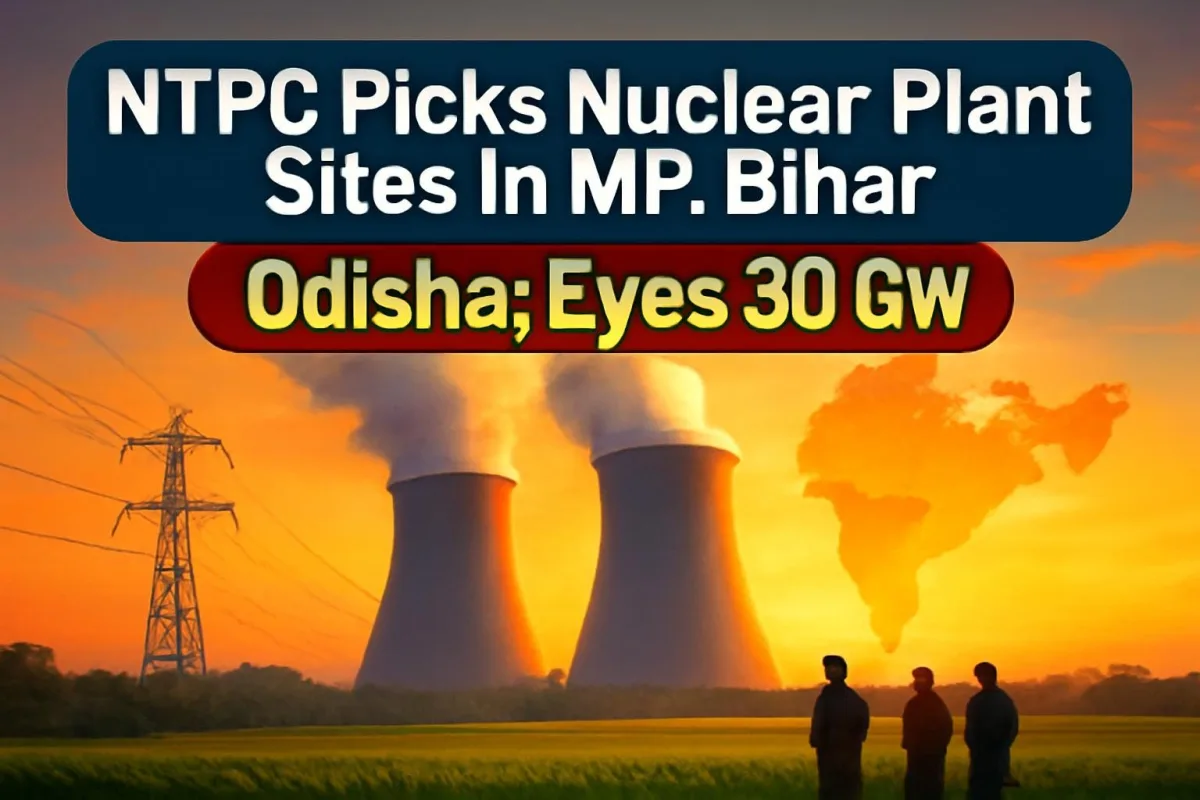
India's largest power producer is moving deeper into nuclear energy. NTPC has identified three new sites, one each in Madhya Pradesh, Bihar and Odisha, to build nuclear power plants, and has submitted feasibility reports for them to the Atomic Energy Commission for approval. The move is part of NTPC's plan to build 30 gigawatts (GW) of nuclear capacity by 2047.
The development, reported on October 8, signals that the state-run company sees nuclear power as a core part of its future, not just a side project alongside coal and renewables.
What NTPC has announced
According to reports citing officials familiar with the plan, the three sites will host projects based on pressurised water reactor (PWR) technology. NTPC has not publicly named the districts or the planned capacity at each site. Each location could typically host 2 to 4 GW of capacity, based on the company's roadmap.
The company is also weighing which global partner to work with for reactor technology and design engineering. Names under evaluation include US firms Westinghouse and Holtec International, Russia's Rosatom and France's EDF. NTPC has reportedly signed non-disclosure agreements with Rosatom and EDF. Technology transfer and the share of local manufacturing are expected to be key factors in the final choice.
| Company | NTPC Ltd |
| New sites identified | Madhya Pradesh, Bihar, Odisha |
| Approval stage | Feasibility reports sent to the Atomic Energy Commission |
| Reactor type | Pressurised water reactor (PWR) |
| Long-term nuclear target | 30 GW by 2047 |
| Possible partners | Westinghouse, Holtec, Rosatom, EDF |
| First nuclear project | Mahi Banswara, Rajasthan (2,800 MW) |
| Nuclear subsidiary | NTPC Parmanu Urja Nigam Ltd |
Background: NTPC's nuclear journey so far
NTPC's first nuclear project is the 2,800 MW Mahi Banswara plant in Rajasthan, planned as four units of 700 MW each. It is being developed through Anushakti Vidhyut Nigam Ltd (ASHVINI), a joint venture between NTPC and the Nuclear Power Corporation of India Ltd (NPCIL), the government company that runs India's existing nuclear fleet.
NTPC has also set up a wholly owned subsidiary, NTPC Parmanu Urja Nigam Ltd, to house its nuclear business. Beyond the three sites now identified, the company is studying possible locations in several more states as it builds a long-term pipeline.
In Odisha, NTPC had already received a go-ahead last month to carry out feasibility studies for a nuclear plant, alongside a separate approval for Adani Power, showing how the state has emerged as a candidate for new nuclear capacity.
Why nuclear, and why now
NTPC currently has about 89 GW of installed capacity across coal, gas, hydro and renewable sources. It aims to reach 149 GW by 2032 and 244 GW by 2037. Nuclear power fits that plan because it can run around the clock without carbon emissions, something solar and wind cannot do on their own without large storage.
India's power demand is rising quickly with growth in manufacturing, data centres, electric vehicles and cooling needs. At the same time, the country has committed to reaching net-zero emissions by 2070. Large, steady sources of clean electricity are central to balancing those two goals, and nuclear is one of the few options that can deliver at scale.
What it means for people in India
For the three states involved, a nuclear project would bring major investment, construction jobs and local infrastructure over many years. Bihar and Madhya Pradesh in particular have limited large-scale clean power projects compared with southern and western states.
Nuclear projects also raise questions that communities will want answered: land acquisition, water use, safety systems and long-term waste management. Those issues are examined during the regulatory approval and public consultation stages, which typically take years before construction begins.
For electricity consumers, nuclear power will not change bills in the near term. But a larger share of steady clean power could, over time, reduce India's dependence on imported fuels and make supply more reliable.
What happens next
- Approval: The Atomic Energy Commission will review NTPC's feasibility reports for the three sites.
- Partner selection: NTPC is expected to finalise a global technology partner, likely through a separate joint venture for reactor design and engineering.
- Site studies and clearances: Detailed site evaluation, environmental clearances and safety reviews by the Atomic Energy Regulatory Board follow.
- Fuel planning: Fuel sourcing for nuclear plants falls under the central government's framework and will shape the final reactor choice.
Nuclear plants take years to plan and build, so the real impact of this decision will be felt in the 2030s and 2040s. But the choice of sites is the first concrete step, and it shows that NTPC intends to be one of India's major nuclear power players alongside NPCIL.





Comments (0)