
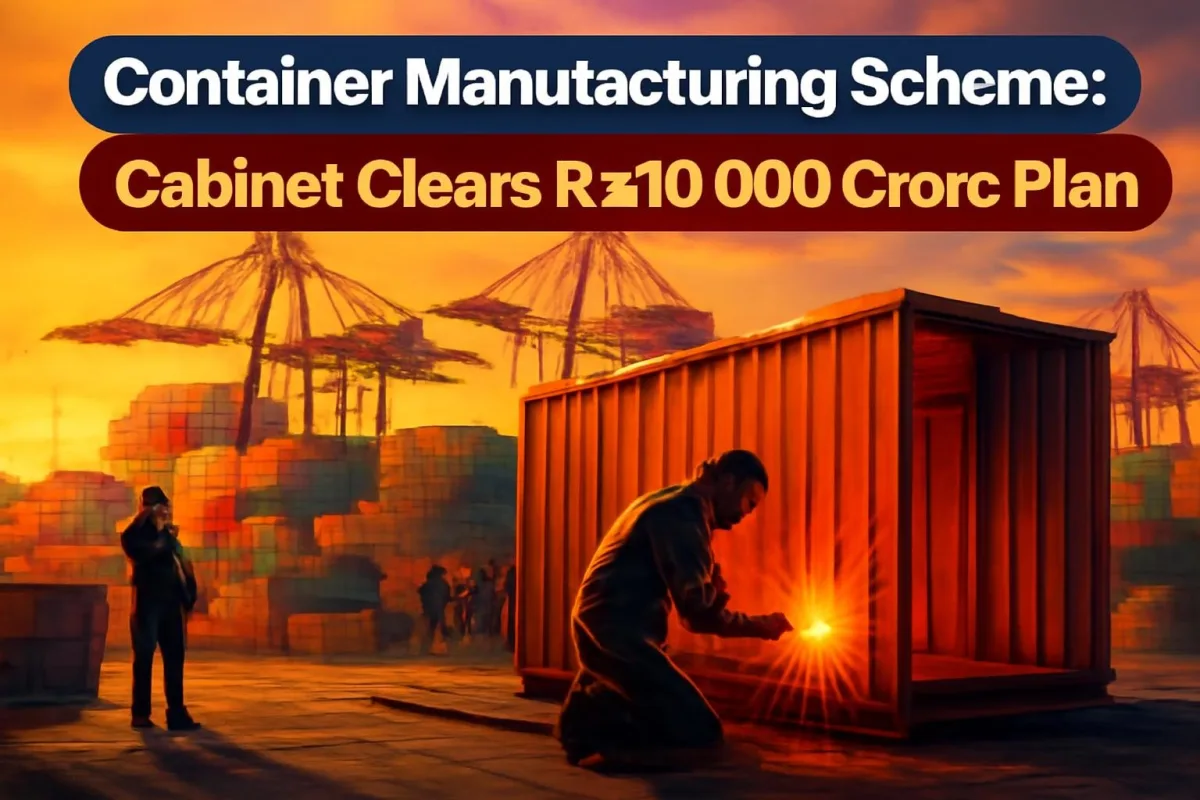
India wants to stop depending on imports for one of the most basic building blocks of global trade, the humble steel shipping container. On Wednesday, October 28, the Union Cabinet chaired by Prime Minister Narendra Modi approved the Container Manufacturing Promotion Scheme (CMPS) with an outlay of Rs 10,000 crore, running up to the financial year 2039-40. Union Minister Ashwini Vaishnaw, who briefed reporters after the meeting, said the goal is to raise India's annual container manufacturing capacity almost tenfold to 7.5 lakh twenty-foot equivalent units (TEUs).
Why containers suddenly matter so much
Almost everything India exports or imports, apart from bulk commodities such as coal, crude oil and grain, travels inside a container. Yet the manufacturing of these boxes is concentrated in very few hands worldwide. Vaishnaw put it bluntly at the briefing: "Container manufacturing is highly concentrated globally, with 95% of production taking place in a single country." He also said shipping lines themselves have asked for another country to build a strong position in the industry.
Exporters in India have felt this concentration directly in the past. Whenever global trade is disrupted, empty containers become scarce, freight rates shoot up and small exporters are often the first to lose orders. A domestic manufacturing base is meant to cushion Indian trade against such shocks.
The scheme was first announced in the Union Budget 2026-27, and Wednesday's approval turns that announcement into a funded programme.
What the Rs 10,000 crore will be spent on
The money has been split into three parts, each targeting a different cost hurdle that has kept Indian manufacturers from competing on price.
| Component | Details |
|---|---|
| Total outlay | Rs 10,000 crore, up to FY 2039-40 |
| Interest Subvention Assistance | Rs 859 crore; 3% annual interest support on eligible term loans for new and expanded factories |
| Operational Expenditure Assistance | Rs 8,891 crore; support for containers built to global shipping standards and sold by eligible makers |
| Testing and certification | Rs 150 crore, including common testing facilities |
| Capacity target | 7.5 lakh TEUs a year, almost ten times current levels |
| Expected jobs | About 3,000 direct and over 50,000 indirect |
| Approved on | October 28, 2026 |
The largest share, the operational expenditure support, is designed to narrow the price gap between Indian-made containers and cheaper imports. The interest subvention lowers the cost of borrowing for both greenfield plants and brownfield expansions, while the testing budget will help manufacturers obtain the certifications that global shipping lines insist on before they lease or buy a box.
Jobs and the wider supply chain
The government expects about 3,000 direct jobs and more than 50,000 indirect jobs from the scheme. The bigger story may be in the supplier network. A container is not just a steel box; it needs corner castings, special-grade steel, wooden flooring, paints and coatings. Each of these is a business opportunity for small and medium enterprises, many of which already serve the automobile and engineering sectors.
Earlier this year, India also unveiled its first indigenously built export-import shipping container, a step that showed the technical capability exists at home. The challenge now is scale and cost, which is exactly what CMPS targets.
What it means for Indian exporters and readers
For exporters, a reliable domestic supply of containers could mean shorter waiting times and fewer sudden freight spikes. For the logistics sector, it fits with the wider push to build ports, dedicated freight corridors and multimodal hubs. And for job seekers in industrial belts, new container plants could open roles in fabrication, welding, painting and quality testing.
The scheme also links with the government's broader effort to reduce import dependence in strategic supply chains, much like earlier production-linked incentives in electronics and solar modules.
What happens next
The government is expected to notify detailed guidelines, eligibility conditions and the application process for manufacturers. Investors will be watching for clarity on how operational support will be calculated per container and how quickly disbursements will begin. With the scheme running until 2039-40, the real test will be whether Indian factories can match global prices once the support tapers off.



Comments (0)