
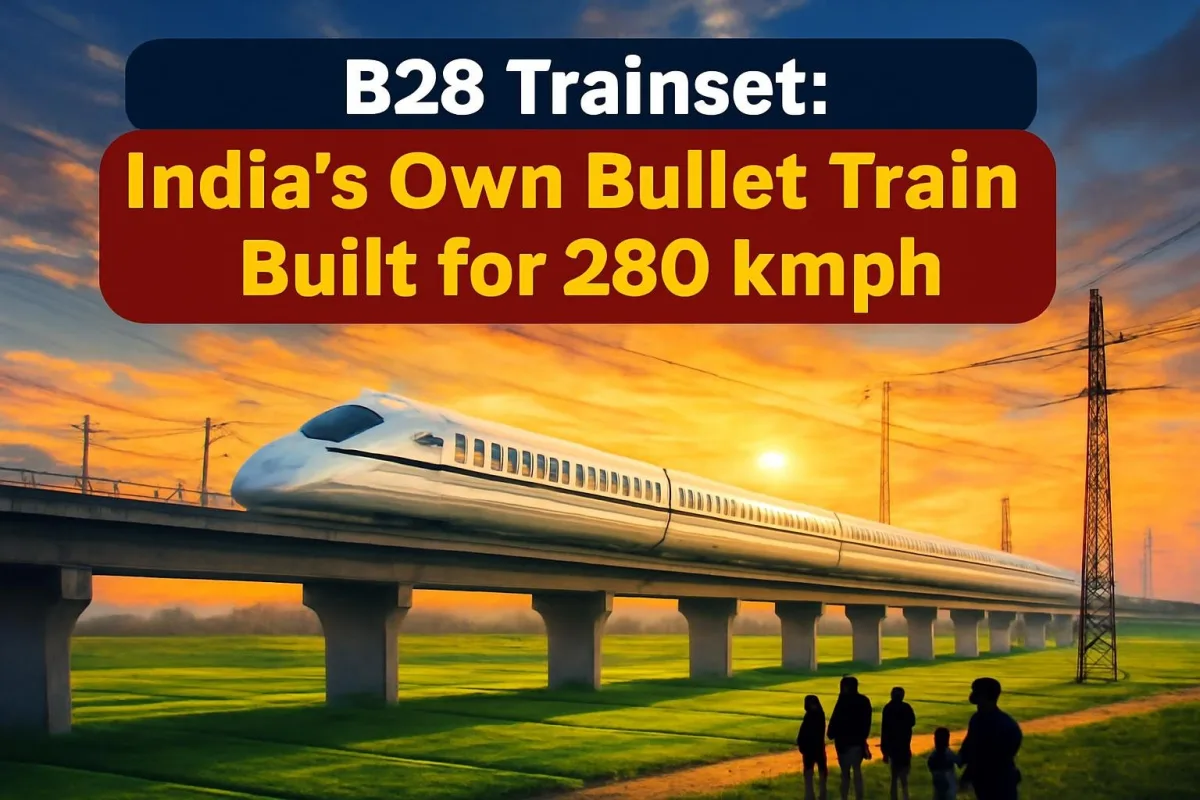
India's homegrown bullet train is taking shape. In a detailed blog post published on Sunday, October 25, Railway Minister Ashwini Vaishnaw said the indigenous B28 trainset – being developed by the Integral Coach Factory (ICF) and BEML – is designed for 280 kmph, with its first body frame complete and track trials expected by mid-2027. He also gave the most detailed update yet on how the 508-km Mumbai-Ahmedabad high-speed corridor is being built.
The B28: India's own bullet train
The Mumbai-Ahmedabad line uses Japanese Shinkansen technology, but India is also building its own high-speed trains. According to Vaishnaw, the first B28 body frame has been completed and is now undergoing structural testing. Track trials are expected around mid-2027.
The trainset is being manufactured at BEML's Aditya facility in Bengaluru, which was inaugurated in April 2026. Public records show BEML won the contract for two prototypes in October 2024 at about Rs 867 crore. The prototype is planned as an eight-car train made up of two four-car units.
A faster version, the B35, designed for 350 kmph, is planned as the next step.
Engineering behind the corridor
Mostly elevated, no level crossings
The corridor is designed for a top speed of 350 kmph, with trains expected to run at around 320 kmph. About 465 km – more than 90% of the route – will run on elevated viaducts. Vaishnaw said this removes level crossings and the risk of trespassing.
Full span launching
Instead of building bridges piece by piece, engineers cast entire 40-metre concrete girders weighing about 970 tonnes in casting yards and lift each into place in one go. Vaishnaw said this is ten times faster than segmental construction. The launching cranes that lift over 1,000 tonnes were imported at first, but are now designed and made in India.
Under Thane Creek and below BKC
A 21-km tunnel in Maharashtra includes a 7-km stretch under Thane Creek. Two tunnel boring machines, each weighing more than 3,000 tonnes with 13.6-metre cutterheads, were launched in July 2026 from Vikhroli and Sawli. By September, 5 km had been dug using mountain tunnelling methods. The Bandra Kurla Complex station, about 32 metres underground with six platforms over 400 metres long, is the only underground station; the other 11 are elevated.
Progress so far
| Item | Status / Detail |
|---|---|
| Corridor length | 508 km (Mumbai-Ahmedabad) |
| Design / operating speed | 350 kmph / about 320 kmph |
| Viaduct completed | 371 km (as of September 2026) |
| Pier work completed | 456 km |
| Stations with civil work done | 8 of 12 |
| Electric masts installed | Over 9,300 of about 22,000 |
| B28 trainset | Designed for 280 kmph; track trials by mid-2027 |
| First section | Surat-Vapi, final quarter of 2027 |
| Full journey time | About 1 hour 58 minutes |
Why this matters
For travellers, the headline number is the journey time: once fully open, Mumbai to Ahmedabad is expected to take just under two hours. But Vaishnaw's bigger point is about technology. "The first project is not just a line on the map. It is the absorption of an entire technology by an entire industry," he wrote.
Several key parts are now made in India – from the J-slab ballastless track slabs cast in Indian yards using Japanese technology, to the electrification components for the 2x25 kV system and the heavy launching cranes. He quoted Masafumi Shukuri, Chairman of the International High-Speed Rail Association, as saying: "Japan could not have done it at this speed."
That know-how matters because the Union Budget 2026-27 announced seven more high-speed corridors covering about 4,000 km, at an estimated Rs 16 lakh crore. "Every one of them will be built on the standards, the suppliers and the skills created by the first corridor," Vaishnaw said.
What happens next
The next milestones to watch are completion of the B28 prototype and its trials in 2027, continued tunnelling under Thane Creek, and the launch of the first Surat-Vapi section in the last quarter of 2027. The rest of the corridor will open in phases after that. Passengers will also be watching for details on fares and ticketing, which have not yet been announced.



Comments (0)