
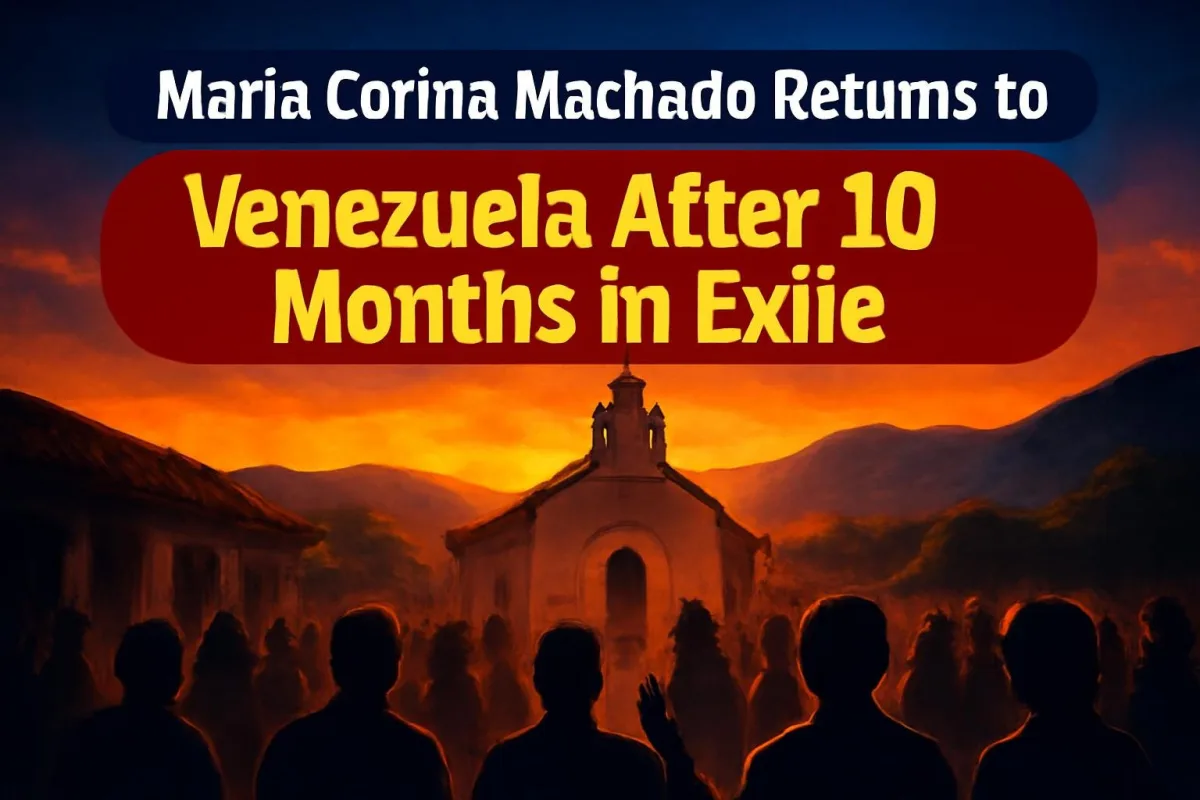
Venezuela's best-known opposition leader is back on home soil. Maria Corina Machado, the 2025 Nobel Peace Prize winner, returned to Venezuela unannounced on Sunday, October 25, ending more than ten months abroad. She surfaced at a church in the western state of Lara, where supporters greeted her in tears, and wrote on X: "I'm here. With you all." Her arrival sets up a direct challenge to interim President Delcy Rodriguez, whose government has yet to fix a date for a presidential election.
A surprise homecoming
Photos shared by her party, Vente Venezuela, showed Machado embracing supporters at a church on the Plaza del Pueblo de Santa Rosa in Lara. Reports said she then set off towards Caracas. It was not immediately clear how she entered the country. According to US-based outlets, her return came after several earlier attempts to cross back had been called off.
Notably, there was no visible move by the authorities to detain her on Sunday – even though Rodriguez had earlier warned that Machado would "have to answer" if she came back.
How Venezuela got here
Machado's journey over the past two years has been dramatic:
- July 2024: Her movement said its candidate, Edmundo Gonzalez Urrutia, won the disputed presidential election. Nicolas Maduro's government refused to accept the result, and Machado went into hiding.
- December 2025: She secretly left Venezuela to travel to Oslo and receive the Nobel Peace Prize.
- January 2026: US forces seized Maduro, who now faces charges in the United States. Washington then backed his former deputy, Delcy Rodriguez, as interim president.
- October 2026: With no election date announced, Machado's supporters marched in Caracas on October 22 to demand a vote. Three days later, she returned.
Key facts
| Detail | Information |
|---|---|
| Who | Maria Corina Machado, opposition leader and 2025 Nobel Peace laureate |
| Returned on | Sunday, October 25, 2026 |
| Where she appeared | Church in Santa Rosa, Lara state |
| Time abroad | More than 10 months |
| Current leader | Interim President Delcy Rodriguez (US-backed) |
| Main demand | A date for a free and fair presidential election |
| Her plans | Meet quake victims, political prisoners' families and democratic leaders |
What she wants
Machado has made clear she intends to run for president whenever an election is held. Her foreign affairs adviser, David Smolansky, told Reuters that she plans to meet victims of the June earthquakes, which killed at least 6,500 people, as well as families of political prisoners, the international community and leaders of the democratic movement. He said she "will work proactively for a date for free and fair elections".
Her movement is not part of the talks under way this month between a faction of the opposition and the interim government on reshaping the top court and the electoral council.
The US angle
Machado's return could complicate Washington's approach. The Trump administration has been working with Rodriguez's government, including on oil deals with American companies. US President Donald Trump said he had not been told about her return in advance, called her "a very nice woman" and said he hoped she was safe, but indicated the US would continue to back Rodriguez. Secretary of State Marco Rubio welcomed her return while maintaining that stabilisation and economic recovery must come before an election.
Edmundo Gonzalez, who lives in exile in Spain, welcomed her arrival on X and said he would soon return to Venezuela too.
Why it matters for India
Venezuela holds some of the world's largest oil reserves, and any political shake-up there affects global crude supply. With Brent crude already above $117 a barrel because of tensions in West Asia, steady Venezuelan output matters for oil-importing countries like India, where fuel prices and inflation track global crude. Indian refiners have also bought Venezuelan crude in the past when sanctions allowed.
What happens next
All eyes are now on how the Rodriguez government responds – whether it tolerates Machado's public campaigning or moves against her. Her presence is likely to energise opposition supporters and add pressure for an election timetable. Washington's balancing act between backing the interim government and supporting democratic change will also come under sharper focus in the weeks ahead.



Comments (0)