
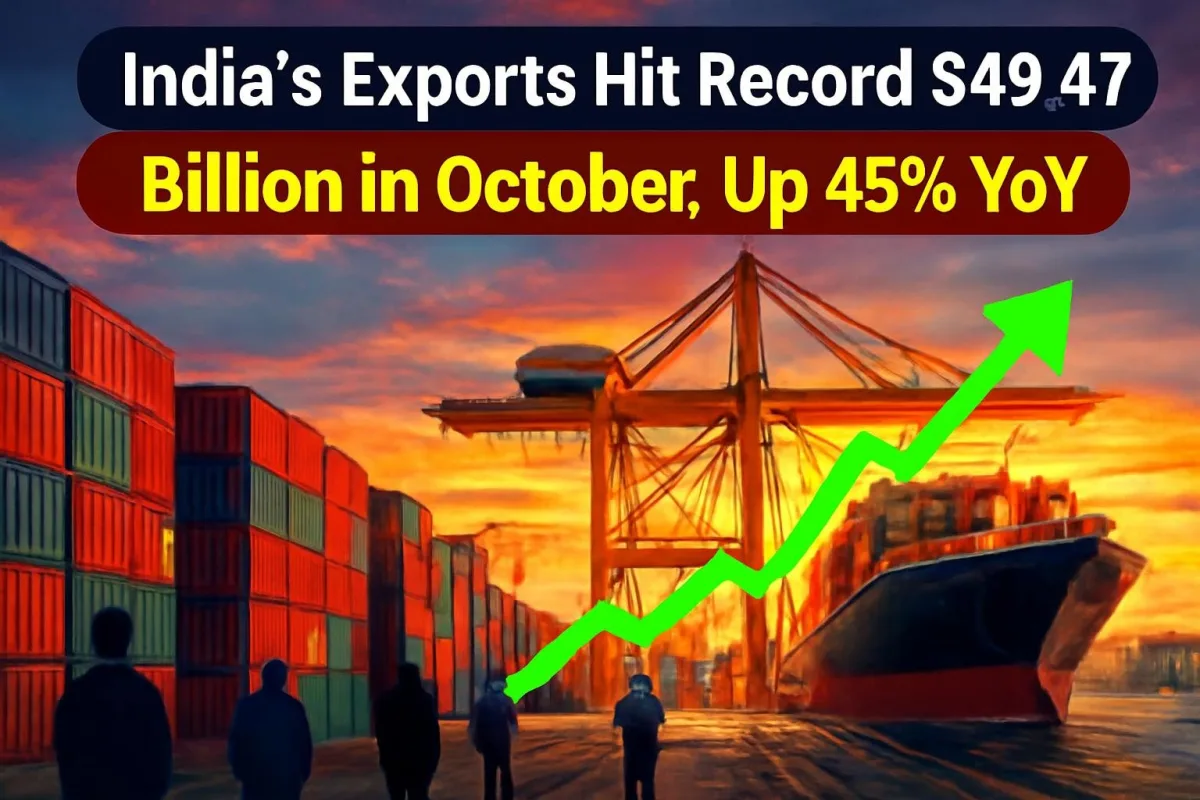
India's exporters have just delivered their best month ever. Merchandise exports jumped to a record $49.47 billion in October 2026, up about 45% from $34.11 billion in October 2025, according to data released by the Commerce Ministry on Friday, November 13. Counting services too, India's total exports touched an all-time monthly high of nearly $90 billion.
The surge comes at a time when global trade is anything but calm, with conflict in West Asia disrupting key shipping routes and tariffs still reshaping supply chains.
The October 2026 Numbers
Releasing the figures, Commerce Secretary Rajesh Agrawal said October's goods exports were the highest India has ever recorded in a single month, and the combined goods and services figure of $89.99 billion was also a monthly record.
| Merchandise exports | $49.47 billion (Oct 2025: $34.11 billion) |
| Growth in goods exports | About 45% year-on-year |
| Merchandise imports | $89.35 billion (up about 16.5%) |
| Merchandise trade deficit | $39.88 billion |
| Services exports | $40.51 billion |
| Total exports (goods + services) | $89.99 billion (Oct 2025: $69.27 billion) |
| Growth in total exports | About 29.9% |
| Overall trade deficit | $20.09 billion (Oct 2025: $25.15 billion) |
The headline takeaway: even though India still imports far more goods than it sells, a strong services surplus pulled the overall trade gap down by roughly $5 billion compared with a year ago.
What Drove the Jump
Officials and trade data point to a broad-based rise rather than a single star sector. The main contributors were petroleum products, electronics, gems and jewellery, organic and inorganic chemicals and engineering goods.
Gems and jewellery exports, for instance, rose 34% to $2.92 billion on buoyant demand. Exports also grew to most of India's major markets – 43 of the top 50 destinations recorded growth, according to a summary of the data. A weaker rupee, which makes Indian goods more competitive abroad, is also seen as having helped.
Why imports are still high
India imports more than 85% of the crude oil it uses, so higher oil prices and costlier shipping have kept the import bill elevated. That is why the merchandise trade deficit, at $39.88 billion, remains large even in a record export month.
How October Compares
October's goods exports were also about 11% higher than September's $44.40 billion, so the jump is not just a low base effect from last year. The month-on-month rise suggests orders picked up through the festive and pre-winter shipping season. On the flip side, the merchandise trade deficit of $39.88 billion was the widest in roughly a year, a reminder that India's import appetite – especially for energy – remains huge.
Services keep doing the heavy lifting
Services exports of $40.51 billion against services imports of about $20.72 billion left India with a services surplus of nearly $20 billion in the month. IT, business services and other professional exports continue to cushion the country's external balance, and they are a big reason the overall trade gap narrowed despite the goods deficit.
The $1 Trillion Target
Commerce and Industry Minister Piyush Goyal said India is on track to meet its $1 trillion export goal for the year. Total exports in the first six months of the financial year were around $480 billion, about 48% of that target, and the minister expects momentum to pick up in the second half.
October's numbers certainly help. If the next few months even come close, the goal looks far more achievable than it did earlier in the year when West Asia tensions spooked shippers.
What It Means for You
Trade data can feel abstract, but it has real-world effects for ordinary Indians:
- Jobs: Export-heavy sectors such as gems and jewellery, engineering goods and electronics are big employers. Strong orders usually mean more hiring and steadier wages in hubs like Surat, Tiruppur, Chennai and Noida.
- The rupee: Higher export earnings bring in more dollars, which can ease pressure on the rupee over time.
- Prices: A narrower overall trade deficit gives the RBI a little more room as it battles retail inflation, which crossed 6% in October.
What to Watch Next
Economists will be watching whether October was a festive-season spike or the start of a sustained run. Key factors include crude oil prices, shipping conditions through West Asian chokepoints and the progress of the proposed India-US trade deal, under which Indian officials say the US has assured a comparative tariff advantage. November's trade data, due in mid-December, will be the next big test.






Comments (0)