
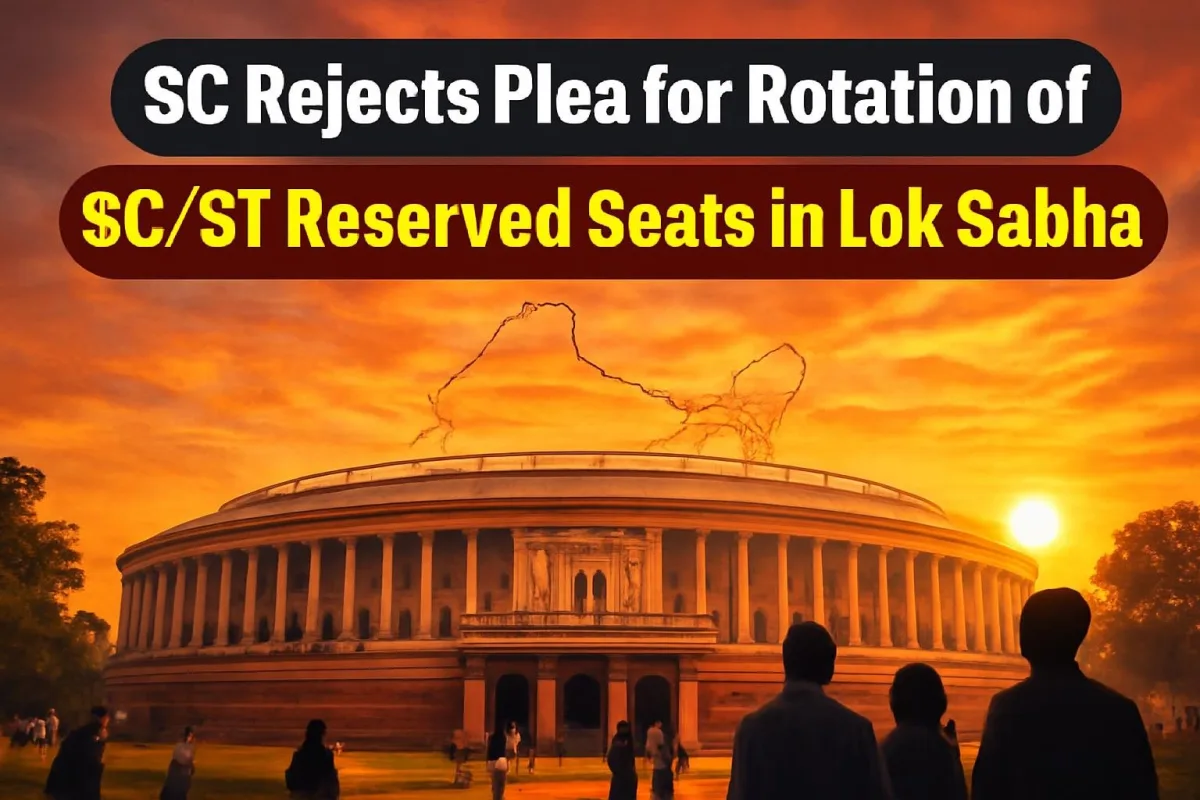
The Supreme Court on Wednesday, November 4, refused to order rotation of seats reserved for Scheduled Castes and Scheduled Tribes in the Lok Sabha and state assemblies. A bench headed by Chief Justice Surya Kant said the question falls squarely within Parliament's domain and that courts cannot direct lawmakers to bring in a rotation system.
In doing so, the court declined to interfere with an Allahabad High Court judgment that had upheld Section 9(1)(c) of the Delimitation Act, 2002, the provision that guides how reserved constituencies are identified. The petitioner was told he was, in the bench's words, dialling the wrong number.
What the Petition Wanted
The plea was linked to the continued reservation of the Kadipur Assembly constituency in Uttar Pradesh. The petitioner argued that some constituencies have stayed reserved for SC/ST candidates for decades, which, in effect, permanently prevents candidates from other communities from contesting there. Reports said the petition referred to reservation of constituencies continuing since 1972 and cited a 2008 recommendation of the Delimitation Commission on the question of rotation.
The petitioner wanted the court to declare the Delimitation Act provision invalid to that extent and to direct that reserved seats be rotated periodically, so that the benefit and burden of reservation shift across constituencies.
What the Supreme Court Said
The bench, which included Justices Joymalya Bagchi and V Mohana, held that Articles 330 and 332 of the Constitution, which provide for reservation of seats for SCs and STs in the Lok Sabha and state assemblies, do not prescribe any rotation mechanism. Whether to introduce one is a policy decision for Parliament, and the court cannot issue a writ of mandamus compelling it to legislate.
The court contrasted this with local bodies. For panchayats and municipalities, Articles 243D and 243T expressly provide for rotation of reserved seats. The absence of a similar provision for Parliament and assemblies, the bench noted, is a deliberate constitutional choice.
During the hearing, Justice Bagchi remarked that the court cannot play the role of a third chamber of Parliament. He also told the petitioner's counsel that even if a voter's options in a reserved seat are limited, the right to vote remains intact. CJI Surya Kant suggested that the remedy lay in the political arena, observing that the petitioner was free to campaign and raise slogans for the change he wanted. The court said the petitioner could make a representation to elected representatives.
Key Facts
| Date of ruling | November 4, 2026 |
| Bench | CJI Surya Kant, Justices Joymalya Bagchi and V Mohana |
| Provision upheld | Section 9(1)(c), Delimitation Act, 2002 |
| Earlier ruling | Allahabad High Court upheld the provision |
| Constituency in focus | Kadipur Assembly seat, Uttar Pradesh |
| Constitutional provisions | Articles 330 and 332 (no rotation); Articles 243D, 243T (rotation for local bodies) |
| Outcome | Plea rejected; petitioner may approach elected representatives |
How Reserved Seats Are Decided Today
Reserved constituencies for Parliament and assemblies are identified during delimitation, the exercise of redrawing constituency boundaries. Under the Delimitation Act, seats for Scheduled Castes are generally reserved in constituencies where their share of the population is relatively high, while ST seats are reserved, as far as possible, where the tribal population is largest.
Because delimitation does not happen often, and because the population figures used to identify reserved seats change slowly, many constituencies remain reserved across several elections. That is the core grievance the petition raised. The current freeze on delimitation is linked to the first Census after 2026, which is why the issue is likely to resurface as the Census 2027 exercise begins and fresh delimitation comes onto the national agenda.
What It Means for Voters and Parties
For now, nothing changes on the ground. Reserved constituencies stay as they are until the next delimitation, and any move towards rotation would need Parliament to amend the law, or possibly the Constitution.
The ruling also sends a broader signal. The Supreme Court has made it clear that structural questions about political representation, such as how reservations are distributed across constituencies, are for elected lawmakers to decide. Political parties that want change will need to take up the demand in Parliament rather than in courtrooms.
What Happens Next
With the petition dismissed, the Allahabad High Court's judgment stands. The debate over rotation is expected to return when the next Delimitation Commission is set up after the Census. Whether Parliament chooses to adopt a rotation model, similar to the one already used in panchayats and municipalities, will be a political decision with significant consequences for many constituencies.


Comments (0)