
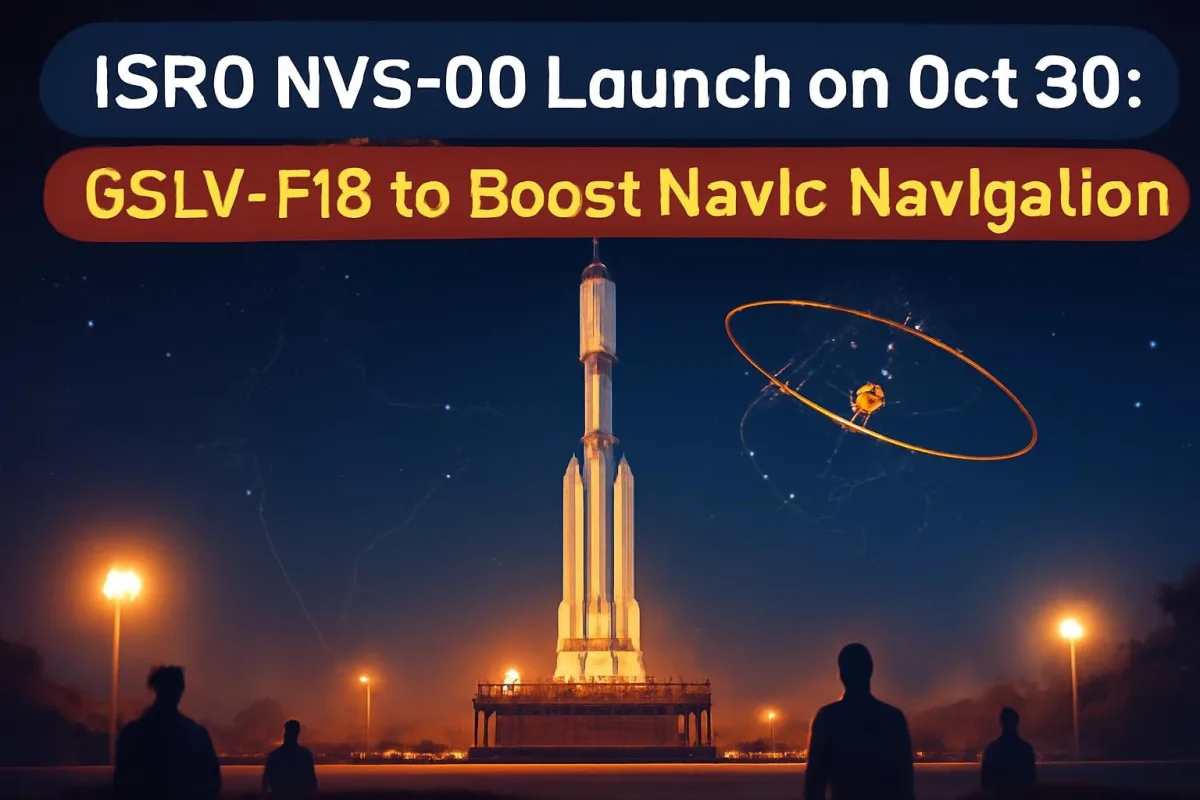
The Indian Space Research Organisation (ISRO) is set to launch NVS-03, its third next-generation navigation satellite, on Friday, October 30, 2026. The satellite will lift off at 11:51 pm on board the GSLV-F18 rocket from the Satish Dhawan Space Centre in Sriharikota, Andhra Pradesh, ISRO announced on October 28.
The mission matters well beyond the space agency. NavIC, India's own satellite navigation system, has been running short of fully working satellites for years, and NVS-03 is meant to plug that gap.
Mission at a glance
| Detail | Value |
|---|---|
| Mission | GSLV-F18 / NVS-03 |
| Launch date and time | October 30, 2026, 11:51 pm |
| Launch site | Satish Dhawan Space Centre, Sriharikota |
| Satellite mass | About 2,232 kg |
| Satellite bus | I-2K |
| Signals | L1, L5 and S bands |
| Planned mission life | About 12 years |
| Coverage | India and about 1,500 km beyond its borders |
What NVS-03 will do
NVS-03 is part of ISRO's second-generation navigation series, NVS-01 to NVS-05, which is intended to keep the NavIC (Navigation with Indian Constellation) system running and to modernise it. NavIC provides position, velocity and timing services over India and a region of about 1,500 km around it, through a Standard Positioning Service for civilian users and a Restricted Service for authorised users such as the armed forces.
The satellite carries an indigenous atomic clock along with procured atomic clocks. Clocks are the heart of any navigation satellite: positioning depends on extremely precise timing, and failures of imported clocks on the first-generation IRNSS satellites were one of the main reasons NavIC struggled.
NVS-03 also adds the L1 band to the existing L5 and S-band signals. L1 is the same frequency band widely used by GPS, which makes it far easier for everyday smartphones, smartwatches and fitness trackers to pick up NavIC signals without special chips.
Background: why NavIC needs this launch
The NavIC constellation was designed with seven satellites, and a minimum of four healthy satellites is needed to give users a position fix. Over the past decade, the system has lost capacity due to atomic clock failures on several first-generation satellites and the failed launch of IRNSS-1H in 2017.
The new series began well when NVS-01 was launched on GSLV-F12 on May 29, 2023, becoming the first Indian navigation satellite to fly an indigenous atomic clock. But NVS-02, launched in January 2025 as ISRO's 100th launch from Sriharikota, could not reach its intended orbit after a valve in its propulsion system failed to open. That setback made NVS-03 even more important.
The GSLV has also had a steady run recently. In September 2026, GSLV-F17 placed the EOS-05 earth observation satellite in orbit on the rocket's 19th flight.
How NavIC compares with GPS
GPS, run by the United States, is a global system with dozens of satellites, while NavIC is regional by design and concentrates its satellites over the Indian Ocean region. That focus means a full NavIC constellation can offer strong coverage and accuracy over India with far fewer satellites. For civilian users, accuracy better than about 20 metres has been the design goal. The real strategic value, though, is independence: during a conflict or crisis, India would not have to rely on a foreign-controlled signal for military navigation, missile guidance or the timing that keeps power grids, telecom networks and banking systems in sync.
Smartphone makers have been slow to support NavIC because the original system did not broadcast on L1. With NVS satellites adding that band, chipmakers can support NavIC far more cheaply, which is why each successful launch in this series matters for ordinary users as well.
What it means for users in India
A healthier NavIC constellation means more reliable location services that do not depend on a foreign system. That matters for defence, disaster response, shipping, fishing communities that use NavIC-based alert devices, railways and vehicle tracking, and for the government's push to have NavIC support in Indian-sold phones.
- Better accuracy and availability over India once NVS-03 is commissioned.
- Wider phone compatibility thanks to the L1 civilian signal.
- Less reliance on imported atomic clocks, a key lesson from the first-generation fleet.
- Stronger encrypted services for strategic users.
What happens next
After lift-off, GSLV-F18 will place NVS-03 in a transfer orbit, from where the satellite will use its own engine to climb to its geosynchronous slot, planned at 32.5 degrees East. In-orbit testing of the payload and clocks will follow before it joins the operational constellation. ISRO has said NVS-04 and NVS-05 are in advanced development, and a successful flight on Friday would put the NavIC rebuild firmly back on track.


Comments (0)