
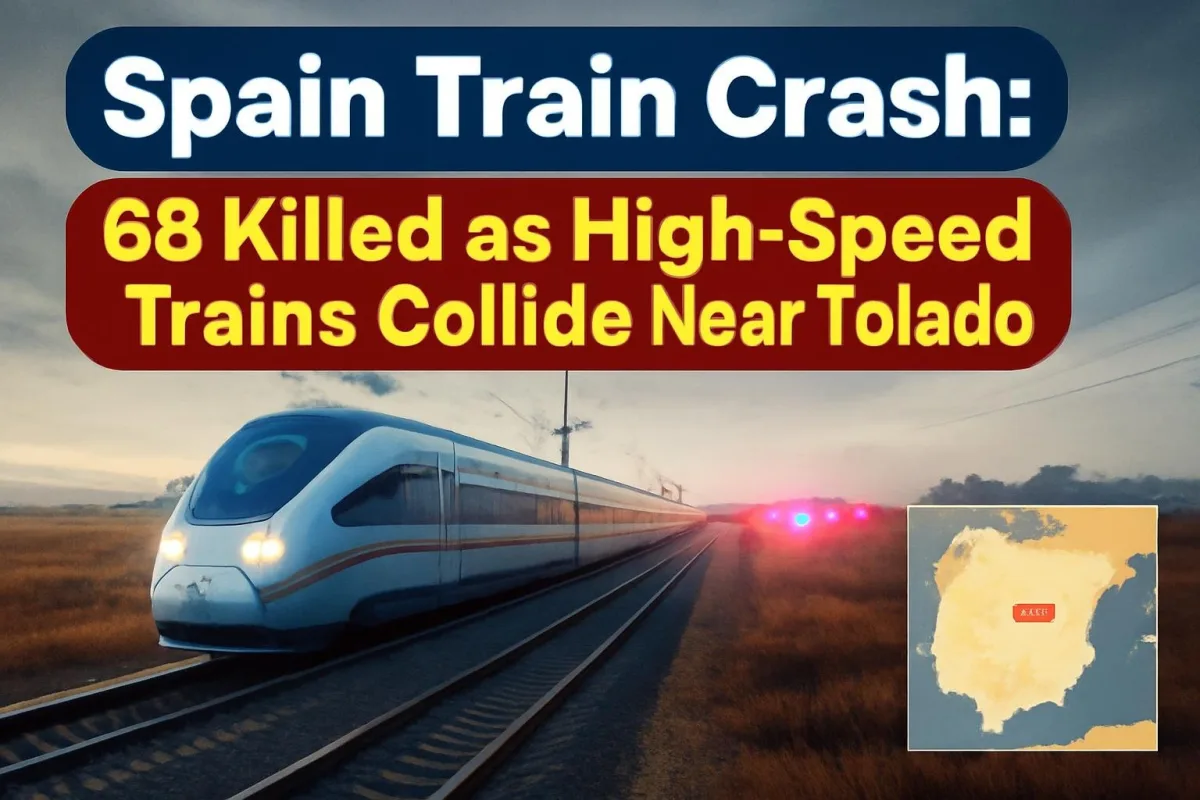
Spain is in mourning after two high-speed passenger trains collided near Toledo on Wednesday morning, October 28, 2026, killing at least 68 people. The crash happened at about 8:30 am local time on the Madrid-Seville high-speed line, between the towns of Urda and Los Yebenes in the Castilla-La Mancha region, when a Renfe train ran into the back of an Iryo train travelling in the same direction.
It is the deadliest high-speed rail accident in Spain since 2013, and the second major crash on the same corridor this year.
What happened
Both trains had left Madrid for Seville. According to the regional government, the Iryo service was carrying around 146 people, including a baby, while the Renfe train had 397 people on board. Preliminary accounts from officials suggest the Iryo train was stationary or moving slowly when the Renfe train struck it from behind, knocking two coaches off the track and sending carriages down an embankment.
One survivor told reporters that the Renfe train had stopped earlier because of a problem on the track before setting off again. Passengers described carriages tipping over, luggage flying and people breaking windows to get out. Firefighters pulled some of them from the wreckage.
Key facts
| Detail | Value |
|---|---|
| Date and time | October 28, 2026, about 8:30 am local time |
| Location | Near Urda, Toledo province, Castilla-La Mancha |
| Line | Madrid-Seville high-speed line |
| Trains involved | Renfe and Iryo services, both Madrid to Seville |
| People on board | About 146 (Iryo) and 397 (Renfe) |
| Deaths | At least 68 (toll may rise) |
| Injured | At least 15 seriously, more than 50 hospitalised |
| Rail services | Madrid-Andalusia high-speed line suspended |
Rescue and response
Emergency services, military rescue teams and sniffer dogs worked through the day at the crash site, concentrating on the two most damaged carriages. The town of Urda turned its sports pavilion into a centre for treating injured passengers before they were moved to hospitals in the region.
'All of Spain is mourning,' said Emiliano Garcia-Page, president of Castilla-La Mancha, who added that the ministry would establish the causes and that any negligence would come to light. Health Minister Monica Garcia said the government was mobilising all available resources and working with regional authorities.
Rail infrastructure manager Adif suspended traffic on the high-speed line between Madrid, Ciudad Real and Andalusia, and Iryo cancelled all its services from Madrid's Puerta de Atocha station on the southern corridor until further notice.
The Madrid-Seville corridor
The Madrid-Seville line was Spain's first high-speed railway, opened in 1992, and it remains one of the country's most important routes, linking the capital with Andalusia through Castilla-La Mancha. Thousands of passengers use it daily for business, tourism and family travel, and the line carries trains of several operators. A closure of the corridor affects not just Seville but also Cordoba, Malaga and other southern cities that depend on fast connections to Madrid.
The scale of the crash, with more than 540 people on the two trains, explains why the toll is so high. Rear-end collisions on high-speed lines are rare because modern signalling is meant to keep trains a safe distance apart automatically, which is why the investigation into how two trains came to be on the same stretch at the same time will be closely followed across Europe.
Second disaster on the line this year
The collision has raised serious questions about safety on one of Europe's busiest high-speed routes. In January 2026, a crash near Adamuz in Cordoba province involving trains of the same two operators killed more than 40 people. Before this year, Spain's worst high-speed accident was the 2013 derailment near Santiago de Compostela in Galicia, which killed 80.
Spain opened its high-speed network to private competition in recent years, and operators such as Iryo now run alongside state-owned Renfe on the same tracks. Investigators will be looking closely at signalling, traffic control and the instructions given to both trains before the crash.
What it means for Indian travellers
Indians travelling in Spain, particularly between Madrid and Andalusian cities like Seville, Cordoba and Malaga, should expect cancellations and disruption on the high-speed route and check with operators before travelling. The accident also comes as India builds its own high-speed rail network, where signalling and collision-avoidance systems will be central to safety.
What happens next
Spain's railway accident investigation authorities and the Transport Ministry are expected to examine the trains' data recorders and signalling logs. The death toll may rise as rescue work continues, and rail traffic on the corridor is likely to remain suspended until the site is cleared and inspected.




Comments (0)