
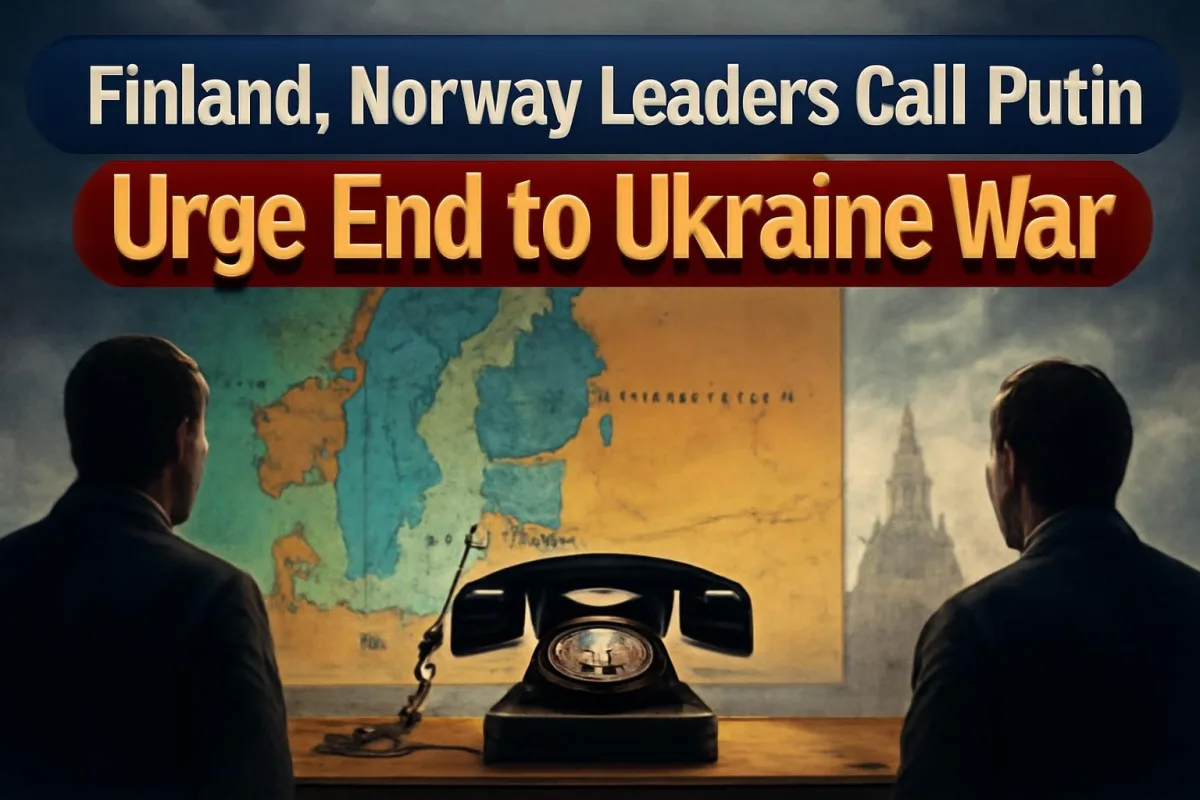
Two Nordic leaders have done what most of Western Europe has avoided for years: picked up the phone and spoken directly to Vladimir Putin. Finnish President Alexander Stubb and Norwegian Prime Minister Jonas Gahr Støre held a call with the Russian president on Tuesday, October 27, urging him to end the war in Ukraine, before briefing Ukrainian President Volodymyr Zelensky.
The call reportedly ran for about 90 minutes and has already exposed divisions within Europe over how to deal with Moscow.
What was said on the call
Stubb described the conversation as "frank and substantive." Støre said the two leaders "stressed the importance of de-escalation" and reminded Putin that "the war comes with enormous human and material costs." Both are leaders of NATO countries that share a border with Russia, and both stressed that they remain firm supporters of Ukraine.
"The outcome of this war will have a direct impact on our and the broader European security," Stubb said, adding later on social media that Finland and Norway would continue to back Ukraine and efforts to find "a just and lasting peace." The leaders made clear they were speaking for their own countries, not for Europe as a whole.
The Kremlin's readout showed little sign of compromise. It said a just and lasting peace was possible only if Russia's "legitimate interests" were fully taken into account, and blamed the "confrontational policy of the EU and NATO countries" for prolonging the fighting. The three leaders agreed to stay in direct phone contact.
| Detail | Information |
|---|---|
| Date of call | Tuesday, October 27, 2026 |
| Participants | Alexander Stubb (Finland), Jonas Gahr Støre (Norway), Vladimir Putin (Russia) |
| Duration | About 90 minutes |
| Follow-up | Leaders briefed Volodymyr Zelensky afterwards |
| Next talks | Russia-Ukraine-US technical talks in Abu Dhabi, first half of November |
| New local truce | Humanitarian ceasefire around Oleshky, Kherson region |
How the call came about
The initiative grew out of a meeting in Oslo on October 20 between Støre, Stubb, Zelensky and US envoy Steve Witkoff, with Jared Kushner joining remotely. Witkoff then travelled to St Petersburg to meet Putin. Ukrainian officials said Zelensky had briefed the Nordic leaders ahead of their conversation, and the call was held in consultation with Kyiv.
The timing is significant. Relations between Washington and Kyiv are under strain after US President Donald Trump announced a diesel deal with Russia and eased some sanctions this month, moves he linked to bringing down oil prices that rose during the US conflict with Iran. The Nordic leaders tied their outreach to planned Russia-Ukraine-US talks in Abu Dhabi in November, the first such round since February.
Europe is not united on this
Not everyone welcomed the call. Danish Prime Minister Mette Frederiksen said she was "very sceptical about this Norwegian and Finnish initiative," adding: "It hasn't been coordinated with any of the rest of us." She also said she did not know what the two countries thought they could achieve, accusing them of going "solo." Sweden's leadership was also reported to be unhappy with the lack of coordination.
A small truce, and continued attacks
On the ground, there was one modest sign of progress. Russia and Ukraine began a US-brokered local ceasefire around Oleshky, a Russian-held town on the eastern bank of the Dnipro opposite Kherson, to allow aid deliveries and evacuations. Ukrainian officials said US First Lady Melania Trump was involved in arranging it, and the truce has been extended.
Elsewhere, the fighting continued. A Russian missile attack on Kyiv killed at least one person and injured 15, including students in a dormitory, while drone strikes caused casualties on both sides of the front line. Russia and Ukraine both deny deliberately targeting civilians.
Why it matters for India
India has long argued that the Ukraine war can only end through dialogue and diplomacy, and has kept channels open with both Moscow and Kyiv. Any movement towards talks matters for Indian interests too, from energy prices and fertiliser supplies to the stability of global shipping routes, all of which have been hit by the war.
What happens next
Attention now shifts to the technical-level talks between Ukrainian, Russian and US negotiators in Abu Dhabi, expected in the first half of November. Whether the Nordic channel adds real momentum, or simply deepens Europe's internal divisions, should become clearer then.
Comments (0)