
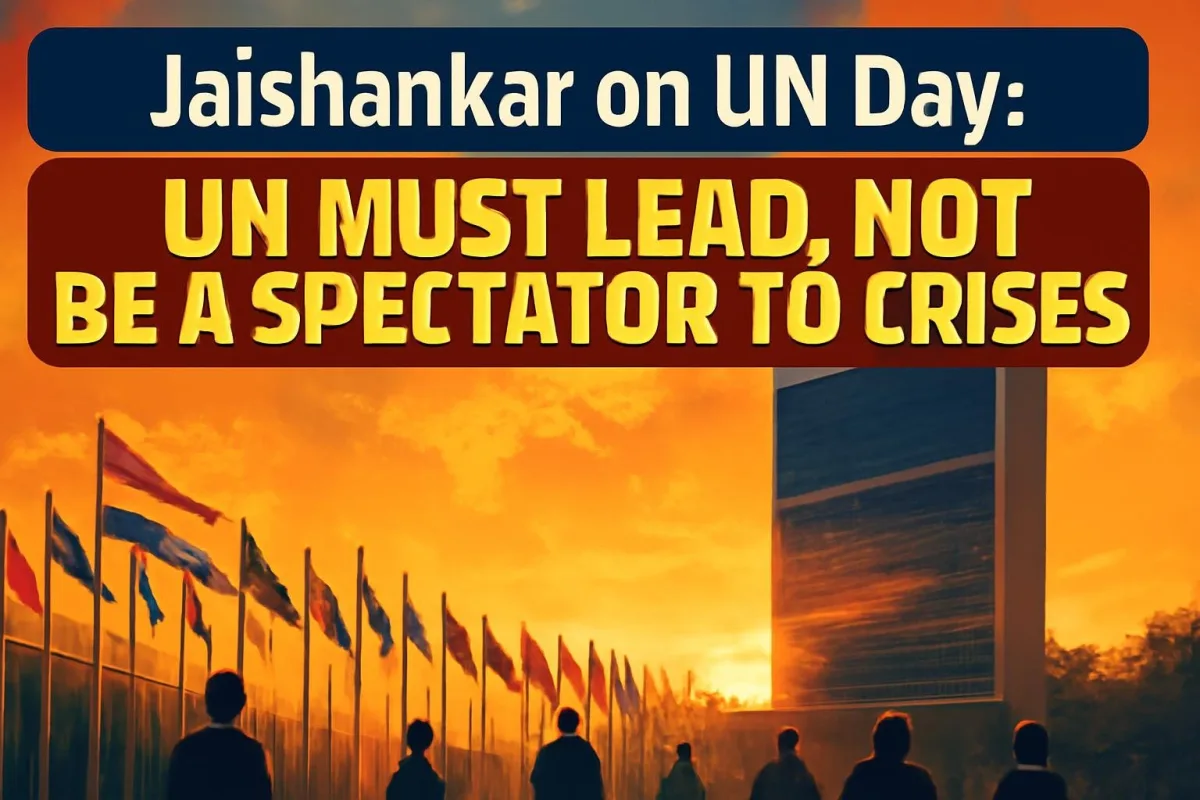
India has once again put the United Nations on notice. Speaking a day after UN Day, External Affairs Minister S Jaishankar said the world body must show leadership instead of being a spectator to global crises, and called for long-pending reforms, including an overhaul of the UN Security Council. He made the remarks on Sunday, October 25, at the Chinmaya Amrit Mahotsav Global Sammelan at Bharat Mandapam in New Delhi.
The minister's message was simple: when wars far away push up fuel and food prices for ordinary people everywhere, the UN cannot afford to sit on the sidelines.
What Jaishankar said
The event, themed "Non-Dualism for World Understanding", was held on the occasion of UN Day, which is marked every year on October 24, the date the UN Charter came into force in 1945. Jaishankar used the platform to reflect on what the UN was built for and where it is falling short.
- Costs of distant wars: He said the conflicts in Ukraine and West Asia were hurting countries and people far from the fighting, who have little say in these wars but are paying higher prices. "We cannot remain helpless spectators," he said.
- Cooperation over competition: He described global politics as a choice between competition and cooperation, and said the founding of the UN after the Second World War had been a choice for cooperation.
- Reform of decision-making: He called for changes in bodies such as the Security Council, saying "large parts of the world cannot be left out of decision-making".
- India's position on the wars: "India expresses global sentiment when we urge that dialogue and diplomacy are the only solution," he said, adding that India is helping in its own way and is ready to work with partners for peace.
Key facts
| Speaker | S Jaishankar, External Affairs Minister |
| Event | Chinmaya Amrit Mahotsav Global Sammelan |
| Theme | Non-Dualism for World Understanding |
| Venue | Bharat Mandapam, New Delhi |
| Date | October 25, 2026 |
| Occasion | UN Day (October 24) |
| Main demand | Long-pending UN reform, including the Security Council |
| Conflicts cited | Ukraine and West Asia |
Why India keeps pushing for UN reform
India has argued for years that the UN Security Council reflects the world of 1945, not the world of today. The five permanent members, the US, Russia, China, the UK and France, hold veto powers, while large regions such as Africa, Latin America and much of Asia have no permanent voice. India, the world's most populous country and one of its largest economies, is not a permanent member either.
New Delhi has framed this as a fairness issue for the entire Global South, and Jaishankar's remarks continued that line. Critics of the current system say the veto has repeatedly frozen the Council when major powers are involved in a conflict, which is exactly the kind of paralysis the minister was pointing to.
What it means for people in India
The minister's point about distant wars is not abstract for Indian households. Fighting in West Asia has kept global crude prices high in recent weeks, which feeds into petrol, diesel, cooking gas and transport costs. Disruptions in the Gulf have also affected flights and the lakhs of Indians who live and work in the region. When Jaishankar talks about countries paying the price for conflicts they did not start, India is one of them.
A more effective UN, in India's view, would be better placed to push for ceasefires early and reduce these spillover effects.
What happens next
Talks on Security Council reform at the UN have dragged on for years without a breakthrough, and Jaishankar's remarks are unlikely to change that overnight. But India is expected to keep raising the issue at every major forum, from the UN General Assembly to BRICS and G20 meetings, and to build support among developing countries. With the wars in Ukraine and West Asia still unresolved, New Delhi will also keep pressing its message that dialogue and diplomacy are the only way out.

Comments (0)