
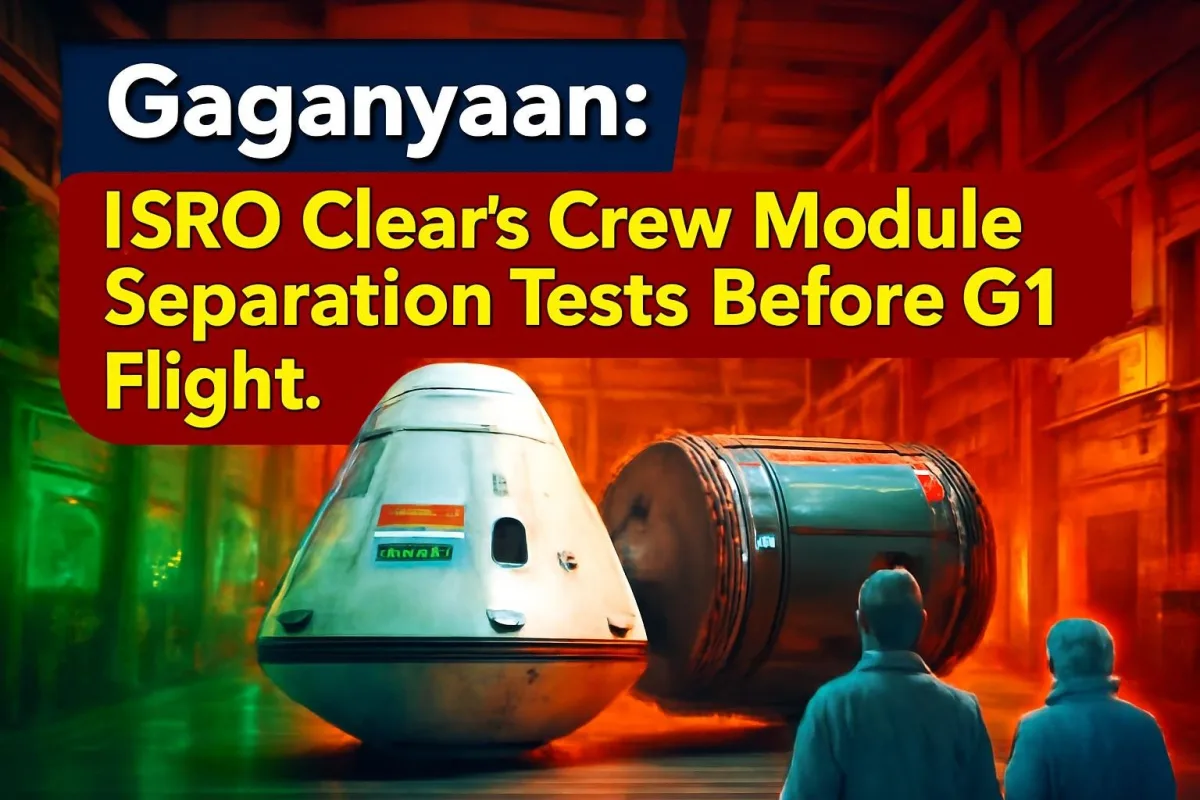
India's human spaceflight programme has cleared another important hurdle. The Indian Space Research Organisation (ISRO) has completed a series of Gaganyaan separation tests at the Vikram Sarabhai Space Centre (VSSC) in Thiruvananthapuram, proving that the crew module can cleanly break away from the service module. ISRO announced the results on October 16, and the milestone moves the first uncrewed mission, G1, a step closer to the launch pad.
What exactly did ISRO test?
The Gaganyaan spacecraft is made of two main parts. The crew module is the capsule where astronauts will sit, and the service module beneath it carries propulsion, power and other support systems. The two stay joined from lift-off through the entire orbital phase. Just before the journey home, they have to separate so that only the crew module re-enters the atmosphere and splashes down.
That separation is not a simple unclipping. Several umbilical connections, the lines that carry power and fluids between the two modules, have to be cut at exactly the right moment, and the structures are pushed apart using pyrotechnic devices and jettison systems. Any snag here could put the crew in danger, which is why ISRO built a full-scale simulated crew module and service module assembly, fitted it with extensive instrumentation and ran the separation sequence on the ground.
Key results
According to ISRO, the tests "validate the overall design adequacy of the separation system". Just as importantly, they showed that critical systems inside the crew module can survive the shock of the pyrotechnic separation without damage. Those systems include:
- Avionics and inertial navigation systems, which guide the capsule.
- The Thermal Protection System, including the aft and conical heat shields that protect the capsule during re-entry.
- The crew module's Deployable Umbilical Shield.
- Pyrotechnics of the Crew Module Uprighting System, which keeps the capsule upright after splashdown.
- Pyrotechnics of the Thermal and Humidity Control System.
ISRO has not shared the number of test runs or detailed measurements, but the space agency said the overall outcome confirms the separation design is sound.
| Key fact | Details |
|---|---|
| Test | Crew Module - Service Module separation |
| Location | Vikram Sarabhai Space Centre, Thiruvananthapuram |
| Announced | October 16, 2026 |
| Outcome | Design adequacy of separation system validated |
| Next mission | Gaganyaan G1 (uncrewed) |
| Passenger on G1 | Vyommitra, a half-humanoid robot |
| Crewed flight target | 2027 |
Background: a long, careful road to G1
The Gaganyaan programme aims to send Indian astronauts into low Earth orbit on an Indian rocket, something only the United States, Russia and China have done on their own so far. The first uncrewed test flight was originally planned for December 2020, but it has been pushed back several times as ISRO chose to add more tests rather than take shortcuts with a system meant to carry humans.
This latest test is part of a steady run of qualification work. In July, ISRO announced the completion of three major crew module system tests, and earlier this year the G1 crew module was dropped from an aircraft to check that its parachute system deploys correctly. Each test closes off a specific risk, and the separation trial was one of the key items that needed to be ticked off before an orbital flight.
Who flies on G1?
G1 will not carry astronauts. Instead, its passenger will be Vyommitra, a half-humanoid robot developed by ISRO. Vyommitra is designed to monitor cabin conditions and mimic certain human functions, giving engineers data on how the capsule's life support and controls behave in orbit before any person is put on board.
What it means for India
For India, Gaganyaan is about more than prestige. A working human spaceflight capability opens the door to longer missions, the planned Bharatiya Antariksh Station and a bigger role in global space science. It also strengthens India's fast-growing private space ecosystem, as many components and services for these missions come from Indian industry. Each successful test also builds public confidence that, when Indian astronauts finally climb into the capsule, every system has been checked many times over.
The separation test matters in a very practical sense too. A capsule that fails to separate cannot come home safely. Getting this right on the ground means fewer unknowns once the spacecraft is actually in orbit.
What happens next
ISRO Chairman V Narayanan has said on more than one occasion this year that the G1 mission will fly in 2026, with the last quarter of the year mentioned as the target window. ISRO has not yet announced a launch date. After G1, the plan calls for further uncrewed flights before the first crewed mission, which is targeted for 2027. Watch for ISRO updates on the integration of the G1 spacecraft with its human-rated launch vehicle at Sriharikota, which will be the clearest sign that launch is close.




Comments (0)