
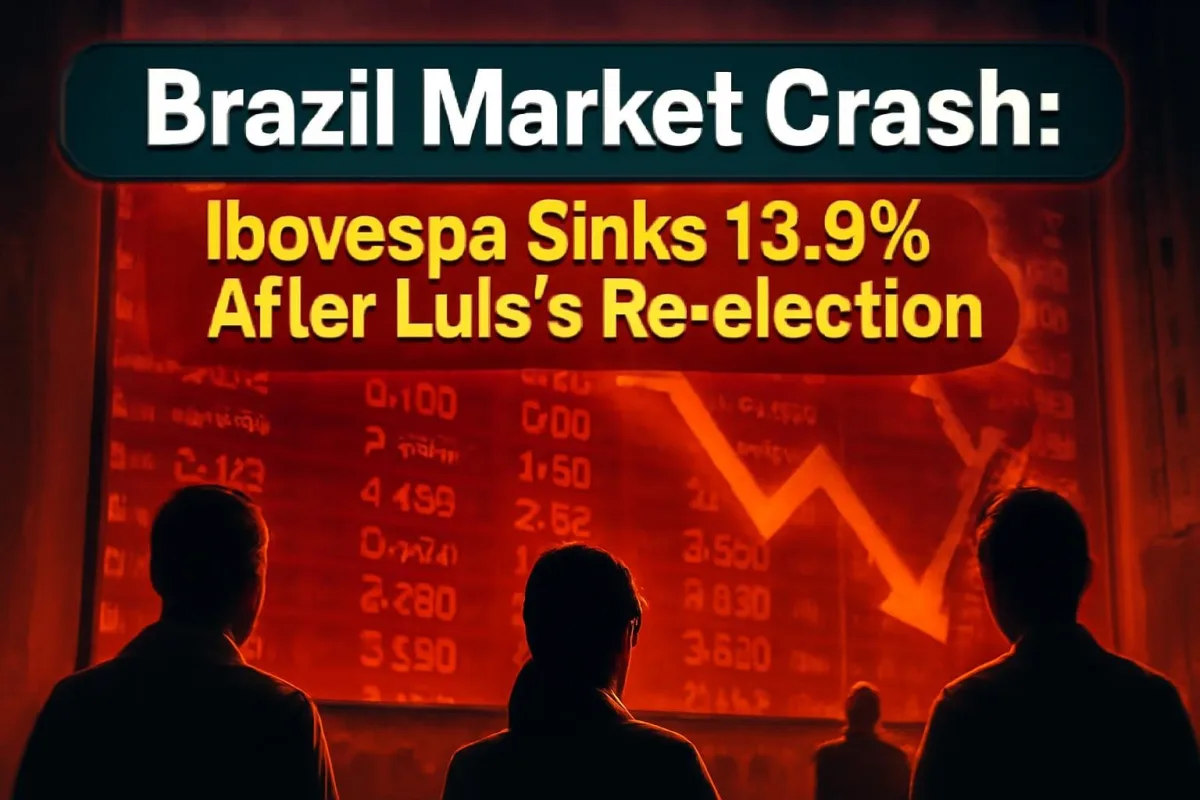
Brazil's financial markets suffered one of the worst days in their history on Monday, October 26, as investors reacted to President Luiz Inácio Lula da Silva's surprise re-election. The benchmark Ibovespa index closed 13.9% lower, its steepest one-day fall since the Covid crash of March 2020, while the Brazilian real slumped against the US dollar and trading on the São Paulo exchange was briefly halted.
The sell-off came a day after Lula defeated Flávio Bolsonaro in Sunday's runoff to win a fourth term. Markets had spent the previous weeks betting heavily on a Bolsonaro victory, and Monday was the painful unwinding of those bets.
How bad was Brazil's market crash?
The Ibovespa ended the day at around 176,608 points, down from about 205,083 on Friday. At its worst point in the session the index was down roughly 17%. Once the fall crossed 10%, the B3 exchange triggered a circuit breaker and paused trading for 30 minutes, the first such halt in more than six years.
The currency was hit just as hard. The real fell around 12% against the dollar in spot trading at one stage, before recovering some ground; by the close the dollar was up a little over 8%, trading near 5.41 reais compared with about 4.99 on Friday. Interest-rate futures also jumped as traders priced in a riskier fiscal outlook.
Winners and losers
Banks led the decline, with Itaú Unibanco falling by double digits, while state-run oil major Petrobras lost about 8%. Exporters that earn in dollars held up better: mining giant Vale rose about 4% and pulp maker Suzano gained around 10%, as a weaker real makes their overseas sales more valuable. In New York, the iShares MSCI Brazil ETF, a popular way for foreign investors to hold Brazilian stocks, closed nearly 20% lower.
Brazil market crash: key numbers
| Date | Monday, October 26, 2026 |
| Ibovespa close | About 176,608, down 13.9% |
| Intraday fall | About 17% at the lowest point |
| Trading halt | 30-minute circuit breaker after a 10% fall |
| Dollar vs real | Up about 8.4% to near R$5.41 at close; real down as much as 12% intraday |
| Biggest fall since | March 2020 |
| Brazil's public debt | Above 82% of GDP |
| Trigger | Lula's runoff win over Flávio Bolsonaro on October 25 |
Why investors reacted so sharply
The main worry is government spending. Brazil's public debt is already above 82% of GDP, and investors fear a fourth Lula term will mean more social spending and slower efforts to bring the budget under control. Lula's team has set a target of a budget surplus of about 1.3% of GDP by 2030, a gradual path that many investors see as too slow.
Analysts quoted by Al Jazeera said the fall in the real was not a surprise given how many traders had positioned for a Bolsonaro win. One fund manager noted that while Lula has spoken about spending cuts, he has not explained what they would look like. Adding to the uncertainty, Flávio Bolsonaro has refused to concede, although the size of Lula's margin suggests the result will stand.
Markets are now waiting for Lula to name his finance minister for the new term, a choice that will be read as a signal of how seriously the government intends to tackle the deficit.
What it means for India
Brazil and India are both large emerging markets and BRICS partners, so a shock in São Paulo is watched closely on Dalal Street. Sharp falls in one big emerging market can make global funds more cautious about the whole asset class, at a time when Indian equities have already been volatile amid high oil prices and a nervous mood around the Middle East.
There can also be a flip side. When investors pull money out of one emerging market, some of it is reallocated to others that look more stable, and India's relatively steady fiscal and political picture could benefit. Indian investors who hold international or Latin America-focused funds may see a noticeable hit in their latest NAVs.
On trade, a weaker real makes Brazilian exports such as soybean oil, sugar and iron ore cheaper on world markets, which matters to Indian importers and to Indian producers who compete with Brazil in commodities like sugar.
What happens next
- Cabinet picks: The name of Lula's next finance minister is the market's most important near-term signal.
- Central bank response: Investors will watch whether Banco Central do Brasil steps in to steady the currency.
- Fiscal plan: Any concrete spending-cut proposals could help calm bond and currency markets.
- Political noise: Whether Flávio Bolsonaro eventually concedes will affect how quickly confidence returns.
For now, Brazil's markets have delivered a blunt verdict on the election result. Whether it is a one-day panic or the start of a longer slide depends on what Lula does in the next few weeks.



Comments (0)