
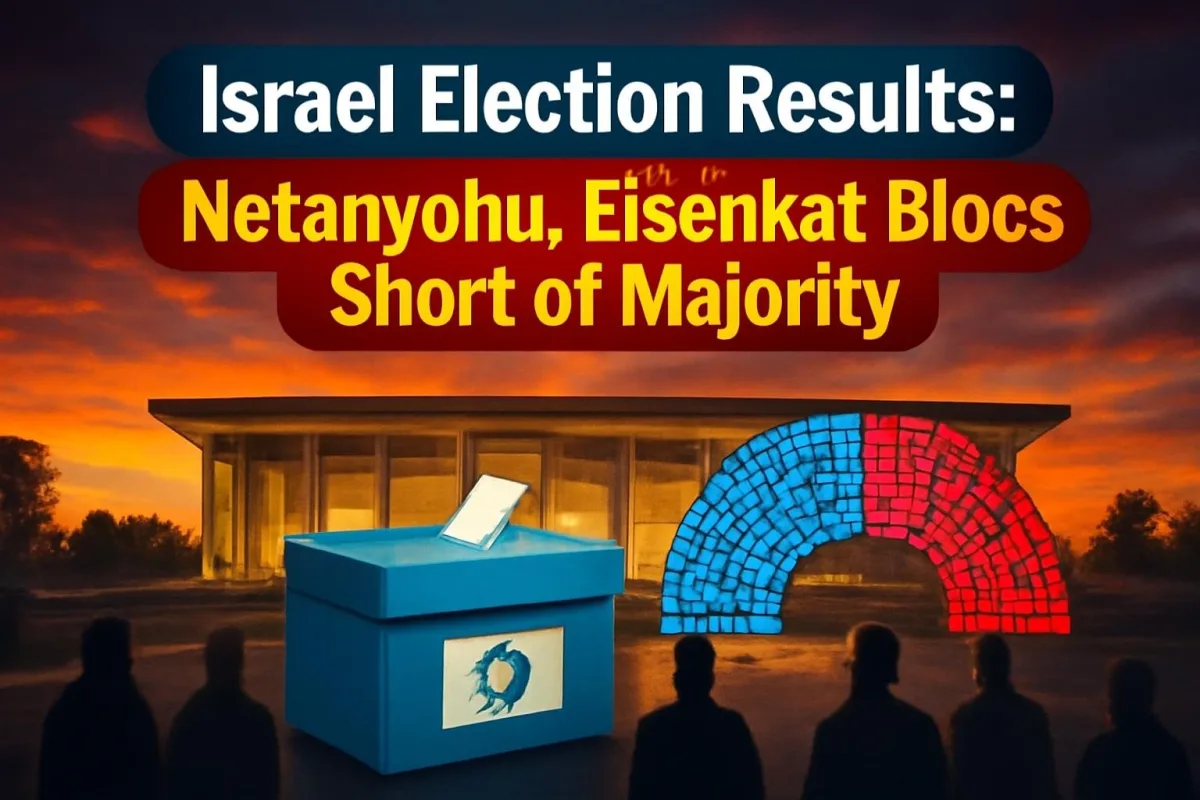
Israel has voted in record numbers, but it has not yet picked a government. After Tuesday's general election on October 27, exit polls and updated projections on Wednesday showed neither Prime Minister Benjamin Netanyahu's bloc nor the opposition led by former army chief Gadi Eisenkot reaching the 61 seats needed for a majority in the 120-member Knesset.
Netanyahu's Likud is projected to be the single largest party, but the arithmetic of coalition-building looks harder than ever, and Arab parties have emerged as a bloc no side can ignore.
A wartime vote with record turnout
This was Israel's first general election since the Hamas-led attacks of October 7, 2023, and voters turned out in force. By 8 pm, turnout stood at 74.3 per cent, the highest at that hour since 1988, with about 5.45 million of 7.33 million eligible voters having cast their ballots. By the time polls closed at 10 pm, the Central Elections Committee put turnout at 77.7 per cent, more than seven points higher than in 2022.
What the projections show
The first exit polls on Tuesday night pointed to a near tie. The three main TV channels gave Netanyahu's bloc between 50 and 52 seats, with the opposition bloc in a similar range, and Arab parties winning between 17 and 19 seats. The opposition was quick to claim victory.
Updated projections on Wednesday morning, as more of the count came in, moved in Netanyahu's favour. Channels 11 and 12 gave his bloc 57 seats and Channel 13 gave it 53, while all three put the opposition bloc at 47. Even at the top of that range, Netanyahu remains four seats short of a majority.
| Party / bloc | Projected seats (range across TV channels) |
|---|---|
| Likud (Benjamin Netanyahu) | 24 to 28, largest party |
| Yashar! (Gadi Eisenkot) | 21 to 23 |
| Beyahad (Naftali Bennett) | 12 to 14 |
| Democrats (Yair Golan) | 9 to 10 |
| Arab parties (Joint List and Ra'am) | 16 to 19 combined |
| Netanyahu bloc (Wednesday update) | 53 to 57 |
| Opposition bloc (Wednesday update) | 47 |
| Seats needed for majority | 61 of 120 |
| Final turnout | 77.7% |
Several smaller parties, including Ofer Winter's party and the Reservists-Economic party of Yoaz Hendel, were projected to fall below the 3.25 per cent threshold needed to enter the Knesset.
Why forming a government will be hard
The numbers alone do not tell the whole story. Eisenkot has ruled out serving under Netanyahu, even in a rotation arrangement, and other opposition leaders have also refused to join a Netanyahu-led coalition. At the same time, most opposition leaders have said they will not rely on Arab parties to form a government, with Democrats leader Yair Golan the main exception.
That leaves both camps short. Israeli media have floated the idea of a minority government that survives a confidence vote without 61 seats, while others warn that the deadlock could eventually push the country towards yet another election.
Eisenkot struck a combative tone, saying the exit polls showed "a complete lack of confidence in Netanyahu and his October 7 government." He declared that "the prime minister is now a caretaker prime minister" and warned him not to "use security for political purposes." Netanyahu's camp, meanwhile, pointed to Likud finishing first as proof of its mandate.
Why it matters for India
Israel is one of India's key defence and technology partners, and thousands of Indian workers are employed there in construction and caregiving. A long period of political uncertainty in Jerusalem could slow decisions on trade, defence projects and labour agreements, and will be watched closely in New Delhi given the wider tensions across West Asia, including the US-Iran standoff and its effect on oil prices and Gulf flights.
What happens next
Counting is not over. More than 650,000 double-envelope ballots, cast by soldiers, diplomats and others, need separate verification, and officials have warned this could take until Friday. Final seat allocation may take several days. After that, President Isaac Herzog will consult every party elected to the Knesset before asking the leader with the best chance of forming a coalition to try. Expect days, and possibly weeks, of hard bargaining before Israel knows who will govern it.



Comments (0)