
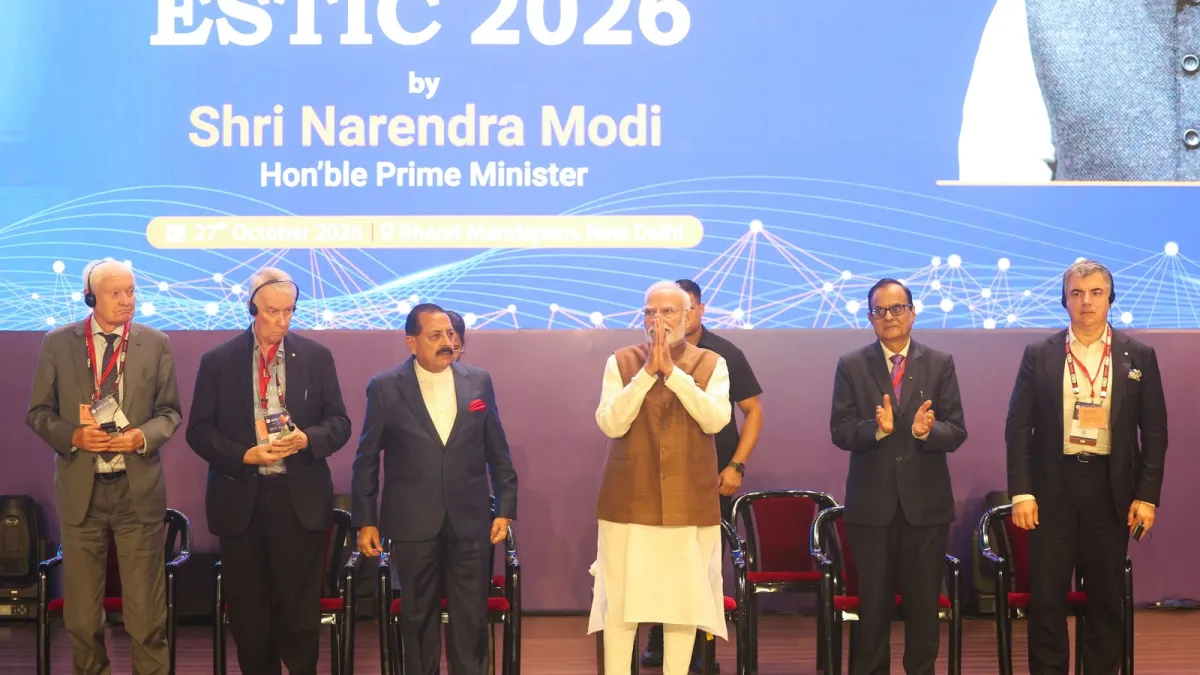
Prime Minister Narendra Modi has set India's scientists a deadline. Inaugurating the Emerging Science, Technology and Innovation Conclave (ESTIC) 2026 at Bharat Mandapam in New Delhi on October 27, he urged researchers and young innovators to fix clear three-year targets for turning ideas into technologies, prototypes and pilot projects, rather than letting work stay inside laboratories.
The three-day conclave, which runs until October 29, drew more than 5,000 delegates on its opening day, including scientists, policymakers, industry leaders and deep-tech startups from India and abroad.
A conclave built around 12 frontier areas
ESTIC is organised around 12 priority domains that the government sees as critical for the next decade. Principal Scientific Adviser Prof. Ajay K. Sood outlined them at the opening, with areas such as quantum communication, generative and autonomous AI, semiconductor fabrication, advanced manufacturing, biotechnology, energy, space science and the Deep Ocean Mission on the list.
The programme mixes big-name lectures with hands-on sessions. Two Nobel laureates gave plenary talks on day one: Prof. Joachim Frank, who won the 2017 Nobel Prize in Chemistry, spoke on cryo-electron microscopy in drug design, while Sir Richard J. Roberts, the 1993 Nobel laureate in Physiology or Medicine, spoke on gene splicing and the life sciences. A startup exhibition and poster track was also opened alongside the main sessions.
| Detail | Information |
|---|---|
| Event | Emerging Science, Technology and Innovation Conclave (ESTIC) 2026 |
| Dates | October 27 to 29, 2026 |
| Venue | Bharat Mandapam, New Delhi |
| Inaugurated by | Prime Minister Narendra Modi |
| Delegates on day one | More than 5,000 |
| Thematic domains | 12, including AI, quantum, semiconductors, biotech |
| Key funding route | Rs 1 lakh crore Research, Development and Innovation (RDI) Fund and ANRF |
What the Prime Minister asked for
The core of Modi's message was accountability. He said scientific research should produce measurable results and practical answers to real-world problems, and asked participants to set three-year milestones for technologies, prototypes and pilots. He also said India must move beyond adopting foreign technology and build its own capability in critical areas, linking this to the goal of self-reliance under Atmanirbhar Bharat.
He pointed to progress in nuclear energy, space technology, artificial intelligence and semiconductors, and said science should ultimately improve lives in healthcare, agriculture, education and disaster resilience. He also highlighted the jump in India's annual patent filings, from fewer than 50,000 a decade ago to nearly 1.5 lakh last year.
The PM referred to the Anusandhan National Research Foundation (ANRF) and the Rs 1 lakh crore Research, Development and Innovation initiative announced earlier, which are meant to channel long-term funding into deep-tech work. No fresh funding commitment was announced at the event.
Jitendra Singh: from consumer to co-creator
Union Minister of State for Science and Technology Dr. Jitendra Singh said India was shifting from being a consumer of technology to a global co-creator. He noted that the number of startups has grown from about 400 in 2014 to more than 2.3 lakh today, with an estimated 50 to 60 per cent of them based in Tier-2 and Tier-3 cities. He called for stronger capabilities in gene synthesis, systems biology and nuclear medicine.
Sessions that stood out
- Generative and Autonomous AI: chaired by IndiaAI CEO Saurabh Vijay, with IIT Madras professor Mitesh M. Khapra delivering the keynote. Talks focused on homegrown large language models, compute access under the IndiaAI Mission, agentic AI and safe deployment.
- Advanced Manufacturing: chaired by CSIR Director General Dr. N. Kalaiselvi, covering digital twins, collaborative robots, 3D printing and MSME supply chains.
- Systems and Synthetic Biology: built around the BioE3 strategy, with discussion on precision biotherapeutics, biofortified crops and turning waste into useful products.
Why it matters for India
For students and early-career researchers, the push for three-year deliverables signals where government money and attention are likely to flow: applied work that can move from paper to product. For startups, the conclave is a rare chance to pitch directly to policymakers and funding agencies in one room. And for ordinary citizens, the stated aim is technology that shows up in hospitals, farms, classrooms and disaster response, not just in research journals.
The challenge, as many scientists point out, is that frontier research rarely runs to neat timelines. How the RDI Fund and ANRF translate the three-year ambition into grants, labs and industry partnerships will decide whether ESTIC's targets become reality.
What happens next
The conclave continues until October 29 with more technical sessions, panels on deep-tech funding and technology transfer, and the startup showcase. The government is expected to use the discussions to shape priorities for its research funding schemes over the coming year.



Comments (0)