
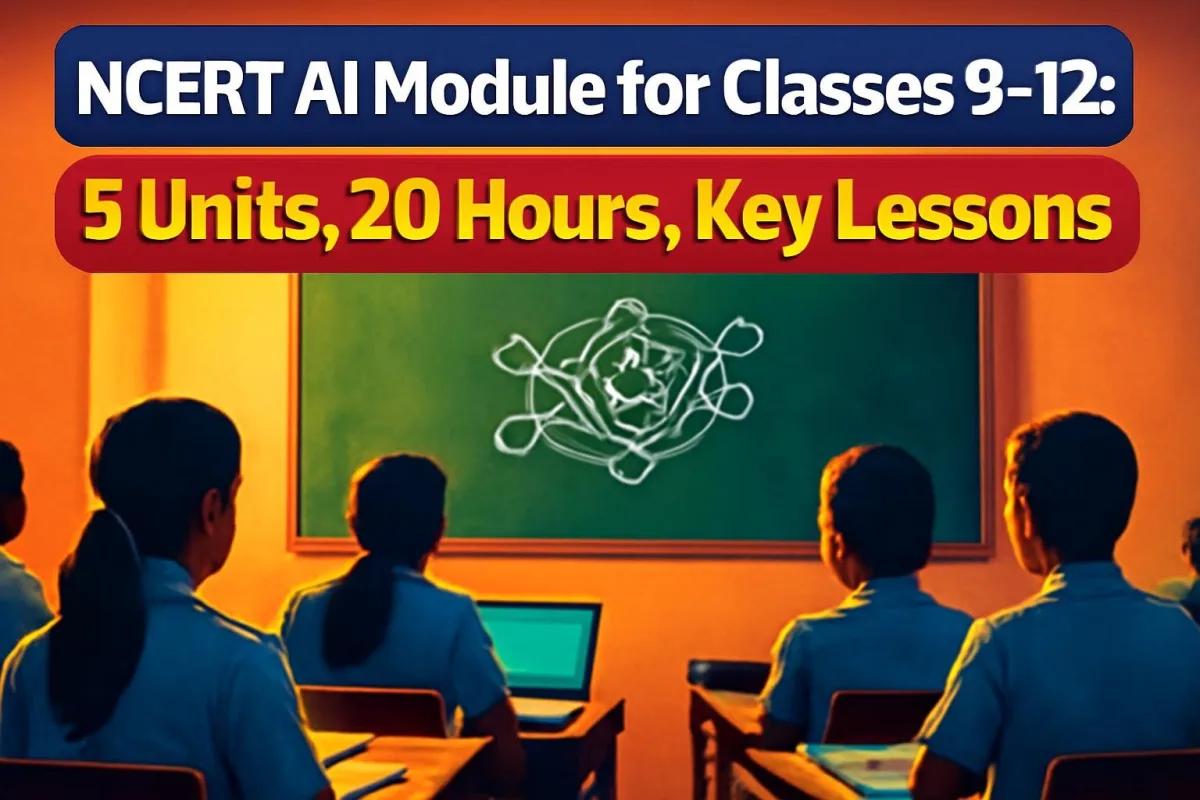
Students in Classes 9 to 12 across India now have an official, beginner-friendly way to learn about artificial intelligence. The National Council of Educational Research and Training (NCERT) has introduced an introductory module on computational thinking and AI, designed for students with no prior knowledge of the subject. Announced on October 23, the module is activity-based, takes about 20 classroom hours, and puts as much stress on using AI safely and ethically as on understanding how it works.
Who made it and why
The module has been developed by NCERT along with faculty from IIT Madras and IIT Jodhpur, and is aligned with the National Education Policy (NEP) 2020. NCERT director Dinesh Prasad Saklani, who wrote the foreword, said responsible and safe use of technology is woven throughout the module. The idea is not to turn every teenager into a coder, but to help them understand the AI tools they already use every day, from phone keyboards that predict words to apps that recommend songs.
The five units
- AI in daily life: how everyday AI works, and how spotting patterns is different from the human understanding of context.
- Machine learning: students train a simple image classifier, test its weak spots and see how the training data changes the results.
- When AI gets it wrong: misinformation, deepfakes and AI "hallucinations", along with a five-step method to verify information.
- Data privacy and digital safety: personal data, consent and fairness, India's Digital Personal Data Protection Act, 2023, reading app privacy policies, and never sharing Aadhaar or PAN numbers, passwords or OTPs.
- Responsible AI use: writing and improving prompts, judging AI answers and correcting their mistakes, with technology treated as a helper while humans make the decisions.
Students are also encouraged to keep a "Curious Notebook" to record observations and reflections. The module team describes it as a set of habits to be practised, not content to be memorised.
Key facts at a glance
| Item | Details |
|---|---|
| Module | Introductory Computational Thinking and AI |
| Released by | NCERT |
| Announced | October 23, 2026 |
| Classes | 9, 10, 11 and 12 |
| Developed with | IIT Madras and IIT Jodhpur faculty |
| Suggested duration | About 20 classroom hours |
| Units | 5 |
| Prior knowledge needed | None |
| Policy link | NEP 2020 |
Works even without computers
One of the most practical features is that the module can be taught in three ways. Schools with good facilities can let students use individual or shared devices. Others can use teacher-led demonstrations on a single screen. And schools with little or no computer or internet access can use "unplugged" activities with paper, charts and classroom discussion. NCERT says this ensures meaningful participation across very different school settings, from big-city private schools to rural government ones.
What it means for students and parents
For students, the biggest gain may be the lessons on spotting fake content and protecting personal data. With deepfake videos, AI-written messages and online fraud rising, knowing how to check a claim or refuse to share an OTP is a real-life skill. Principals of CBSE-affiliated schools have welcomed the module as a timely step. Parents can expect children to come home with questions about how apps use their data, which is no bad thing.
The module also builds on CBSE's computational thinking and AI curriculum for Classes 3 to 8, which recommends 50 hours a year for Classes 3 to 5 and 100 hours a year for Classes 6 to 8. Together, the two give Indian school students a path to learn about AI from primary school to Class 12.
Tips for students starting out
The easiest way to get the most from a course like this is to treat it as hands-on practice. Students can try a free AI chatbot under supervision and check its answers against textbooks, compare two news reports of the same event to spot differences, and go through the privacy settings of the apps on their own phones. Small habits like these turn the lessons into skills that last well beyond the classroom.
What happens next
Schools will decide how to fit the 20 hours into their timetables, and teachers will need training to deliver the activities well. More details on access and teacher support are expected from NCERT and boards such as CBSE in the coming weeks. Students preparing for board exams need not worry, as the module is an introductory course and not an exam subject.




Comments (0)