
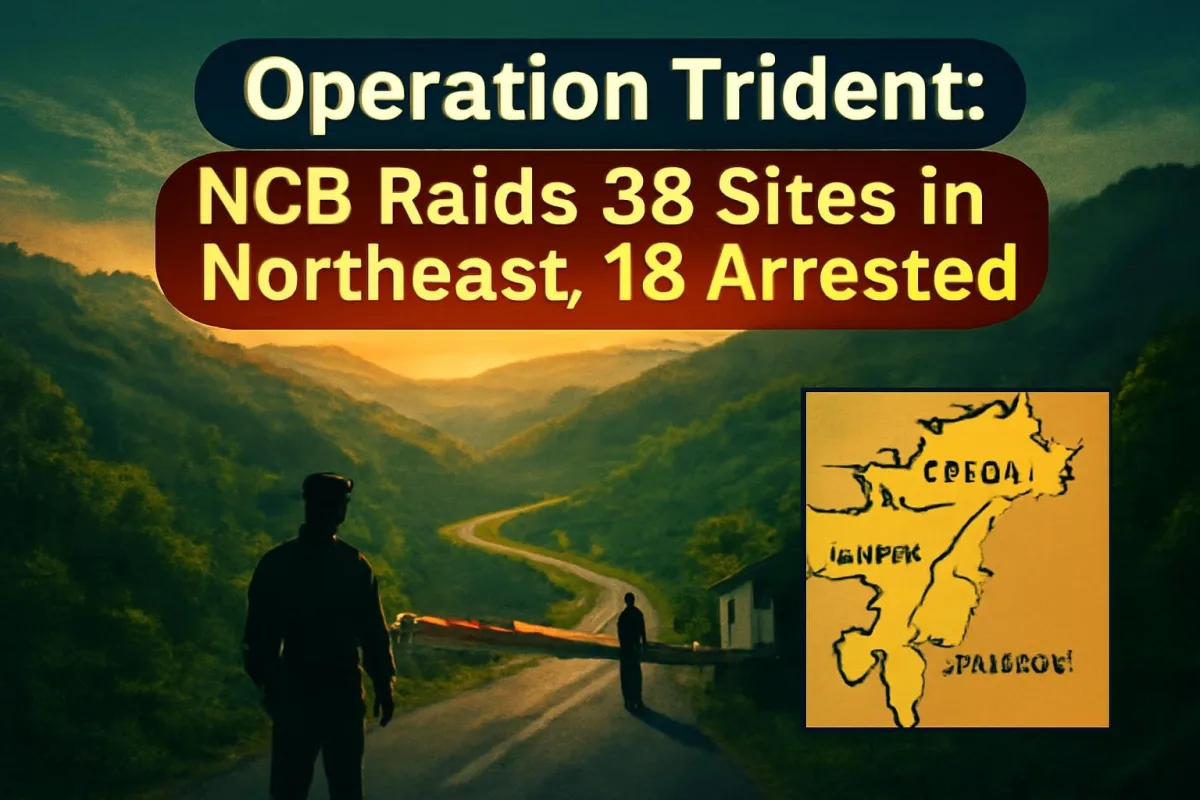
In one of the biggest coordinated drug crackdowns in the Northeast this year, the Narcotics Control Bureau (NCB) and partner agencies raided 38 locations across Assam, Mizoram and Manipur at the same time on the morning of October 23. The operation, called Operation Trident, led to 18 arrests, the freezing of 1,424 bank accounts and the discovery of hawala transactions worth around Rs 100 crore, Union Home Minister Amit Shah said on Sunday.
What happened on October 23
According to the Home Ministry, 38 joint teams drawn from central agencies and the police of the three states moved in together on pre-identified targets. The NCB led the operation with close support from the Mizoram Police and the Enforcement Directorate (ED). Planning took several days of covert intelligence sharing, joint mapping of targets and high-level briefings, so that searches, questioning and financial checks could all happen at once and suspects would have no time to run or hide assets.
The raids covered major towns and sensitive border corridors. In Mizoram, teams hit Aizawl, Champhai and Zokhawthar, a trading town on the India-Myanmar border. Linked hideouts in Churachandpur in Manipur and the Cachar transit corridor in Assam were also searched.
Key facts at a glance
| Item | Details |
|---|---|
| Operation | Operation Trident |
| Date of raids | October 23, 2026 |
| Teams and locations | 38 joint teams, 38 locations |
| States | Assam, Mizoram, Manipur |
| Lead agencies | NCB, Mizoram Police, Enforcement Directorate |
| Arrests | 18 |
| Bank accounts frozen | 1,424 |
| Hawala trail uncovered | About Rs 100 crore |
| Property attached | Rs 17.82 crore |
| Other seizures | 500 detonators, Rs 12 lakh cash |
The cartel behind the raids
Investigators say the network was run by a Myanmar-based kingpin, Thangcintuang, also known as Chintuang and Tluanga, who is wanted in more than 10 cases under the NDPS Act registered by the NCB, the Champhai police and Mizoram's excise department. He was arrested in Delhi after a long multi-state surveillance effort. His gang allegedly moved methamphetamine and heroin from Myanmar through Mizoram, Manipur, Assam and Tripura into mainland India and across to Bangladesh.
Earlier phases of the probe had already taken out several of the network's pillars. His close aide Vungkhanthawna, who coordinated consignments coming in from Myanmar, was arrested and later detained under the PIT-NDPS Act. Lalrampari, described as the main hawala operator, was arrested by the NCB in August 2024, and that is when the roughly Rs 100 crore money trail first came to light. Abu Saleh alias Saifuddin, said to be the logistics head on the Assam route, was picked up in Cachar in November 2025. Financial profiling and digital forensics then exposed a wider web of associates, shell entities and money mules, which became the target of Operation Trident.
What Amit Shah said
Posting on X, Amit Shah called the operation another "lethal blow" against drugs and said the network trafficked narcotics across India, Myanmar and Bangladesh through what he called the "Death Triangle Corridor". He congratulated the anti-narcotics teams of the central agencies and the three state police forces and repeated the government's goal of wiping out every drug network in the country by December 31, 2029.
Why it matters
The Northeast, and Mizoram and Manipur in particular, sits next to one of the world's largest drug-producing regions across the Myanmar border. For years, enforcement focused on seizing consignments, but the smugglers simply replaced what was lost. The Centre's Narcotics Control Vision Document for 2026 to 2029 shifts the focus to breaking whole networks and choking their money. Freezing over 1,400 accounts and attaching property hits the cartel where it hurts most. The recovery of 500 detonators along with drug money is also likely to draw close attention from security agencies in a region that has seen repeated violence.
For people living in the border districts, the raids are also a reminder of how deeply drug money has seeped into local economies. Community groups and churches in Mizoram have long campaigned against heroin and methamphetamine abuse among young people, and many families have lost members to addiction. Breaking a network's finances, rather than only seizing packets at checkpoints, is seen by officials as the way to make a lasting difference on the ground.
What happens next
Officials say questioning of those arrested and analysis of seized phones, documents and bank records will continue, and the ED is expected to pursue the money trail under anti-money laundering law. More arrests and attachments are possible as investigators follow up leads from the raids.





Comments (0)