
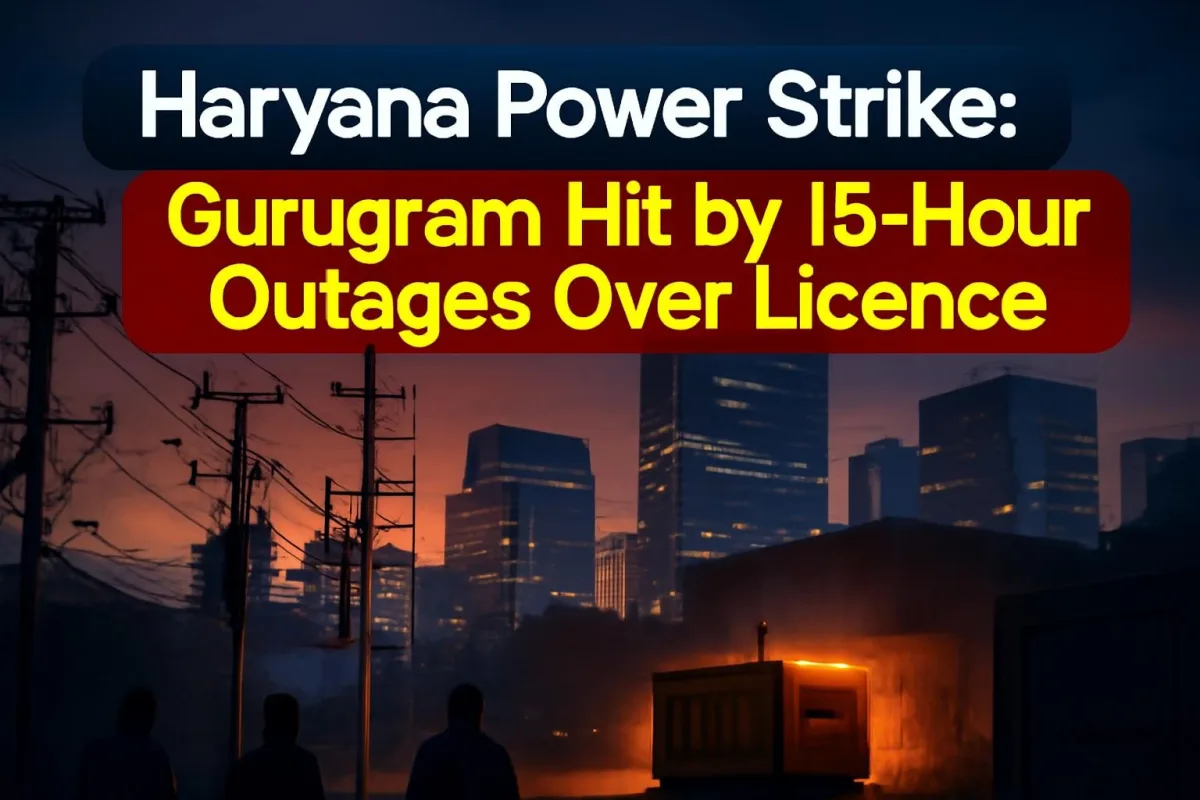
Thousands of homes and factories in Gurugram spent long hours without electricity this week as nearly 40,000 Haryana power employees went on a three-day strike against a private company being allowed to distribute electricity in Gurugram and Nuh. In some neighbourhoods, outages ran past 16 hours because faults simply went unattended while staff stayed off duty.
The strike, which began at 10 pm on October 21 and was called until October 24, was triggered by the Haryana Electricity Regulatory Commission's (HERC) October 19 order granting Eleven Power Private Limited a 25-year parallel distribution licence for the two districts.
Why power employees walked out
The Haryana Electricity Employees and Engineers Joint Struggle Front called the strike, with support from national power federations, the Samyukt Kisan Morcha and trade unions including CITU, AITUC and INTUC.
Employees see the parallel licence as privatisation through the back door. Under the order, issued under Section 14 of the Electricity Act, 2003, Eleven Power can supply electricity in Gurugram and Nuh alongside the state-run Dakshin Haryana Bijli Vitran Nigam (DHBVN). Unions fear the private firm will pick off the most profitable commercial and industrial customers, weakening the state utility and threatening jobs.
Their demands include immediate withdrawal of the licence, an impartial inquiry into how it was granted, and a clear policy against parallel licences in Haryana.
The stakes are high for DHBVN. It has said Gurugram and Nuh accounted for 35.23% of its electricity sales and 42.98% of its revenue in 2025-26. Eleven Power has disputed fears of a large customer shift, saying its plans rely mainly on new connections.
How bad were the outages
The impact was felt quickly. DHBVN received more than 3,000 complaints within the first 12 hours of the strike in Gurugram, and around 5,000 complaints on Thursday alone. Complaint centres were reportedly not responding, and many repairs were left pending.
Areas such as Sector 9A, Palam Vihar, Ashok Vihar, Hari Nagar, Rajendra Park and Old Gurugram reported long outages, along with industrial pockets in Daulatabad, Kadipur and Sector 37. Nearly 1,800 manufacturing units were disrupted, with factories forced onto diesel generators that could not run indefinitely because of overheating and pollution norms. Several areas also faced drinking water shortages as pumps went down.
Residents were vocal about their frustration. "I have called the officials nearly 50 times, but nobody is responding," said Suraj Bhola, general secretary of the Sector 9A residents' welfare association. Hari Nagar RWA president Sumit Gujjar said employees should take their dispute to the government "instead of leaving residents without electricity and water."
Gurugram was not alone. Faridabad's NIT-2 residents blocked a road after a long outage, and disruptions were reported in Nuh, Rewari, Sonipat and Ambala.
Haryana power strike: key facts
| Strike period | 10 pm, October 21 to October 24, 2026 |
| Called by | Haryana Electricity Employees and Engineers Joint Struggle Front |
| Employees involved | About 40,000 (union estimate) |
| Trigger | HERC's October 19 order giving Eleven Power a 25-year parallel licence |
| Areas covered by licence | Gurugram and Nuh |
| Gurugram complaints | 3,000+ in first 12 hours |
| Factories hit | Nearly 1,800 units |
| Government stand | Opposes licence, challenging it before APTEL |
What the government says
Interestingly, the Haryana government says it is on the same side as the employees on the core issue. Energy Minister Anil Vij said the state opposes privatisation and has challenged the HERC order before the Appellate Tribunal for Electricity (APTEL), seeking a stay. He pointed out that HERC is an autonomous regulator under central law.
Vij urged workers to return to duty and offered them a role in the legal fight. "Leave the path of strike and join us to fight the legal battle against it," he said. Chief Minister Nayab Singh Saini also appealed to employees to reconsider, and said the government would put forward their case and could engage lawyers the employees trust.
Talks between Gurugram Deputy Commissioner Uttam Singh and employee representatives, however, did not break the deadlock.
What it means for residents
For people in Gurugram and Nuh, the bigger long-term question is whether competition in power supply would bring better service or destabilise the existing system. Supporters of parallel licences argue that choice pushes utilities to improve; unions argue it leaves the public distributor with loss-making rural and domestic consumers.
In the short term, residents should keep inverters charged, store water and register complaints through DHBVN's helplines and app so that faults are logged for repair once crews are back.
What happens next
The scheduled end of the strike is October 24, but unions have indicated it could be extended if the licence is not withdrawn. Much now depends on APTEL's response to the state's plea for a stay. If the tribunal pauses the HERC order, it could give both the government and employees a way to step back.




Comments (0)