
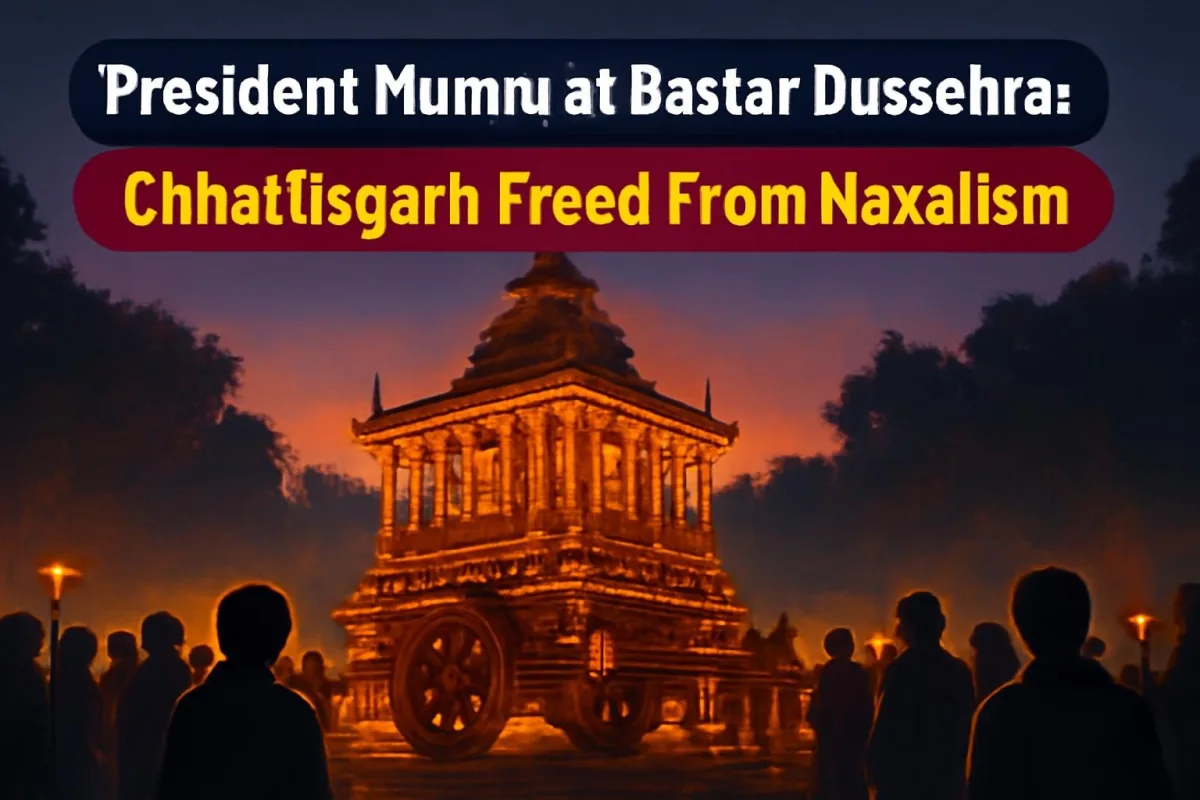
President Droupadi Murmu on Friday told a packed gathering at Lalbag Maidan in Jagdalpur that Chhattisgarh has been freed from Naxalism, crediting the combined work of the Centre and the state government. Speaking at the Bastar Dussehra Festival 2026, she said the state had left behind years of Maoist violence and was now firmly on the path of development.
The address came on the first day of her two-day visit to Chhattisgarh, a trip that also saw her offer prayers at the Maa Danteshwari Temple and take part in the centuries-old Muria Darbar, one of the most important rituals of Bastar's famous Dussehra.
What President Murmu Said in Jagdalpur
For a region that spent decades as the epicentre of India's Left Wing Extremism problem, the President's words carried weight. She said Chhattisgarh had struggled with Naxalism for many years and was now developing quickly, and she congratulated both governments on the new opportunities opening up for people in the state.
Murmu said she had been told that efforts to give financial support to tribal entrepreneurs and connect them with markets had increased. She expressed confidence that young people and tribal communities would take an active part in the country's growth, and linked these steps to the larger goal of a developed India by 2047.
An appeal to protect Bastar's forests
A large part of her speech was about nature. Calling trees and plants "living gods", the President said worship alone was not enough – people must also plant and nurture them, because trees take years to grow. She pointed out that tribal communities revere forests because they provide water, air, food, fruit, flowers and medicine.
People have a right to use forest resources, she said, but also a duty to replace what they take and to protect forests, hills and mountains. She urged tribal communities and every section of society to plant trees on farmland, barren land and open spaces, and called for a collective pledge to keep the earth green for future generations.
Murmu also referred to Bastar's identity as Dandakaranya, the forest linked with Lord Ram's exile in the Ramayana, and said keeping the region's sanctity intact was a shared responsibility.
A Historic Muria Darbar
Earlier in the day, the President attended the traditional Muria Darbar at Sirhasar Bhavan, where she met tribal leaders, priests and community representatives, including the Manjhis and Chalkis who play key roles in the festival, and listened to their concerns. At Lalbag Maidan she also visited festival stalls and spent time with local schoolchildren.
Chief Minister Vishnu Deo Sai called it a historic day for the state, saying it was perhaps the first time a President of India had taken part in the Muria Darbar. Governor Ramen Deka and several state ministers were present at the event.
Political undertones
While the President kept her remarks focused on development and the environment, the visit also drew political comment. Welcoming her to Bastar, CM Sai said the region's Naxal problem had been eradicated and accused the Congress of treating tribal communities as a "vote bank" during its decades in power. Cabinet Minister O.P. Choudhary also attacked the Congress, saying the President's presence – as a leader from a tribal community herself – was a matter of pride for Bastar.
| Key Fact | Details |
|---|---|
| Event | Bastar Dussehra Festival 2026 |
| Venue | Lalbag Maidan, Jagdalpur, Chhattisgarh |
| Date | Friday, October 23, 2026 |
| Main message | Chhattisgarh freed from Naxalism through Centre-state efforts |
| Other engagements | Maa Danteshwari Temple, Muria Darbar at Sirhasar Bhavan |
| Present | Governor Ramen Deka, CM Vishnu Deo Sai, state ministers |
| Visit length | Two days |
Why Bastar Dussehra Is Unique
Bastar Dussehra is unlike the Ravan-burning celebrations seen in most of India. Described by the state as the world's longest Dussehra festival, it stretches over about 75 days and is centred on the worship of Goddess Danteshwari, the presiding deity of the Bastar region. The festival brings together tribal communities from across the division, with rituals such as the chariot procession and the Muria Darbar – a traditional assembly where community representatives raise issues with those in authority.
That history makes the President's presence at the Darbar symbolic. Murmu, India's first President from a tribal community, has repeatedly spoken about forest rights, tribal entrepreneurship and education during her tenure.
What It Means for Readers in India
For years, districts such as Sukma, Bijapur, Dantewada and Narayanpur in Bastar made headlines mainly for attacks on security forces. A declaration of this kind from the country's highest constitutional office signals that the state now wants to be seen through a different lens – tourism, forest produce, tribal crafts and infrastructure.
For people living in the region, the real test will be on the ground: roads, schools, health centres, mobile connectivity and better prices for forest produce such as tendu leaves and mahua. The President's emphasis on linking tribal entrepreneurs to markets points in that direction.
What Happens Next
The President continues her Chhattisgarh visit on Saturday. The state government is expected to keep pushing development and tourism projects in Bastar, while the political sparring between the BJP and Congress over credit for the region's transformation is likely to continue. Readers can follow our coverage of other Dussehra events and internal security developments below.




Comments (0)