
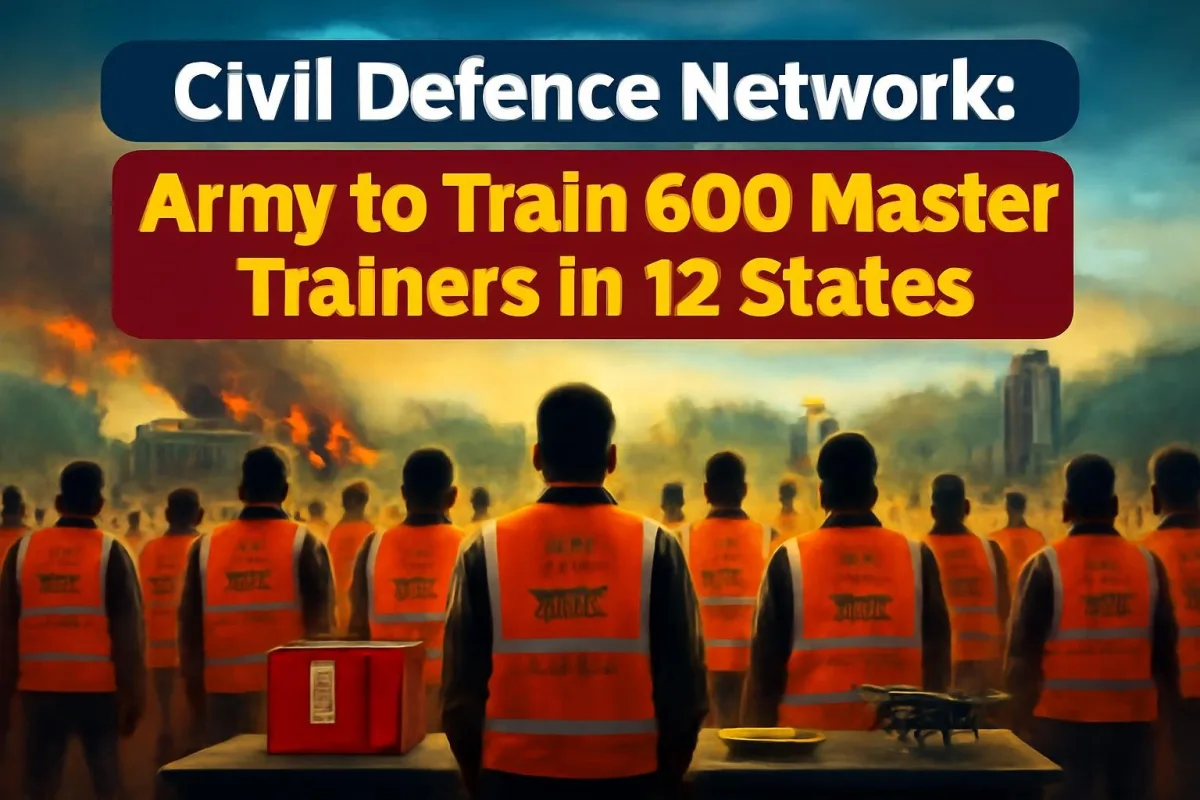
The Ministry of Home Affairs (MHA) on Friday, October 23, announced a first-of-its-kind pilot in which the Indian Army will train Civil Defence Master Trainers to prepare the country for modern threats such as drone attacks, air raids and hybrid warfare. In the first phase, 600 master trainers from 12 states and Union Territories will go through a three-day course at Army training establishments by the second week of November.
The idea is simple but ambitious: each trainer will go back and train 100 volunteers, creating a ready pool of around 60,000 trained Civil Defence volunteers across the participating states.
What the Pilot Involves
The programme is being run by the Directorate General of Fire Services, Civil Defence and Home Guards (DGFSCDHG) together with the Army. According to the MHA, it will enhance preparedness for emerging threats, coordinated emergency response and protection of critical infrastructure.
Fifty master trainers will be selected from each of the 12 states and UTs in the first phase: Jammu and Kashmir, Punjab, Rajasthan, Gujarat, Delhi, Meghalaya, Sikkim, Assam, Uttar Pradesh, Kerala, Karnataka and Tamil Nadu. The list includes several border states as well as large urban centres.
What trainers will learn
- Threat awareness: modern and hybrid warfare, drone awareness and air-raid threats.
- Protection and emergency response: protecting critical infrastructure, fire safety, awareness of chemical, biological, radiological and nuclear (CBRN) threats, casualty management, and search and rescue.
- Communication and coordination: emergency communication, cyber hygiene, digital resilience, civil-military coordination and incident command.
| Key Fact | Details |
|---|---|
| Announced by | Ministry of Home Affairs, October 23, 2026 |
| Implementing agencies | DGFSCDHG and Indian Army |
| Phase 1 trainees | 600 Civil Defence Master Trainers (50 per state/UT) |
| States/UTs | 12 |
| Training | Three days at designated Army training establishments |
| Deadline | Second week of November 2026 |
| Volunteers to be trained next | About 60,000 (100 per master trainer) |
Background: The PM's Red Fort Vision
The pilot builds on Prime Minister Narendra Modi's Independence Day address from the Red Fort on August 15, 2026, in which he spoke of building a "vibrant" Civil Defence network with modern systems, technology and preparedness to deal with new security challenges.
India's Civil Defence framework dates back decades and has traditionally focused on air-raid precautions, blackouts and disaster relief. The nature of threats has changed sharply since then – drones, cyber attacks on power grids and banks, and attacks on critical infrastructure now pose risks to ordinary citizens far from any border. Linking the Army's operational experience with the civilian volunteer network is meant to close that gap.
Why the Army Is Involved
Bringing the Army into civil defence training is the most significant part of the plan. Soldiers deal with drones, air threats, casualties and communication breakdowns as part of their routine training, and Army establishments already have the ranges, equipment and instructors to teach these skills in a practical way. Civil Defence and Home Guards organisations, on the other hand, have the local reach – volunteers who know their towns, streets and communities.
By combining the two, the government hopes to create a layer of trained civilians who can support the police, fire services and disaster response forces during a crisis, while the armed forces focus on their primary tasks. The mix of border states such as Jammu and Kashmir, Punjab, Rajasthan and Gujarat with populous states like Uttar Pradesh and southern states such as Kerala, Karnataka and Tamil Nadu also gives the pilot a varied test bed.
What It Means for Citizens
If the cascade model works, many neighbourhoods, housing societies, schools and offices in the 12 states could soon have volunteers trained in first aid, fire safety, evacuation and basic drone and cyber awareness. In an emergency – whether a cross-border threat, an industrial accident or a natural disaster – these are the people likely to respond first, before professional teams arrive.
The emphasis on cyber hygiene and digital resilience is also notable. Volunteers will learn not just how to deal with physical damage, but how to help communities avoid panic, misinformation and online fraud that often follow crises.
How to Get Involved
Citizens interested in becoming Civil Defence volunteers usually enrol through their state's Civil Defence or Home Guards directorate, or the local district Civil Defence office. Once the master trainers complete their course, states are expected to begin volunteer training sessions locally.
What Happens Next
The MHA says the outcomes of this pilot will shape a phased expansion of the programme to all remaining states and Union Territories. The first batch of master trainers is expected to finish training by mid-November, after which volunteer training at the state level should begin.





Comments (0)