
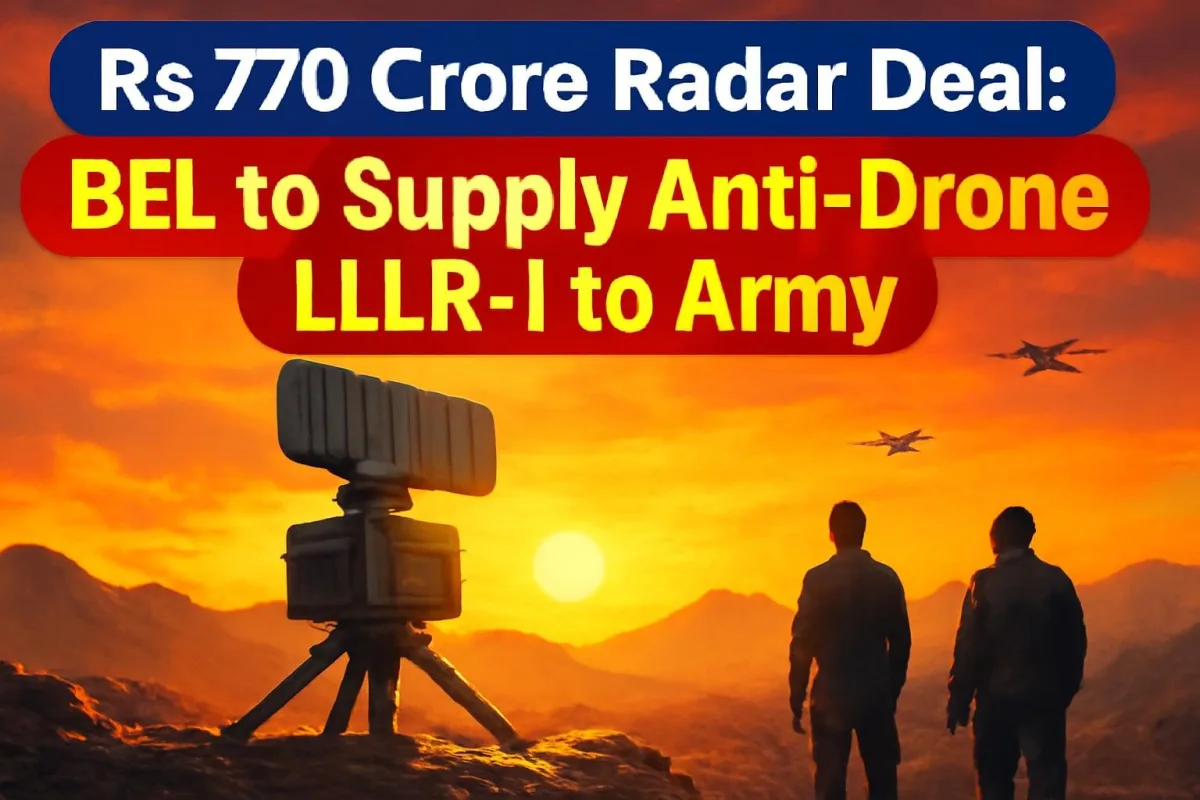
The Indian Army is getting a fresh set of eyes in the sky. The Ministry of Defence on Wednesday, October 21, signed a contract worth about Rs 770 crore with state-owned Bharat Electronics Limited (BEL) for Improved Low Level Light Weight Radars, or LLLR-I. The radars are designed to spot and track both fighter-sized aircraft and the small drones that have become a major threat on modern battlefields.
The contract was signed in New Delhi in the presence of Defence Secretary Rajesh Kumar Singh.
What the LLLR-I radar does
Low-level radars are built to watch the lower slice of airspace, where helicopters, low-flying jets, cruise missiles and drones often operate to avoid detection by large long-range radars. The "light weight" part matters too: these systems can be moved and set up quickly by troops in the field, including in mountainous areas.
According to the ministry, the improved version can:
- Detect and track fighter-sized aircraft
- Detect and track mini and micro drones, which are much harder to pick up because of their small size
- Prioritise aerial targets, so air defence teams know which threat to deal with first
That last ability is important during a swarm-style attack, when several objects appear at once and gunners or missile crews need to know where to point first.
In practice, radars like these act as the early-warning layer for the Army's short-range air defence. They pick up a threat, work out its speed, height and direction, and pass that picture to the guns and missile units that actually shoot it down. Without a reliable radar feed, even the best air defence weapon is left firing blind, which is why the Army has been steadily upgrading this part of its network.
| Contract value | About Rs 770 crore |
| Signed on | October 21, 2026, New Delhi |
| Buyer | Ministry of Defence, for the Indian Army |
| Supplier | Bharat Electronics Limited (BEL) |
| System | Improved Low Level Light Weight Radar (LLLR-I) |
| Key role | Tracking fighter-sized aircraft and mini/micro drones |
| Quantity and delivery | Not disclosed |
Why drones changed the game
Over the past few years, cheap drones have reshaped warfare across the world. Small quadcopters and loitering munitions can be used to spy on troop positions, drop explosives or guide artillery fire, and they often fly too low and too slow for traditional air defence radars to notice. India has faced this on its own borders too, with drones used to drop weapons and narcotics along the western frontier.
Plugging that gap has become a priority for the Army's air defence units. A radar that can see both a fighter jet and a palm-sized drone, and help commanders decide which one to engage first, fills a crucial role in that layered defence.
A boost for Make in India
The ministry said the procurement is part of its push to increase indigenous content in air defence systems and reduce dependence on imported equipment. BEL, a Navratna defence PSU headquartered in Bengaluru, already makes a wide range of radars for the armed forces. The contract is also expected to support a network of smaller Indian suppliers, including MSMEs, that make parts and sub-systems for BEL.
The government has linked such deals to the Viksit Bharat @2047 goal of building a self-reliant defence industry.
What it means for India
- Security: Better low-altitude surveillance for Army formations, especially along sensitive borders where drone activity has grown.
- Industry: Orders flowing to BEL and its supply chain help keep domestic radar production lines busy and skilled jobs in India.
- Markets: Large defence orders are closely tracked by investors in defence PSU stocks, and BEL's order book is often seen as a barometer for the sector.
What happens next
The ministry has not shared how many radars will be supplied or the delivery schedule. Once production starts, the systems are expected to be inducted into Army air defence units in phases. The deal comes amid a busy stretch for India's defence sector, with naval trials, joint exercises and procurement decisions moving forward in parallel.





Comments (0)